


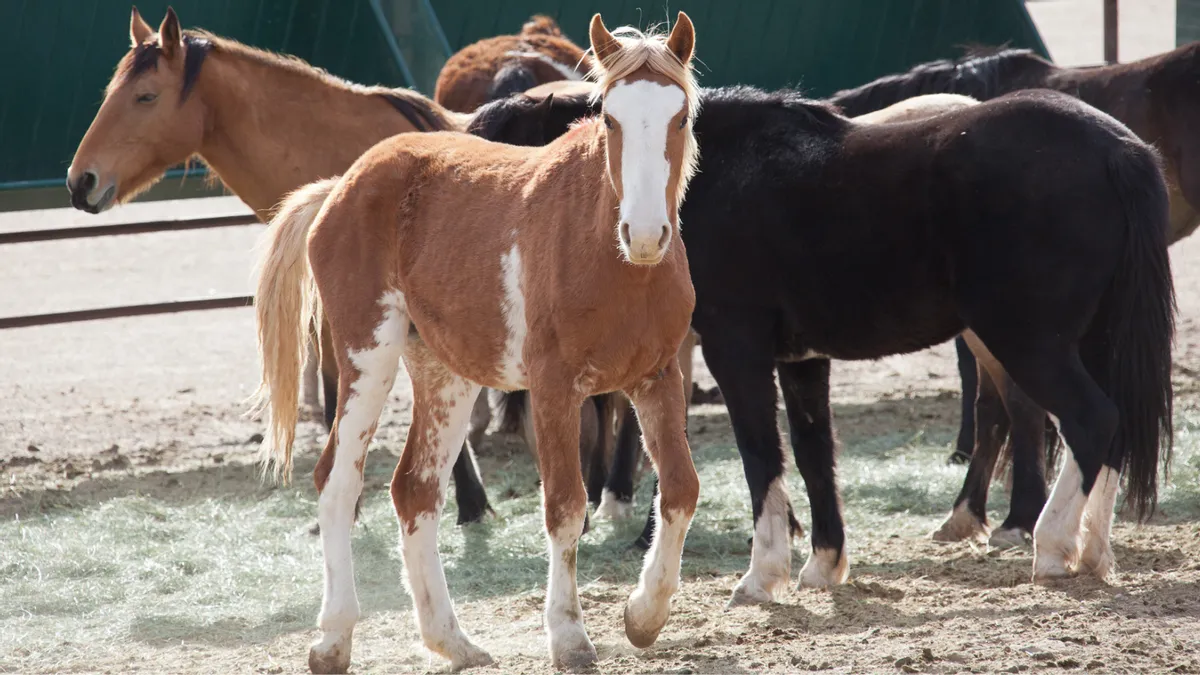
- The claim that the Trump administration’s alleged plan to slaughter wild horses was linked to its plan to import 300,000 tons of ground beef is unproven.
- The rumor appeared to mix elements of several different news items: a New York Times investigation that says the Trump administration allowed protected wild horses and burros to be sold for slaughter, an announcement by U.S. President Donald Trump on Truth Social that his administration would import “up to 300,000 metric tons of product for ground beef” to lower beef prices, and a series of food recalls.
- While Trump did post on Truth Social that he plans to import “up to 300,000 metric tons of product for ground beef,” it was not possible to find evidence that a plan exists for that meat to come from slaughtered wild horses, as online claims suggest. Such a plan would likely be illegal under federal legislation.
- U.S. government investigations in 2008 and 2015 found that some people who bought wild horses from the BLM did eventually sell them on for slaughter. Due to a lack of primary evidence, such as documents tracking sales and slaughters, we could not independently confirm a claim in a separate article that buyers also sold formerly wild horses for slaughter during the second Trump administration or that the administration plans to sell protected wild horses for slaughter.
- The U.S. Department of the Interior called the rumor that the government would sell ground beef made from slaughtered wild horses, “ridiculous and untrue.” A spokesperson for the Food Safety and Inspection Service — the Department of Agriculture agency that regulates meat, poultry and egg products in the U.S. — said the claim is false.
In August 2026, a claim (archived) circulated online that the Trump administration’s alleged plan to slaughter wild horses was linked to the same government’s plan to import 300,000 tons of ground beef into the United States.
The rumor circulated amid a series of food recalls and days after a New York Times investigation reported that the Trump administration’s Bureau of Land Management had allowed protected wild horses and burros to be sold for slaughter through a legal loophole.
The Times published its investigation on Aug. 20. The next day, U.S. President Donald Trump posted (archived) on Truth Social that he would allow the import of “up to 300,000 metric tons of product for ground beef” to lower domestic beef prices.
Some social media users connected the two news items. For example, one Facebook page posted a graphic with text that says (archived):
Does anyone else think it’s really suspicious that the same week we learned trump was rounding up our wild horses to sell overseas to be slaughtered for their meat, trump announced he’s flooding our markets with tariff-free Argentinian beef? Coincidence?
Other social media users on X, Threads and Bluesky suggested the Trump administration would slaughter wild horses and resell them in the U.S. as ground beef. Snopes readers also contacted us about the claim.
While Trump did post on Truth Social that he plans to import “up to 300,000 metric tons of product for ground beef,” it was not possible to find evidence that a plan exists for that meat to come from slaughtered wild horses, as online claims suggest. Federal legislation prohibits “misbranding” meats sold for human consumption in the U.S., including horse meat, meaning that even if the Trump administration did plan to produce ground horse meat, processors could not legally sell it as beef.
U.S. government investigations in 2008 and 2015 found that some people who bought wild horses from the BLM eventually sold them on for slaughter. Due to a lack of primary evidence, such as documents tracking sales and slaughters, Snopes could not independently confirm a claim in a separate article that BLM buyers also sold formerly wild horses for slaughter during the second Trump administration or that the administration plans to sell protected wild horses for slaughter.
The White House press office referred our query regarding this rumor to the Department of the Interior. On Aug. 25, a DOI spokesperson said via email that the claim is “ridiculous and untrue.”
A spokesperson for the Food Safety and Inspection Service — the Department of Agriculture agency that regulates meat, poultry and egg products in the U.S. — said in an emailed statement on Aug. 25 that the claim is
The United States does not import horse meat for human consumption, and it is illegal to sell horse meat as beef. Misrepresenting one species as another renders a product misbranded, and misbranded product cannot be sold in U.S. commerce.
Upon importation, FSIS verifies the certification, labeling, and condition of imported meat, poultry, and egg products. FSIS also conducts laboratory sampling of imported product, including species verification testing to confirm the product is the species stated on the label, as well as testing for pathogens and chemical residues.
Product that fails reinspection is refused entry.
Alleged plan would be impractical and illegal
Though there are no federal laws that outright ban the slaughter of horses in the U.S., a 2006 funding bill (Sec. 794, PDF Page 46) prohibited using federal funds for the inspection of horses. Because federal law says animals must be inspected before they are slaughtered for meat or meat products, the funding bill effectively banned horse slaughter for human consumption in the U.S., starting in 2007.
USDA figures, that nonprofit organization Animal Welfare Institute compiled, suggest the domestic horse slaughter industry largely vanished after Congress removed federal funding for horse inspections, with animals instead being exported to Mexico and Canada for slaughter. Congress lifted the ban on funding horse inspections in 2011, but Animal Welfare Institute’s figures suggest owners largely continued to export animals for slaughter.
The FSIS spokesperson said in a statement on Aug. 25, 2026, that the service does not issue grants of inspection for equine slaughter, meaning horses cannot legally be slaughtered in the U.S.
Given the U.S. does not have a legal domestic horse slaughtering industry, any Trump administration plan for the large-scale slaughter of wild horses would first involve paying to ship animals overseas to be processed at a foreign slaughterhouse before importing the meat back to the U.S. It is unclear how the government would fund such a hypothetical plan that would no doubt be expensive.
Regardless of where an animal is slaughtered, the Federal Meat Inspection Act prohibits the “adulteration or misbranding” of carcasses and meat originating from “cattle, sheep, swine, goats, horses, mules, or other equines.”
The act defines “misbranding” as, among other things, selling carcasses, meat or food products “under the name of another food” or using “false or misleading” labeling. According to the FSIS, ground beef comes from cuts of beef, which comes from cattle, not horses. Therefore, it would seemingly be illegal for meat processors to market ground horse meat as “ground beef,” as some claims suggested the Trump administration is planning to do.
The Federal Meat Inspection Act further says that imported meat must meet equivalent standards to the U.S., which includes standards for branding.
In sum, an alleged Trump administration plan to slaughter wild horses and sell their meat back to U.S. consumers marketed as ground beef is unlikely to be true, given it would be impractical and illegal. Snopes found no evidence connecting the BLM’s sale of wild horses and burros, per the Times’ investigation, and Trump’s announcement about imported beef.
For further reading, Snopes previously investigated whether Project 2025 — The Heritage Foundation’s plan for a conservative presidency that Trump has largely used as a blueprint for his second administration — recommended culling wild horses as a cost-saving measure.
Sources
’21 U.S. Code § 603 – Examination of Animals Prior to Slaughter; Use of Humane Methods’. LII / Legal Information Institute, https://www.law.cornell.edu/uscode/text/21/603. Accessed 25 Aug. 2026.
AGRICULTURE, RURAL DEVELOPMENT, FOOD AND DRUG ADMINISTRATION, AND RELATED AGENCIES APPROPRIATIONS ACT, 2006. 10 Nov. 2005, https://www.govinfo.gov/content/pkg/PLAW-109publ97/pdf/PLAW-109publ97.pdf.
‘Beef From Farm to Table’. USDA Food Safety and Inspection Service, https://www.fsis.usda.gov/food-safety/safe-food-handling-and-preparation/meat-catfish/beef-farm-table#:~:text=%E2%80%9CBeef%E2%80%9D%20is%20meat%20from%20full%2Dgrown%20cattle%20about%202%20years%20old.%20A%20live%20steer%20weighs%20about%201%2C000%20pounds%20and%20yields%20about%20450%20pounds%20of%20edible%20meat.%20There%20are%20at%20least%2050%20breeds%20of%20beef%20cattle%2C%20but%20fewer%20than%2010%20make%20up%20most%20cattle%20produced.%20Some%20major%20breeds%20are%20Angus%2C%20Hereford%2C%20Charolais%20and%20Brahman.
‘Federal Meat Inspection Act’. USDA Food Safety and Inspection Service, https://www.fsis.usda.gov/policy/food-safety-acts/federal-meat-inspection-act.
‘Ground Beef and Food Safety’. USDA Food Safety and Inspection Service, https://www.fsis.usda.gov/food-safety/safe-food-handling-and-preparation/meat/ground-beef-and-food-safety#:~:text=From%20What%20Cuts%20of%20Beef%20Are%20Ground%20Beef%20and%20Hamburger%20made%3F.
‘Horse Slaughter Statistics’. Animal Welfare Institute, https://awionline.org/programs/equines/horse-slaughter/horse-slaughter-statistics/.
‘Investigative Report of Bureau of Land Management Wild Horse Buyer’. 23 Oct. 2015, https://www.doioig.gov/sites/default/files/2021-migration/WildHorseBuyer_Public.pdf.
Philipps, Dave. ‘Under Trump, Protected Wild Horses Are Going to Slaughter’. The New York Times, 21 Aug. 2026, https://archive.ph/muxDA.
‘Setting the Record Straight on Congress’ Lifting of the Ban on Horse Slaughter’. USDA, 9 Dec. 2011, https://www.usda.gov/about-usda/news/blog/setting-record-straight-congress-lifting-ban-horse-slaughter.
THE WILD FREE-ROAMING HORSES AND BURROS ACT OF 1971. 15 Dec. 1971, https://www.blm.gov/sites/default/files/programs_wildhorse_history_doc1.pdf.
United States Government Accountability Office. ‘Effective Long-Term Options Needed to Manage Unadoptable Wild Horses ‘. Oct. 2008, https://www.gao.gov/assets/gao-09-77.pdf.
