


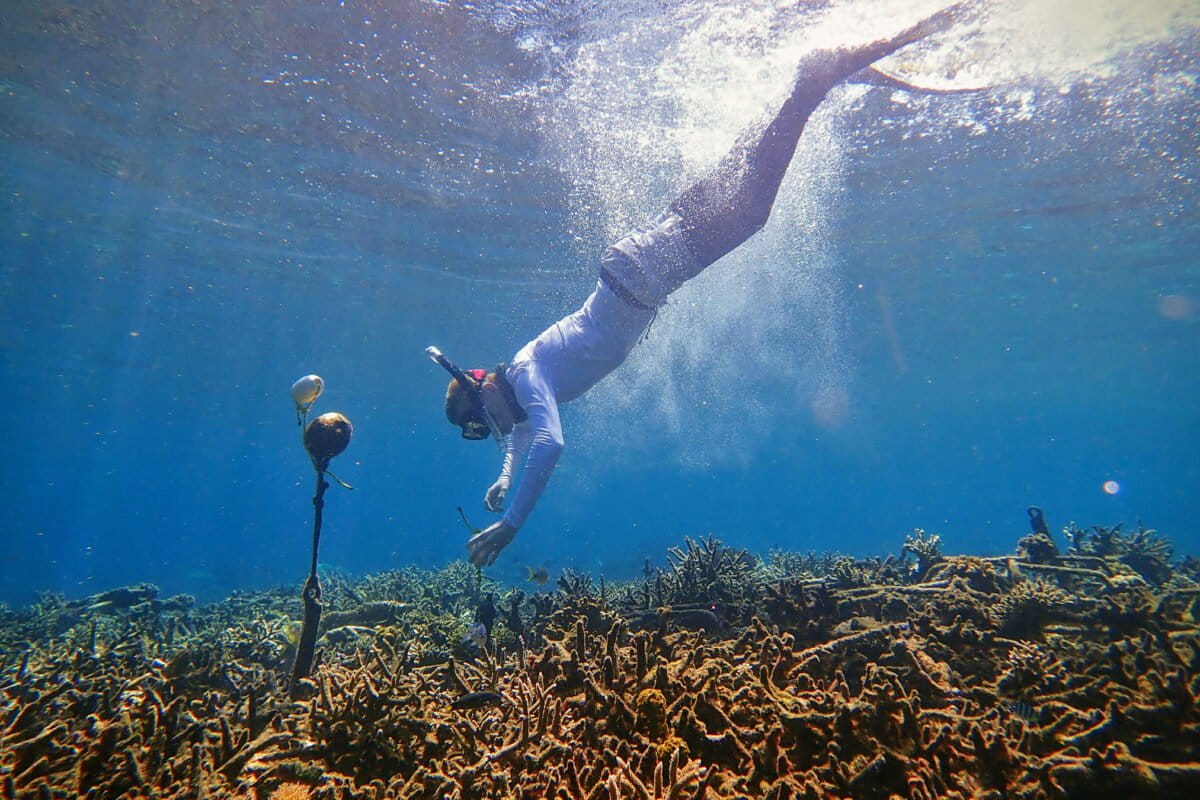
- Once home to a pristine and vibrant network of coral reefs, the Spermonde Archipelago off the coast of South Sulawesi in Indonesia has had its coral decimated by the illegal practice of blast fishing, in which improvised explosives are tossed into the sea to kill and stun fish en masse.
- A new study harnesses acoustic data to produce what is likely the first rigorous estimate of the frequency and intensity of bomb fishing in the archipelago.
- Using low-cost microphones and an easy-to-run algorithm, the researchers detected more than 3,500 so-called fish bombs going off in their study area within the archipelago — an average of 23 blasts a day, or almost one every hour.
- The scientists believe their approach could help communities and NGOs around the world design targeted interventions to combat the practice, which can devastate not only reefs but the broader marine ecosystems.
When he went for a dive between the tiny islands off the coast of South Sulawesi, Indonesia, marine biologist and AI researcher Ben Williams could often hear as many as three fish bombs detonate. “But the thing is, because sounds travel so far underwater, the bombing is often happening quite far away,” he said. “So you could hear one that feels like a kick in the chest, then you look up [above the water], and you can’t even see a boat on the horizon.”
Those islands, the Spermonde Archipelago, were once home to a pristine and vibrant network of coral reefs. But from 1990 to 2022, some three-quarters of this coral was killed, primarily by the illegal practice of blast fishing. In it, fishers toss improvised explosives into the sea to kill and stun fish en masse and scoop up the mostly intact ones, leaving underwater wreckage behind.
“If you look at the rubble after a city’s been blown up in a war zone,” Williams told Mongabay in a video call, “it’s not too dissimilar.”
Since 2013, local communities, conservation organizations and scientists have collaborated on the Mars Coral Reef Restoration Project, an effort to restore those damaged reefs. Williams joined researchers studying the effectiveness of those efforts in 2019. His particular contribution focused on using recent advances in data science to investigate Spermonde’s marine soundscape: Where a healthy reef sings like an alien jungle come to life at night, a dead one crackles like a forest smoldering after a wildfire.
But as Williams and his collaborators listened to their recordings, they noticed that each track was backed by the blasts of bombs detonating in the distance. Attempting restoration before the destruction had even ceased seemed strange to the team. “We felt we needed to do something about fixing the cause rather than treating the symptom,” Williams said.
That required additional data. So, from May 2023 to September 2024, Williams and his colleagues installed low-cost underwater microphones called hydrophones on the reefs that captured nearly 3,700 hours of submarine audio. To make the data easy to review, Williams developed an algorithm simple enough to run on a standard laptop that could quickly scour the recordings for blasts. A human reviewed each suspected explosion to confirm the final tally. The results of this survey were published in August in the journal Remote Sensing in Ecology and Conservation, providing what is likely the first rigorous estimate of the frequency and intensity of bomb fishing in the Spermonde Archipelago.
A hydrophone recording audio on a healthy reef. Image courtesy of M. Rizky Madjid.
A blast almost every hour
While using acoustics to quantify blast fishing isn’t new, the approach Williams and his collaborators developed could enable NGOs and communities far beyond Spermonde to collect data that may help them design targeted interventions.
Authorities and communities have long been aware of bomb fishing in Indonesia and surrounding countries, according to Williams, who is now an Encode fellow at Imperial College London. But there’s never been a simple method to quantify its intensity, he said, “so we’re hoping this [study] will be a big contribution to that space.”
Without acoustic data, “you’re almost completely reliant on anecdotal evidence from people on beach or nearshore areas,” Gill Braulik, a marine conservation scientist at Scotland’s University of St. Andrews who has studied blast fishing in Tanzania, told Mongabay by video. “Acoustics are a really powerful way to be able to capture the data on what’s happening and be able to convince decision makers that this is a problem that needs addressing.”
Although the recordings Williams and his team collected didn’t cover every second of every day during their study period, the hydrophones still detected, on average, 23 blasts a day kicking the waters within the 17-kilometer (10.5-mile) radius that they surveyed.
Across the 3,700 hours of recorded audio, the team verified nearly 3,570 blasts, which amounted to almost a blast every hour. From that, they estimated pyrotechnic fish poachers likely detonate more than 8,400 bombs every year, enough to damage or destroy nearly 17 hectares (42 acres) of reef.

Helping communities fill data gaps
Braulik said because the hydrophones the researchers deployed are low-cost, the data they capture is lower quality than what her team has used. But that’s a large part of what makes the new study special, she added.
By showing that cheap hydrophones and a simple-to-run, open-source algorithm can be used to monitor blast fishing over a wide area, these researchers have developed an approach coastal communities and NGOs could replicate with relative ease anywhere in the world to gather local data, according to Braulik. Whereas the devices and algorithms that her own team has used in the past are quite sophisticated, she said, this is the sort of practical approach “that could be probably rolled out over a wider area at a lower cost.”
However, Braulik said, it’s primarily useful for data gathering, not enforcement. Were a community or local government to attempt apprehension of offenders using acoustic data, they would need a form of real-time monitoring for which this approach isn’t adequate, she explained.
Such technologies do exist. The U.S.-based nonprofit Stop Fish Bombing (SFB) has deployed devices that monitor, detect and triangulate blast fishing activity 24/7 in the waters near Semporna, Malaysia, and share the data with local law enforcement. The organization’s own analysis suggests they helped authorities curb the practice by more than 80% between 2021 and 2023, Dieter Rudolph, executive director of SFB USA, told Mongabay by video.
Despite its limitations, Williams said he sees a lot of promise in the method he and his collaborators developed. Fish bombing occurs around the world, but most places lack data to design effective solutions. Williams hopes his team’s approach will help nonprofits and government agencies “go and gather data in different areas and see where they need to invest their efforts.” Additional funding, Williams said, could support new iterations of their monitors outfitted with GPS, microcontrollers and 3G transmitters to move toward the real-time monitoring and triangulation that enforcement agencies would need.


Finding ways to reduce rates of bomb fishing in Indonesia and beyond is critical, Rudolph said. Not only does it pulverize reefs like those around the Spermonde Archipelago, it devastates the broader marine ecosystem — whether or not the bombs are detonated over reefs, added Terence Lim, executive director of SFB Malaysia, via video. This ultimately harms the people and communities whose livelihoods depend on healthy seas.
“What we see visually when a fish bomb explodes is broken coral, dead fish, the residue of a fish bomb, and sometimes a bit of cloud in the water,” Lim said. “But what we don’t see are the microorganisms, the plankton, the smaller fish fries, the fish eggs. Those are also wiped out.”
Banner image: Researcher Ben Williams deploys a hydrophone on a degraded coral reef in the Spermonde Archipelago, Indonesia. Image courtesy of Tim Lamont.
New treaty promises safer conditions for Indonesia’s fishing crews
AI tool listens for endangered orcas in real time to reduce human disturbance
Citations:
Nurdin, N., Prasyad, H., Rani, C., Al Azizi, S. Q., Pulubuhu, D. A., Aris, A., … Komatsu, T. (2023). Tracking coral loss in the Spermonde archipelago of Indonesia: 32 years of satellite monitoring from 1990 to 2022. International Journal of Remote Sensing, 45(23), 8937-8967. doi:10.1080/01431161.2023.2268823
Williams, S. L., Sur, C., Janetski, N., Hollarsmith, J. A., Rapi, S., Barron, L., … Mars, F. (2018). Large‐scale coral reef rehabilitation after blast fishing in Indonesia. Restoration Ecology, 27(2), 447-456. doi:10.1111/rec.12866
Lange, I. D., Razak, T. B., Perry, C. T., Maulana, P. B., Prasetya, M. E., Irwan, & Lamont, T. A. (2024). Coral restoration can drive rapid reef carbonate budget recovery. Current Biology, 34(6), 1341-1348.e3. doi:10.1016/j.cub.2024.02.009
Williams, B., Du Luart, A., Burniston, S., Razak, T. B., Lamont, T. A., & Jones, K. E. (2026). Widespread bomb fishing in Indo‐Pacific archipelago revealed through machine learning accelerated passive acoustic monitoring. Remote Sensing in Ecology and Conservation. doi:10.1002/rse2.70093
Braulik, G., Wittich, A., Macaulay, J., Kasuga, M., Gordon, J., Davenport, T. R., & Gillespie, D. (2017). Acoustic monitoring to document the spatial distribution and hotspots of blast fishing in Tanzania. Marine Pollution Bulletin, 125(1-2), 360-366. doi:10.1016/j.marpolbul.2017.09.036
Feedback: Use this form to send a message to the editor of this post. If you want to post a public comment, you can do that at the bottom of the page.

