


Welcome back to World Brief, where we’re looking at tit-for-tat tariffs between Canada and the United States, Iran and China’s response to Operation Economic Outcast, and the spread of Ebola across Central Africa.
‘Everyone’s in for an Economic War’
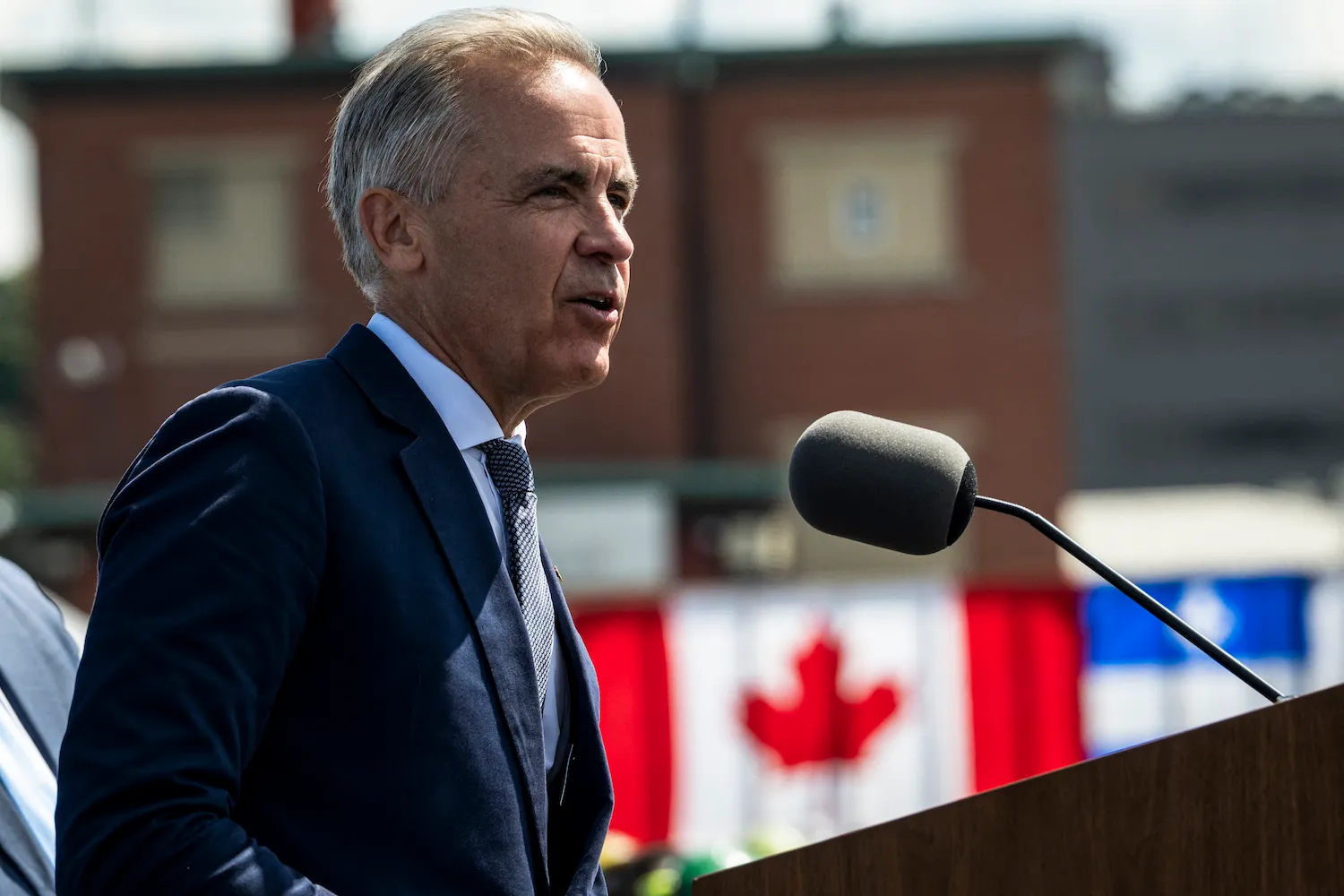
Canada announced retaliatory tariffs against the United States on Tuesday, the latest salvo in the ongoing North American trade war.
Welcome back to World Brief, where we’re looking at tit-for-tat tariffs between Canada and the United States, Iran and China’s response to Operation Economic Outcast, and the spread of Ebola across Central Africa.
‘Everyone’s in for an Economic War’
Canada announced retaliatory tariffs against the United States on Tuesday, the latest salvo in the ongoing North American trade war.
Last week, U.S. President Donald Trump abruptly postponed planned 50 percent tariffs on roughly $20 billion worth of Canadian goods for a 72-hour period, citing progress in ongoing talks. Both Trump and Canadian Prime Minister Mark Carney expressed initial optimism about a potential deal; however, negotiations collapsed on Friday, with Ottawa accusing Washington of trying to destroy key Canadian industries. The next day, the 50 percent U.S. tariffs went into effect.
Trump also warned on Monday that the United States will raise tariffs on cars, trucks, and auto parts to 50 percent starting Jan. 1, 2027. “Canada has been ripping off the United States of America for years,” Trump wrote on Truth Social at the time, calling the relationship “not sustainable.” Canada is one of the United States’ largest trading partners, accounting for around $872.3 billion in bilateral trade in 2025.
In response, Ottawa vowed on Tuesday to impose tariffs as high as 50 percent on roughly 700 U.S. products—including clothing, electronics, and foodstuffs—beginning Sept. 8. Most notably, Ottawa revealed that it will be doubling duties on U.S. aluminum and steel to 50 percent in an effort to go “dollar for dollar” with sweeping U.S. tariffs. The new Canadian levies will cover around $20 billion of U.S. imports annually—the same value as Canadian exports affected by U.S. levies.
“Ultimately, the terms proposed by the U.S. administration were uneconomic, unfair, and ultimately unacceptable,” Canadian Finance Minister François-Philippe Champagne said on Tuesday, referring to last week’s talks. “They asked too much of Canada and offered too little in return.”
The trade war has been accompanied by a war of words between Trump and Ontario Premier Doug Ford, with the two men trading personal insults. Discussing the U.S. tariff threat, Ford told a Toronto radio station on Monday that Trump can “kiss my ass,” and during a press conference later that same day, he described Trump as a “dictator” and a schoolyard bully. “He’s the type of guy in school that would take your lunch money one day, take your toque off your head the next day, and then steal your running shoes,” Ford said.
Trump lashed out on Truth Social in response, accusing the Ontario premier of being Carney’s “Flunky” and calling Ford “the less charismatic, intelligent, and overall unimpressive brother of the late, great, Rob Ford.” On Tuesday, Trump posted that “The United States is giving serious consideration to changing the name of Lake Ontario to Lake America in that we don’t expect to be doing much business with Ontario any longer.” In another post, Trump called Canada “easily the most difficult and unreasonable” country that the United States deals with.
Analysts suspect that tit-for-tat tariffs are far from over. If the United States goes through with its auto duties or if it chooses to escalate in other ways, Canada could look to impose duties on more vital goods. On Monday, Ford said that Canada should consider harsher measures and warned that Ontario could cut off electricity to the United States; Ontario supplies electricity for Michigan, Minnesota, and New York. “We’re all in,” Ford said. “Up here, we’re at a fever pitch; everyone’s in for an economic war. They know they’re going to have to sacrifice.”
Today’s Most Read
What We’re Following
Promising retaliation. Iran vowed on Tuesday to resist the United States’ latest sanctions scheme against the regime, which includes threats of so-called secondary sanctions against any country that chooses to maintain business ties with Tehran. “When a bully declares that every bank, company, port, and government must choose between obeying Washington’s whims or facing American vengeance, this is no longer just about Iran,” Iranian Foreign Ministry spokesperson Esmail Baghaei wrote on X.
Tehran is not alone in its ire. China similarly pushed back against the campaign, which the White House has dubbed “Operation Economic Outcast,” pledging on Tuesday to defend its interests while accusing the Trump administration of disrupting the global financial order. Although U.S. Treasury Secretary Scott Bessent refused on Monday to specify which countries might be targeted by these sanctions, China remains Iran’s top trading partner. However, Bessent said that the White House is “giving everyone the opportunity to remedy bad behavior” before sanctions are applied, noting that “the president is making phone calls to world leaders with specific requests to cease their interactions with the regime.”
The U.S. sanctions threat risks undermining a summit between Trump and Chinese President Xi Jinping in Washington next month. That meeting is expected to prioritize ways to stabilize volatile bilateral relations.
Ebola’s spread. African health ministers convened in Ethiopia on Tuesday for a three-day World Health Organization (WHO) regional summit. The conference aims to address emerging health challenges and brainstorm best strategies to counter them, including bolstering local healthcare systems, strengthening health financing, and retaining more healthcare workers. “Africa’s next health chapter must be defined by ownership over dependency, integration over fragmentation, and practical action over words,” Ethiopian President Taye Atske Selassie said on Tuesday.
The rapid spread of Ebola throughout the Democratic Republic of the Congo is likely to overshadow much of this week’s conversations. Monday marked 100 days since Kinshasa first declared its 17th Ebola outbreak. In that time, the Bundibugyo virus has become the deadliest, fastest-spreading strand on record, with health experts estimating at least 2,600 fatalities, including more than 300 people in just the past week. Around 5,600 cases of Ebola have been detected, almost entirely in Congo and neighboring Uganda.
A key challenge of the outbreak has been the lack of approved treatments. Clinical trials are underway to test the Ervebo vaccine, which was used during past Ebola outbreaks. However, it is unclear if Ervebo will be effective against the rare Bundibugyo strand responsible for this outbreak, which has devastated rural communities and front-line workers.
Secret trip to Russia. CIA director John Ratcliffe reportedly flew to Moscow on Tuesday for talks with Russian officials, marking the highest-level visit by a Trump administration official to the country since January. Neither Washington nor Moscow has commented on the purpose of Ratcliffe’s trip, but it occurs as U.S.-mediated peace talks between Russia and Ukraine have largely stalled.
The unannounced trip is believed to be Ratcliffe’s first visit to Moscow since he became CIA chief. The Financial Times reported that ahead of the flight, the White House asked Ukraine to suspend long-range strikes on several major Russian cities, which have proved detrimental to the country’s critical infrastructure, during Ratcliffe’s trip. On Monday, Russian President Vladimir Putin declared that the Kremlin can temporarily seize control of such facilities if private owners fail to adequately protect them against Ukrainian strikes or do not rebuild them after.
Ratcliffe’s visit comes the same day that Archbishop Paul Gallagher, the Vatican’s foreign minister, met with his Russian counterpart, Sergey Lavrov, in Moscow. Gallagher pushed for an end to the Russia-Ukraine war and said that he and Lavrov agreed to cooperate on humanitarian issues, such as the care of children impacted by the conflict. Tuesday’s meeting was the first in-person talks between Russia and the Vatican in five years.
Odds and Ends
For nearly 20 years, the title of fastest human on Earth has gone to Jamaican sprinter Usain Bolt, who ran the 100-meter dash in 9.58 seconds. But on Saturday, a Chinese-made humanoid robot beat that time by 0.19 seconds. Electronic athleticism was on full display during Beijing’s World Humanoid Robot Games over the weekend, when advanced automatons competed in tennis, boxing, soccer, and other sports. However, experts are hesitant to hand over Bolt’s title to a human-looking machine, especially since the winning robot finished its race by slamming full speed into a padded wall, requiring actual humans to pick up its pieces.
