


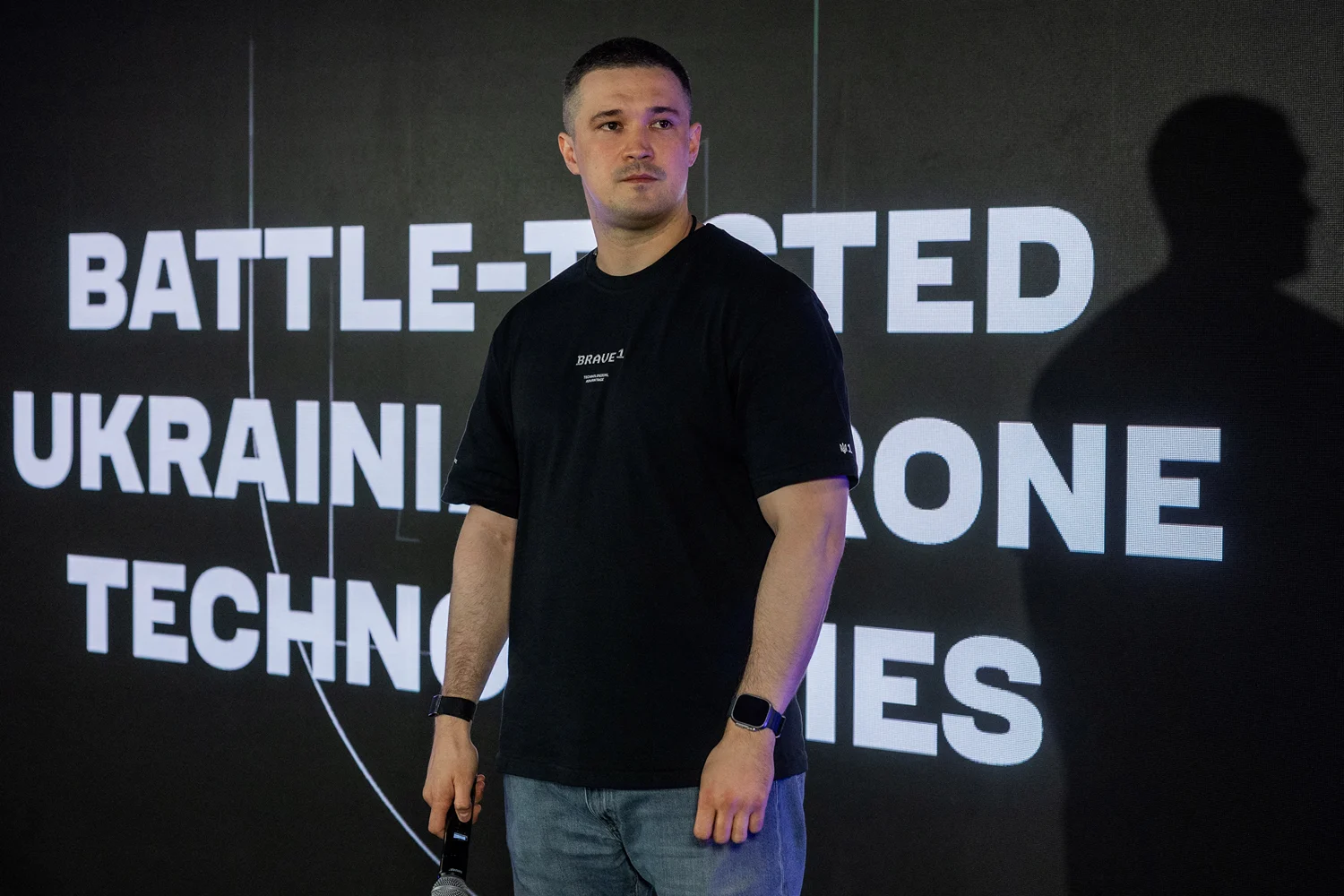
As the sun rose on Aug. 20, rescuers in Kyiv were searching around a nine-story apartment building’s upper floors, which were destroyed after an overnight missile and drone assault that also killed at least 16 people and wounded more than 40.
The night before, former Ukrainian Defense Minister Mykhailo Fedorov asked the country to contemplate the return of electoral politics even under wartime conditions. His nine-minute video arrived on the eve of a parliamentary vote that confirmed his replacement and one month after Ukrainian President Volodymyr Zelensky removed him from government.
“We must not let Putin decide when Ukrainians can choose their government,” Fedorov said. “Democracy is not a peacetime luxury. Democracy is part of what we are fighting for today.”
Fedorov spoke about corruption, personal loyalty, and private interests in defense, pharmaceuticals, and gambling. The video showed David Arakhamia, the head of Zelensky’s Servant of the People faction in parliament. Andriy Yermak, Zelensky’s former chief of staff, also appeared.
After nearly seven years as a Zelensky loyalist, Fedorov’s address was understood in Kyiv as the launch of his independent political career and an open challenge to the president.
When asked by Foreign Policy about Fedorov’s speech, Arakhamia questioned both the feasibility of elections and Fedorov’s motives. “There is no option to conduct democratic, free elections during the war,” he said. “The question has been studied extensively by numerous experts and international institutions, and there are simply too many constraints. This is a weak attempt by one individual to capitalize on a temporary bump in the polls.”
Fedorov’s position is not particularly popular. A survey conducted by the Kyiv International Institute of Sociology from July 20 to Aug. 3 found that 15 percent of Ukrainians wanted elections before hostilities ended. Twenty-three percent supported voting after a cease-fire backed by security guarantees, while 57 percent preferred to wait for a final peace agreement.
Pressure for an election has largely come from outside Ukraine. In February 2025, Trump called Zelensky “a dictator without elections,” which helped set the tone for two leaders’ infamous confrontation at the White House that same month. Zelensky responded that Ukraine could hold an election within 60 to 90 days if the United States and European allies guaranteed its security. Trump has not publicly renewed the demand for an election in recent months, although Moscow continues to use the absence of elections to challenge Zelensky’s legitimacy.
“There should be a government of national unity, but Zelensky is not doing that,” noted Oleksiy Goncharenko, an opposition member of parliament from European Solidarity. “He is making more and more mistakes, but you cannot change him. And this is a problem, and I am in opposition. Yet elections are simply impossible now. It is not a question of whether we want them. They are impossible from a security point of view.”
Fedorov is Zelensky’s first major challenger in years. A popular reformer and civilian minister, he clashed with the commander in chief of Ukraine’s armed forces at the time, Gen. Oleksandr Syrskyi.
Fedorov wanted older commanders replaced with younger officers who were tested after Russia launched its full-scale invasion in 2022. Fedorov accused Syrskyi of blocking his reforms, and the confrontation escalated until Zelensky had to choose between the minister and the commander. Zelensky initially chose Syrskyi. When a government reshuffle forced the reappointment of ministers in July, Zelensky declined to nominate Fedorov for another term.
“Zelensky did not fire him because he was effective or ineffective,” Goncharenko said. “Zelensky always wants to remain at the center of attention, and he removes people who move into positions where they can become the focus. He did it with Fedorov.”
The decision produced an eruption that few in the presidential office had expected. Thousands of Ukrainians gathered in Kyiv and cities across the country, carrying handmade cardboard signs. They demanded Fedorov’s return and Syrskyi’s dismissal.
“It was not just about Fedorov,” Goncharenko said. “People are tired in general: from all the corruption, from one new case after another. They got angry and came to the streets. Fedorov was only a trigger.”
Zelensky eventually removed Syrskyi and appointed Gen. Mykhailo Drapatyi, satisfying half of the protesters’ demands. It proved to be a brilliant political gamble. Zelensky gave the people a victory while denying Fedorov the office that could turn his popularity into power. He offered Fedorov several subordinate positions, including oversight of military innovation, but Fedorov insisted on returning to the Defense Ministry. As Zelensky held his ground, the protests dwindled and the parliament confirmed Gen. Yevhenii Khmara as defense minister on Aug. 19.
“Zelensky essentially ignored these protests, and the people who participated in them decided that since he ignored them, that’s how it would be. This is very similar not to the attitude of society in the republic toward its leaders but to the attitude of subjects toward monarchs,” said Vitaly Portnikov, a Ukrainian journalist and political commentator. “We came under Zelensky’s windows and shouted that we wanted this decision. He said, ‘Don’t bother me, I have other things to do.’ So, we went home. What could we do? He knows better.”
Fedorov’s appointment to defense minister was followed with an expansion of Ukrainian attacks inside Russia and a period when Moscow’s advance appeared to slow. Many Ukrainians connected the two developments and invested in Fedorov with the hope that the war was finally changing.
“His appointment coincided with the transfer of the war to Russian territory,” Portnikov said. “It created a certain hope for a turning point in the war. People developed that illusion, although no one in the government, or even Fedorov himself, actually had said that.”
Recent polls put trust in Fedorov at 65 percent and his first-round support at around 13 percent, with one survey suggesting that he would defeat Zelensky 64 to 36 percent in a runoff. But with no elections in sight, his immediate challenge is keeping the political moment created by his dismissal alive.
Fedorov may have misstepped. The election call seems to have already altered Fedorov’s relationship with the movement that had made him its hero. His election call has already alienated some activists who campaigned for his return. A leading protest organizer, who had dismissed reports of a Fedorov campaign as absurd, signaled an end to the rallies and warned that elections could divide society and damage the war effort. One of Fedorov’s advisors agreed, saying a wartime vote would “tear the country apart from within.” The very qualities that had made him attractive—such as ambition, speed, and impatience with constraints—now raised doubts about whether he had placed his political future ahead of the country’s immediate needs.
Inside the presidential circle, Fedorov is seen as an ambitious, image-conscious former subordinate who has begun to treat public attention as a national mandate. Zelensky’s allies doubt that Fedorov’s popularity can be converted into a party or sustained national campaign.
“Fedorov came back to reality and said, ‘Let’s have elections,’” Goncharenko said. “Even his supporters took it badly, because it became clear that he is acting in his political interests more than in the interests of the country.” Fedorov did not respond to a request seeking details of his proposed plan or his response to the criticism.
Fedorov did not challenge the system until he was pushed out of it. Elections had been suspended under martial law since 2022, and allegations of corruption, political patronage, and the concentration of power have shadowed Zelensky’s government throughout Fedorov’s years inside it. Yet he did not publicly challenge the absence of elections or denounce the system until after his dismissal.
In the absence of an election timetable, Ukraine has relied on public pressure through civil society, street demonstrations, and institutions built partly at the insistence of Western partners. In July 2025, Zelensky signed legislation that stripped independence from the National Anti-Corruption Bureau of Ukraine (NABU) and the Specialized Anti-Corruption Prosecutor’s Office (SAPO). Thousands of Ukrainians protested, and European officials warned that the measure threatened Kyiv’s path toward joining the European Union. Zelensky reversed course within days.
Corruption remains a live issue. On Aug. 19, NABU and SAPO announced Operation Forrest Gump, an investigation into lawmakers and senior presidential officials accused of laundering $3.4 million to cover bail in an energy corruption case. Media reports identified Iryna Mudra, deputy head of the Office of the President, and Vadym Stolar, a lawmaker, among those searched. Zelensky dismissed Mudra that day, though she denied any wrongdoing. Investigators subsequently revealed a connected corporate-raiding case, Operation Themis. Earlier in August, they had also accused Olha Stefanishyna, who served as Ukraine’s ambassador to the United States, of illicit enrichment and inaccurate asset declarations, which she denied.
“The problem of the Ukrainian government, including Fedorov, is that all these people become politicians after their resignation. Before that, they perceive themselves as managers,” Portnikov said. “This is why we have these problems in a post-Soviet society, where people do not understand that a country cannot be governed without politics. We have a president who is not a politician, a prime minister who is not a politician, ministers who are not politicians, and lawmakers who are not politicians. People like this because, for them, politics is a dirty word. But governing a country is political activity.”
Fedorov has crossed a line that Zelensky’s other potential successors have carefully avoided stepping over. Valerii Zaluzhnyi, the former commander in chief who is now serving as Ukraine’s ambassador to the United Kingdom, accepted his removal and left for London without turning his popularity into an opposition movement. Kyrylo Budanov, the head of Ukraine’s military intelligence service, has remained inside Zelensky’s system as his chief of staff despite polls that place him among the country’s most trusted figures.
“There’s no prospect of elections right now, no prospect of ending the war. If we talk about the period after the war, then the political reality will be completely different, a dozen more new heroes could emerge,” Portnikov said. “Who’s to say Fedorov won’t be forgotten in a year or two?”
