


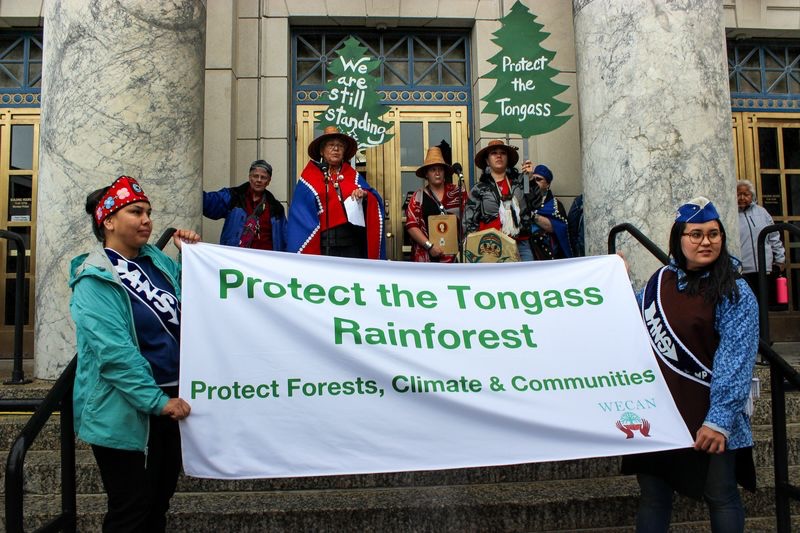
Aug. 25 is a National Day of Action to support U.S. national parks and public lands. One focus of the event is the U.S. government’s intention to rescind a rule that bans road construction and industrial logging across more than 23 million hectares (57 million acres) of national forest land.
The 2001 Roadless Rule, has helped protect some of the country’s most wild public lands, including Alaska’s Tongass National Forest, the world’s largest intact temperate rainforest and the ancestral homeland of several Indigenous peoples.
“A rollback on the Roadless Rule means cultural genocide for our people,” Yolanda Fulmer of the Tlingit Indigenous nation and a Tongass representative with the California-based NGO Women Earth and Climate Action Network (WECAN), said in a statement. “Every part of our culture is intimately intertwined with the Tongass Forest, our traditional homelands.”
The Tongass spans 6.8 million hectares (17 million acres) of mountains, rivers, rugged coastline and old-growth forest. Nicknamed “America’s Climate Forest,” the Tongass holds 20% of all the carbon stored in the country’s national forests and provides habitat for some 400 wildlife species including bears, wolves and moose. It also supports roughly 40% of North American bird species.
If the Roadless Rule is rescinded, roughly 3.6 million hectares (9 million acres) of the Tongass could lose protections against new road development. Nationwide, 18 million hectares (45 million acres) of national forest system land could be affected.
In an Aug. 18 statement, the U.S. Department of Agriculture, which administers national forests through the U.S. Forest Service, said roads are necessary to maintain and protect forests. “Across the country, we’ve watched preventable conditions — overgrown stands, insect outbreaks and disease — turn healthy landscapes into tinderboxes,” Agriculture Secretary Brooke Rollins said in the statement.
However, researchers found that between 1992 and 2024 wildfires were four times more likely near roads than in roadless areas. Another study found more than 90% of wildfires occurred within half a mile of a road.
“Constructing new logging roads into roadless areas will increase human-caused wildfire ignitions by careless recreationists, criminal arsonists, or simple accidents,” Carson States with Firefighters United for Safety, Ethics, and Ecology said in a statement.
Osprey Orielle Lake, WECAN executive director, told Mongabay the administration wants to rescind the Roadless Rule to “open up these roads for industry.”
The Roadless Rule also restricts timber, oil, gas, coal or mineral development on protected land. The Trump administration has issued a series of executive orders supporting such industries, including one aimed specifically at “Unleashing Alaska’s Extraordinary Resource Potential.”
In his first term, U.S. President Donald Trump exempted Tongass from the Roadless Rule; that decision drew half a million public comments, 96% of them opposed. U.S. President Joe Biden later reinstated protections.
“Across the country, people want forests, people want wildlife, people want there to be no roads so that we can enjoy these national treasures,” Lake said.
A public comment period on the proposed Roadless Rule rollback will be open until Sept. 21.
Banner image: WECAN Tongass representatives protesting. Image courtesy of WECAN.
