


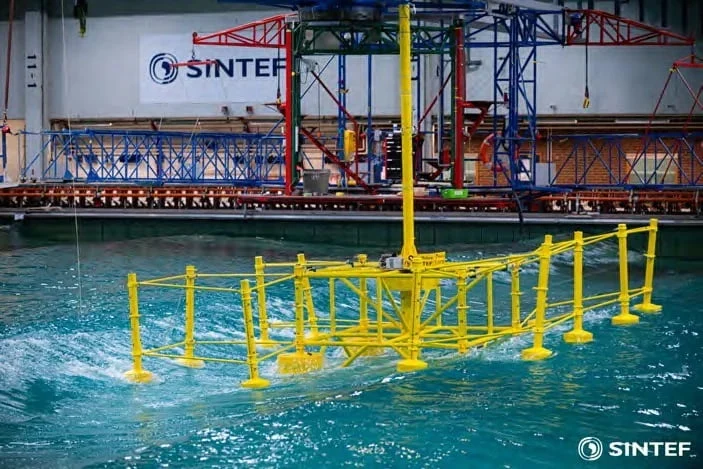
Flex2Future, a Norwegian technology company developing floating offshore energy systems that combine wind, wave and solar power on a single platform, has wrapped up an extensive model testing campaign in Norway, putting its floating wave, wind, and solar energy platform concept through simulated offshore conditions ahead of plans for a full-scale demonstration before the decade ends.
Flex2Future completed an extensive model test campaign in April 2026 at facilities operated by SINTEF Ocean, part of the Norwegian independent research organisation SINTEF, in Trondheim, Norway. The tests were carried out on a 1:25 scale model across two complementary campaigns.
The Norwegian firm explains that the complete module, including a fully modelled mooring system, was tested in the Ocean Basin under combined waves, current, and wind to characterise the structure’s dynamic behaviour.
In addition, a representative corner section was tested in the Towing Tank across a range of wave conditions to study the concept’s wave energy conversion. The testing program verified movements, survivability, and energy production in line with numerical models.
The company emphasized: “The campaign provides valuable measurement data that will be used to validate and calibrate Flex2Future’s numerical models, laying a solid foundation for continued development toward full scale.”
According to SINTEF, the project was initiated to support the development of offshore renewable energy concepts capable of producing electricity from multiple energy sources at the same time to support the green transition.
As the concept combines wave energy converters, a floating wind turbine, and solar panels into one floating offshore platform, the system aims to increase energy production while reducing the cost per produced kWh.
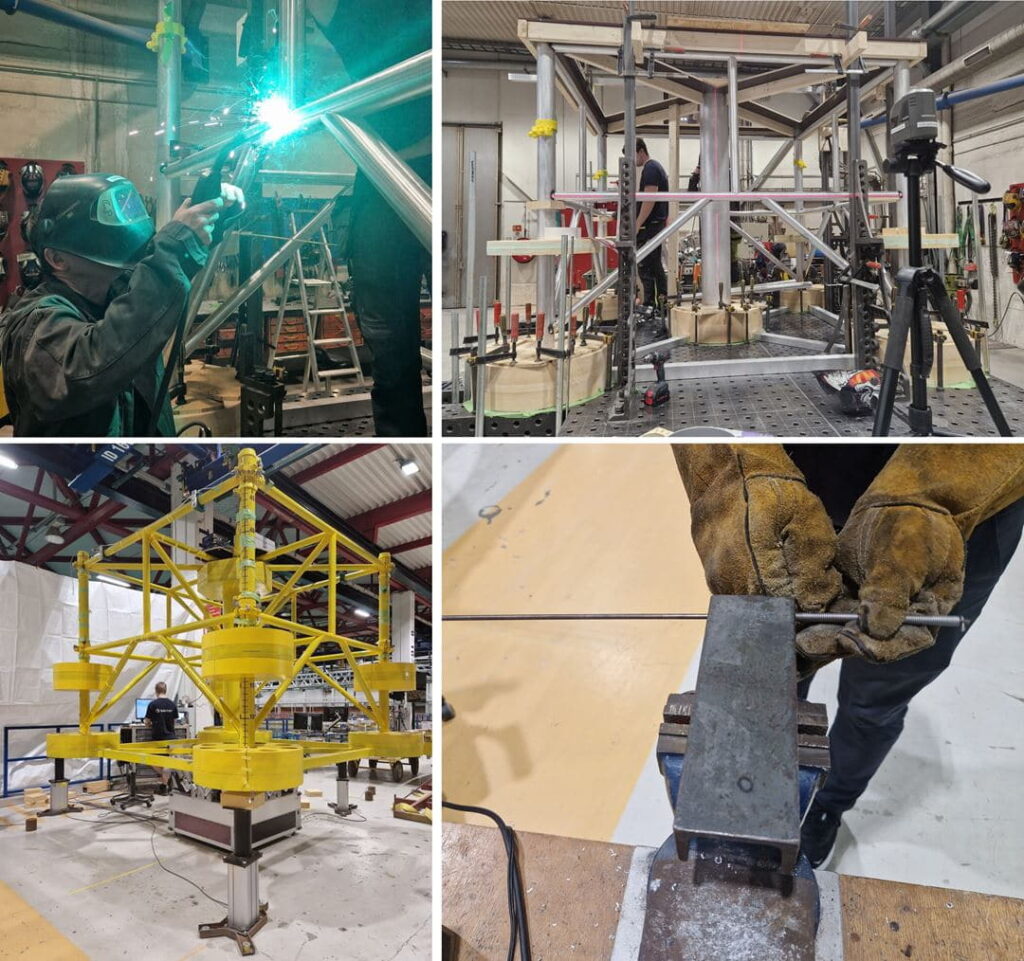
SINTEF elaborated: “The project is highly relevant because there is a growing need for stable and sustainable energy production to support the green transition and reduce greenhouse gas emissions. The project addresses several technical challenges related to floating offshore structures. The platform must withstand large waves, strong winds, and harsh sea conditions while maintaining stable operation and efficient power production.
“Another challenge is understanding how the combined system behaves dynamically in realistic offshore conditions and how energy can efficiently be extracted from the wave energy converters. Numerical simulations alone are not sufficient to predict all hydrodynamic effects and structural responses.”
The scale model tests were performed in the Ocean Basin and Towing Tank laboratories in Trondheim using realistic wave, wind, and current conditions. Hybrid testing combined physical models with real-time numerical models and motor-controlled systems to reproduce realistic offshore loads and power take-off behaviour.
The Norwegian research organization underlines that measurements from sensors, cameras, wave probes, and force transducers were used to validate numerical models and evaluate system performance, motions, mooring loads, and power production capabilities.
At full scale, each module measures 136 × 136 meters and is designed for an average output of around 8 MW, based on Flex2Future’s data. The company is seeking approval to place its S1 pilot offshore Eigerøy as part of its plans to bring the technology to the ocean before 2030.

Power Your Brand With Offshore Energy ⤵️
Take the spotlight and anchor your brand in the heart of the offshore world!
Join us for a bigger impact and amplify your presence at the core hub of the offshore energy community!
