


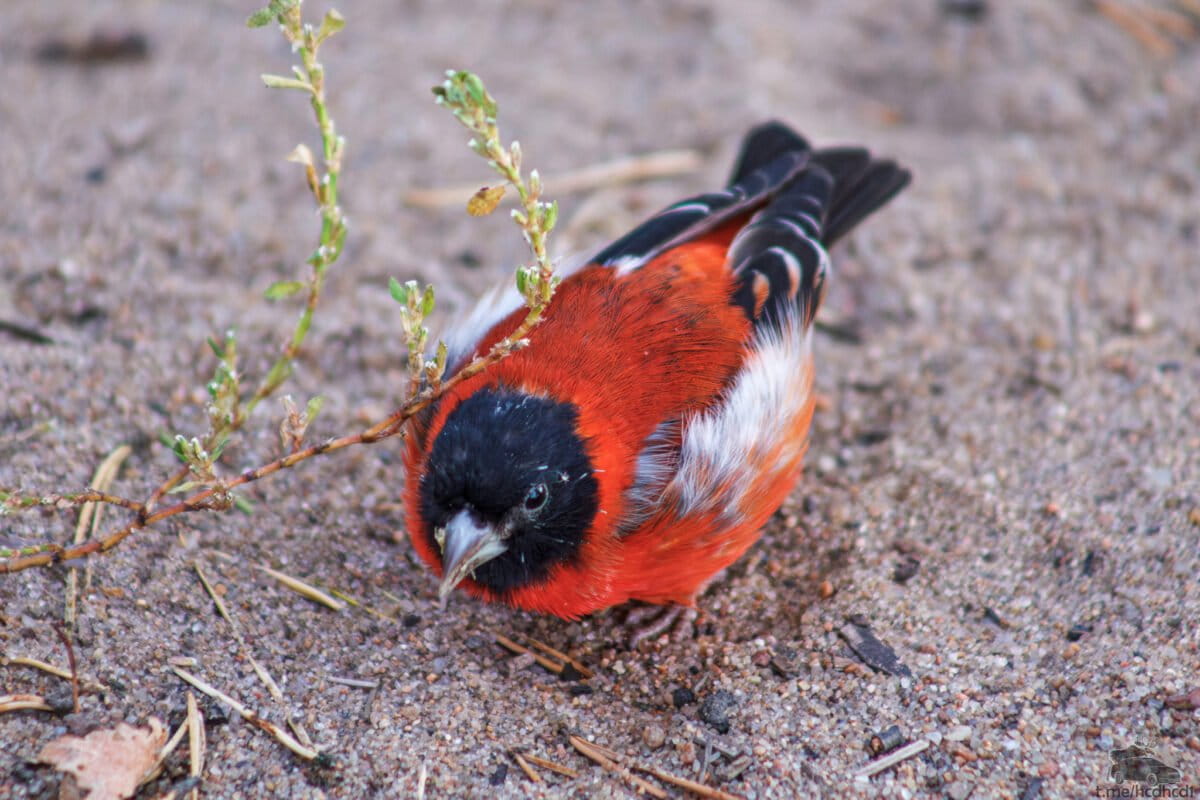
- The documentation of the endangered red siskin, a rare bird, in Guyana inspired the creation of the South Rupununi Conservation Society.
- The organization has built a multi-community grassroots conservation approach that is grounded in traditional knowledge, organizes across 16 village boundaries and includes Indigenous villagers, farmers and teachers who research wildlife, develop conservation guidelines and teach local ecology.
- Projects include community conservation zones to protect wildlife such as giant anteaters, the genetic documentation of species and monitoring.
- Short-term funding, development pressure and cultural change threaten the model, even as communities invest their own money into projects.
WICHABAI, Guyana — At sunrise in Guyana’s South Rupununi, Leroy Ignacio stops beside a tree scored with large claw marks. The animal responsible was a giant anteater.
“They even rub their backs on the trunk to leave a scent behind,” says Ignacio, president of the South Rupununi Conservation Society (SRCS), as he demonstrates the motion.
Indigenous researchers had long observed anteaters (Myrmecophaga tridactyla) climbing and marking trees, behaviors previously documented by scientists only in isolated cases. Working with four Indigenous communities, SRCS placed cameras at trees identified by locals. The resulting 883 recorded visits suggested the solitary animals use the trees to communicate.
For nearly a quarter-century, SRCS has built a multi-community approach to conservation grounded in traditional knowledge. Its members are villagers, farmers and teachers who work with participating communities to research wildlife, develop conservation guidelines and teach local ecology.
Before SRCS, Indigenous-led conservation in the Rupununi was mostly in the form of scattered projects and traditional stewardship by Makushi and Wapichan communities.
But the discovery of an endangered bird, the red siskin (Spinus cucullatus), gave several South Rupununi communities a reason to organize across village boundaries.
A multi-community movement
It all began with a scientific trip, recounts Ignacio.
In 2000, researchers from the Smithsonian and the University of Kansas, both in the U.S., came to the South Rupununi to survey birds. Duane De Freitas and other young Indigenous residents from Wapichan, Makushi and Wai Wai communities guided the scientists in the region. Together, they documented Guyana’s first scientifically confirmed population of the endangered red siskin.
The small red-and-black finch had disappeared from much of its historical range due to illegal trapping for the pet trade. The local guides were already concerned about changes to their sensitive landscape — during the rainy season, Rupununi’s flooded savannas and wetlands form an ecological corridor between the Amazon and Essequibo watersheds, connecting the highly biodiverse Amazon Basin and Guiana Shield.
They used the discovery of this bird as a launching point to develop a formal conservation organization.
The SRCS was officially registered in 2002. It has since expanded into research on giant anteaters, giant armadillos (Priodontes maximus), yellow-spotted river turtles (Podocnemis unifilis) and other threatened birds. What makes it stand out is its multi-community approach, which trains and pays local residents to research and protect wildlife across the Rupununi.
SRCS works in approximately 16 communities, although different villages participate in different projects. An executive body elected at an annual general meeting oversees the organization, while project managers coordinate work with village councils. Rangers are then recommended by community leaders or volunteer themselves.


Rangers can be young people, women, farmers, teachers, guides or livestock owners who take time out to help monitor animals by hiking through predetermined areas of the Rupununi and collecting data on location, behavior and range of each species.
Monitoring is mostly about gathering information about species — if they do see illegal activities, they report them to village leaders. Rangers receive stipends for individual projects rather than full-time salaries.
It was through trial and failure during their red siskin “pioneer pilot project” that they learned how to organize community-led conservation, Ignacio says.
“My role in SRCS is very diverse,” says longtime ranger and project coordinator Angelbert Johnny. “It goes all the way from sitting in meetings with people to being in the field, training and collecting data.” He also translates between English and Wapichan, the Indigenous language spoken in his community, during village council meetings.
Maruranau, a Wapichan community named after the giant armadillo, approached SRCS because residents wanted to better understand and protect their namesake animal. SRCS invited the neighboring communities of Shea and Awarewaunau to join, and Johnny coordinated a two-year project focused on giant armadillos and giant anteaters.
Rangers first interviewed residents in Wapichan and gathered their knowledge about the animals’ ranges, behavior and place in community life. Then, they used camera traps and field surveys to document them. Rangers presented those findings at village meetings, and residents used the information to help identify areas for farming, sustainable logging, tourism and conservation.
Johnny’s translations were central to the process. His role, he says, is to ensure residents understand that “the project belongs to them, not to SRCS.”
The work by the local rangers reshaped how the communities managed their habitat. In October 2025, leaders from the three villages signed an intercommunity agreement establishing shared land-use zones and conservation rules across 150,000 hectares (371,000 acres) to protect the giant armadillo and giant anteater.

A grassroots effort
Field Museum senior conservation ecologist Lesley de Souza has worked with the organization for about six years on rapid inventories and projects involving giant armadillos and the first genetic documentation of cottontail rabbits in Guyana. From her perspective, one of SRCS’s strengths comes from the people who lead the work.
“That grassroots approach, I think, is really effective,” she says. “Anytime you can have local people on the ground gathering real-time data, it can transform whether or not a place or a species will be protected long term.”
The red siskin, SRCS’s longest-running project, has shown successful outcomes. Five Indigenous communities have formally approved a red siskin conservation zone across their territories, where they establish rules and local rangers monitor the birds and threats to their habitat. During its 2022-2025 project, SRCS documented zero reported trapping incidents across the participating communities.
Rangers also recorded red siskins in Shea, extending the species’ known distribution in Guyana.
Where the model struggles
Not all community members are immediately on board with SRCS projects.
Rayson O’Connell, Maruranau’s deputy village leader and SRCS treasurer, said “conservation” can sound like an outside concept, even though residents have practiced its principles for generations. The term can be difficult to translate into Wapishana, and unfamiliarity can breed resistance.
Once projects are culturally translated, he said, communities are more likely to participate.
O’Connell sees another tension among younger residents, who now have smartphones and social media, drawing them toward Western lifestyles. That exposure can pull them away from their language and traditional practices, he said.
“There’s no combating [this], it’s a losing battle,” said Maya de Freitas, SRCS donor and partner relations officer.
But the SRCS has traditional knowledge classes to try and revive the interest of young people in their cultural identity by connecting them with elders and other knowledge holders to learn Wapichan and Makushi languages, cotton spinning, hammock weaving, basketry and arrow-making, as well as traditional natural resource management.
Across 20 communities, they’ve also established an environmental education program to teach children about Rupununi wildlife through activities like camera trapping, bird watching, field trips and community projects. They are now working directly with the Guyana Ministry of Education to develop and implement a nationwide environmental education program for every primary school child in every grade.
Funding remains the largest obstacle for the SRCS. “Because sometimes there is a gap [in funding], you lose people, you lose the capacity that you built, and you have to start over again,” Ignacio says.
Village funding offers a partial solution: Shea, Maruranau and Sand Creek have committed money to conservation. But those contributions cannot sustain a regional ranger network as Guyana’s oil-driven growth brings new infrastructure and land-use pressure to the Rupununi.
SRCS is seeking stable ranger salaries, government comanagement agreements and recognition of community-conserved lands under Guyana’s contribution to the global goal of conserving 30% of Earth’s land and waters by 2030, or the 30-by-30.
The future of SRCS, members said, depends on whether an organization built from local knowledge can secure the money and authority needed to survive beyond individual grants.
Erin Earl, a SRCS project manager, says long-term conservation cannot be sustained by one community or a temporary outside program.
“A single community can’t do that. Nor can an external NGO. Nor can a one-year project or a five-year government program,” she says. “It has to be from the inside, from a place of love, over many years.”
Banner image:A red siskin (Spinus cucullatus). Image by mikehcd via iNaturalist (CC BY-NC 4.0).
In a fight to save a rare bird, Indigenous communities in Guyana are winning
Dragonflies help protect water and ancestral Indigenous languages in Colombia
Elders, conservationists race to record fading sacred ties to Philippines’ endemic birds
Citation:
Earl, E., van Vliet, N., Braga-Pereira, F., Millar, N., … Wilson, N. (2024). Insights into marking behavior of giant anteaters: a camera trap study in the rupununi savannahs, Guyana. Mammalia, 88(5), 455-463. doi:10.1515/mammalia-2023-0006
Cite this article
Gentry Hale (2026). How a rare bird sparked a wildlife movement across 16 villages in Guyana. Mongabay Conservation news. DOI: https://doi.org/10.66709/news-327131

