


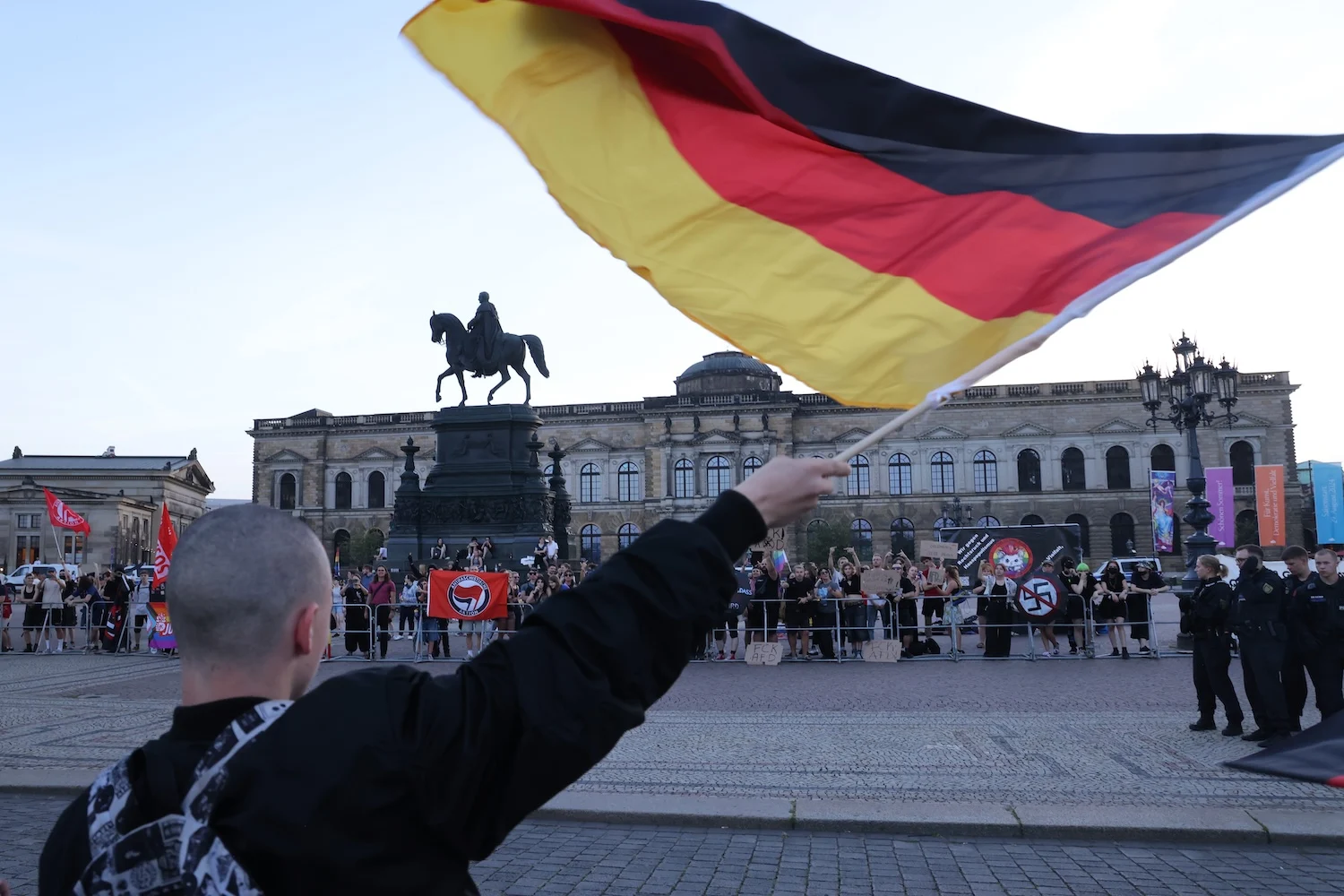
A year ago, an Indian opposition politician who had just met with several representatives of the Alternative for Germany (AfD) quizzed me about Germany’s approach to the far-right party. She wanted to better understand the logic of the “firewall” (Brandmauer) according to which all mainstream parties have resolved to never work with the AfD. At the end of our conversation, she voiced doubts about its prospects of success. In her view, India’s experience pointed to the opposite effect: The attempts to isolate India’s current prime minister, Narendra Modi, after the 2002 riots in the state of Gujarat—for which he was held partly responsible—only made him stronger.
Today, her skepticism seems more justified than ever. While the cordon sanitaire has so far successfully excluded the AfD from any political responsibility at the state and federal levels, the party has grown to become the strongest party in the polls by a clear margin. At the national level, the AfD sits at around 28 percent. In some eastern German states, it is around or above 40 percent. After the upcoming Sept. 6 election in Saxony-Anhalt, the party may soon enjoy an absolute majority in a state parliament, thus earning responsibility for setting the region’s policing, education, and budget policies, and electing its governor.
A year ago, an Indian opposition politician who had just met with several representatives of the Alternative for Germany (AfD) quizzed me about Germany’s approach to the far-right party. She wanted to better understand the logic of the “firewall” (Brandmauer) according to which all mainstream parties have resolved to never work with the AfD. At the end of our conversation, she voiced doubts about its prospects of success. In her view, India’s experience pointed to the opposite effect: The attempts to isolate India’s current prime minister, Narendra Modi, after the 2002 riots in the state of Gujarat—for which he was held partly responsible—only made him stronger.
Today, her skepticism seems more justified than ever. While the cordon sanitaire has so far successfully excluded the AfD from any political responsibility at the state and federal levels, the party has grown to become the strongest party in the polls by a clear margin. At the national level, the AfD sits at around 28 percent. In some eastern German states, it is around or above 40 percent. After the upcoming Sept. 6 election in Saxony-Anhalt, the party may soon enjoy an absolute majority in a state parliament, thus earning responsibility for setting the region’s policing, education, and budget policies, and electing its governor.
Left-leaning political scientists, such as Oxford University professor Tarik Abou-Chadi, mainly blame the AfD’s sustained rise on the normalization of its rhetoric by the mainstream center-right and center-left forces of the Christian Democratic Union (CDU), Christian Social Union in Bavaria (CSU), Social Democratic Party (SPD), and the Free Democratic Party (FDP). That explanation falls short. To be sure, we don’t know how quickly the AfD would have grown without the firewall—after all, right-wing populist parties in other European countries have become leading forces without a German-style cordon sanitaire.
But it is plausible that the firewall has contributed to the specifically German phenomenon of rapid growth combined with increasing radicalization. In some other countries, leading far-right forces have moderated somewhat as their success grew. The AfD, however, has taken the opposite path, adopting even more radical positions and promoting more radical cadres to national leadership.
So far, the firewall reduces incentives for the AfD to moderate. Voters can currently cast their vote for the AfD entirely risk-free. The firewall spares them the risk of having to live with the consequences of their choice. Other parties have to deal with the hard work of governing in increasingly dysfunctional coalitions.
Only very slowly is the possibility of an AfD single-party government changing this calculus. After all, this remains an unlikely option in most states and at the federal level for the time being. At the same time, the firewall fuels the AfD’s narrative of a united front of maligned “cartel parties” doing everything they can to exclude the AfD from taking over any responsibility. The despised “system” could hardly provide better proof of the AfD’s much-touted and unique selling proposition as the only alternative to the supposedly rotten forces of the status quo.
As a strategy for keeping the AfD small, the firewall has failed spectacularly. Going forward, there are just two possible rationales left for the Brandmauer. The first is as a stop-gap solution until a party ban takes effect. Based on the doctrine of militant democracy, the German Constitution explicitly includes a procedure for banning parties. For this, the constitutional court needs to determine the party to be unconstitutional because they “by reason of their aims or the behavior of their adherents, seek to undermine or abolish the free democratic basic order or to endanger the existence of the Federal Republic of Germany.” Everyone who is convinced that the AfD is a severe threat to the constitutional order and cannot be defanged through participation in government needs to push for initiating a ban proceeding. Relying on the firewall alone will not suffice to keep the AfD from power.
The assumption that such a ban procedure would be hopeless simply because of the AfD’s high level of voter support is mistaken. The reason that the constitutional court in 2017 denied the application to ban the small far-right Homeland party, which received just 0.4 percent of all votes that same year, was that there were no “concrete indications of sufficient weight” that it could successfully implement its anti-constitutional program. This means that the very fact that the AfD currently commands more than a quarter of the vote nationwide makes the success of a ban proceeding more likely, not less. What is undoubtedly true, though, is that a ban alone is by no means an answer to the forces driving the AfD today.
The second variant of the firewall that could still make sense is to tie it to conditions that would have to be met for the AfD’s exclusion to be gradually lifted. This would, at least in theory, give the AfD an incentive to moderate. Peer Steinbrück, a former SPD finance minister, and Michael Zürn, a centrist political scientist and director at the WZB Berlin Social Science Center, have recently made proposals along these lines. Steinbrück builds on proposals by the former head of the CDU’s Commission on Fundamental Values Andreas Rödder who argued that if the AfD “sticks to red lines and distances itself clearly from right-wing extremist positions and figures”—rudimentary conditions the party is still very far from meeting—it would be worth having discussions with it.
For now, an AfD drunk on its rise in the polls—and on the verge of winning an absolute majority in Saxony-Anhalt—may have little appetite for this to begin with. Many AfD leaders feel confident that, with the firewall in place, they are on the path to eventually forcing a split of the center-right CDU/CSU over the question of working together with the AfD, allowing the AfD to become a hegemonic force in German politics. However, making the firewall conditional on AfD positioning could possibly turn the tables and reverse the dynamic. It would then be the AfD that could face internal splits over how far to go to meet the conditions set for lifting the cooperation ban.
In any scenario, it is important to rethink coalition governments, especially at the state level. The increasing vote share of the AfD, in particular in East German states, means that all parties need to work together to form a majority government against the AfD, forcing the center-right CDU into an ill-fated formal coalition with the far-left Die Linke. Flexible minority governments seem to be the better option. All-party coalitions only help the AfD’s narrative of being the only opposition force in parliament. What is also needed from mainstream forces is smarter engagement with the economic and foreign-policy positions of an ever-stronger AfD reaching for power.
The rule here should be less moralizing and more hard-nosed, interest-based arguments. Recently, in a debate about foreign policy toward Russia and Ukraine, the highly successful podcaster Paul Ronzheimer, who took a strong moral stance, barely held his own against AfD foreign-policy spokesperson Markus Frohnmaier, who argued calmly and with carefully timed demagogic flourishes. By relying on moralizing, Ronzheimer failed to capitalize on the many contradictions within the AfD on dealing with Trumpism, Russian President Vladimir, Putin, or China’s threat to German prosperity. This past weekend, AfD co-leader Alice Weidel drew a blank on national television when quizzed about what she would do to help a German car industry in distress to meet the challenges posed by Chinese competitors.
It is right to stay vigilant about support for AfD-aligned forces and positions coming from abroad. If MAGA billionaires were to open their coffers on a large scale for activities in Germany and Europe, that should be taken seriously. At the same time, a sense of proportion is needed. In July, together with parts of the media, German Chancellor Friedrich Merz got worked up over a U.S. State Department tender supporting “research, conferences, cultural engagements, and support for civil society” in Europe in line with the MAGA agenda. If you consider your own democracy so brittle that less $5 million poses a serious threat, then you might as well hand over the keys to the AfD directly.
