


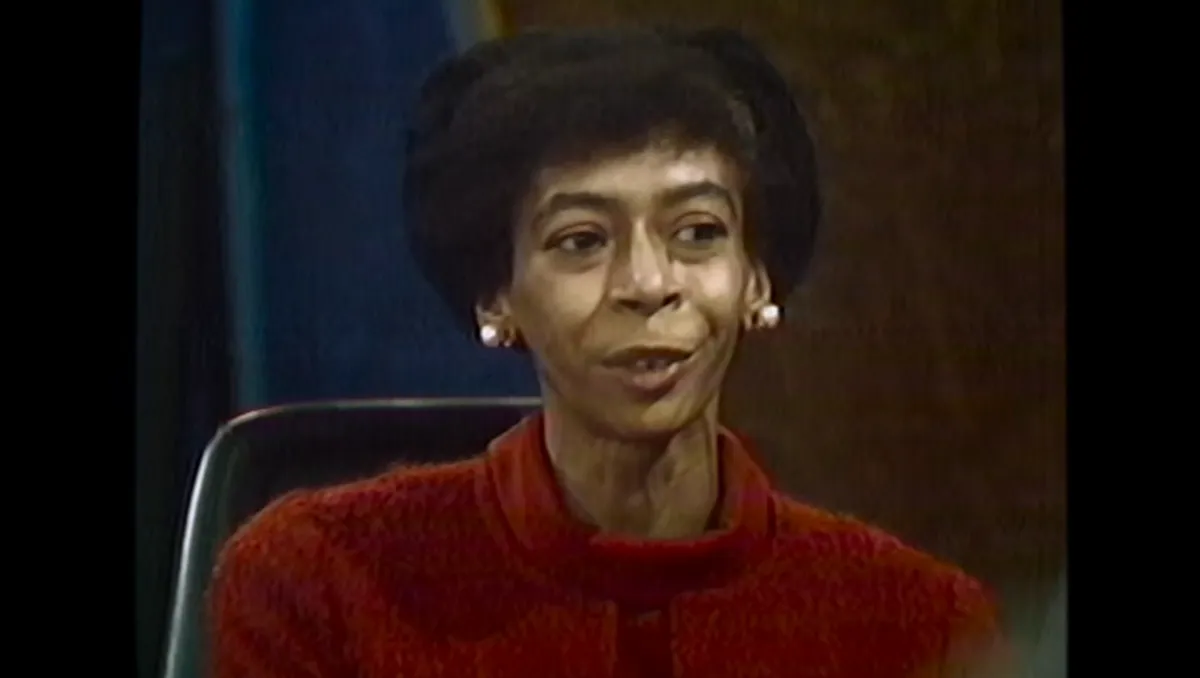
Activist Marion Stokes recorded more than 300,000 hours of news footage from the 1970s to her death in 2021.
Stokes recorded television news for more than three decades, amassing a collection of more than 70,000 tapes.
The duration of her recordings has not been definitively established.
In 2026, posts on social media sites highlighted an important historical figure: activist Marion Stokes. The posts claimed Stokes recorded around 300,000 hours of television — purportedly one of the largest known personal archives of such material.
The claim circulated on TikTok, Reddit and Threads. A TikTok video claimed to detail her remarkable life:
Marion Stokes started recording television in 1979 because she noticed something that bothered her deeply. TV networks were erasing their own archives — wiping old footage to save money and storage space. Nobody was keeping the record. So she decided she would. For 35 years, she ran up to eight VCRs simultaneously in her Philadelphia home, recording around the clock. News, commercials, sitcoms, local broadcasts, breaking events. The tapes ran out every six to eight hours. She almost never missed a change. Friends and family described rushing home from dinner so she could swap them out. By the time she died on December 14, 2012 — as Sandy Hook coverage filled every channel — she had accumulated 71,000 VHS and Betamax tapes. Over 300,000 hours of television. She bought nine additional apartments just to store them all. Historians now call it one of the most valuable media archives ever created. An unfiltered record of how news was told, how narratives shifted, and what powerful institutions chose to quietly walk back or change over time.
It’s true that Stokes recorded news footage onto tens of thousands of tapes, but the duration of that footage has not been definitively established. Therefore we’ve rated this claim a mixture of true and undetermined information.
Stokes was a Black social justice activist and a television producer. According to a profile of Stokes in Atlas Obscura, in 1975, she purchased a Betamax magnetic videotape recorder through which she began her archival project. By 1980 she began recording full time on multiple VCRs, starting with two or three and moving on to eight.
While many sources say she started recording in 1975, the Philadelphia Inquirer reported that she began intermittently taping television programming in 1976. But according to her son, Michael Metelits, who spoke to the Inquirer in a number of interviews, her taping became constant at the onset of the Iran hostage crisis in 1979. She was also bolstered by the founding of CNN in 1980 that ushered in an era of 24-hour news coverage.
Her recordings continued until her death in 2012, and covered nine news stations, according to the 2019 documentary “Recorder: The Marion Stokes Project.”
According to the documentary website, her recordings truly began in 1979. Regardless of her start date, she was recording for more than 30 years, in a manner that her son described as part of her impulse to save and hoard, but also “a form of activism.”
The documentary, which was shown at the Tribeca Film Festival and received critical acclaim, described the importance of her archiving:
Before “fake news” Marion was fighting to protect the truth by archiving everything that was said and shown on television. The public didn’t know it, but the networks were disposing their archives for decades into the trashcan of history. Remarkably Marion saved it, and now the Internet Archive will digitize her tapes and we’ll be able to search them online for free.
This is a mystery in the form of a time capsule. It’s about a radical Communist activist, who became a fabulously wealthy recluse archivist. Her work was crazy but it was also genius, and she would pay a profound price for dedicating her life to this visionary and maddening project.
According to early reports in 2013, Stokes had around 140,000 VHS tapes that contained news coverage of revolutions, political scandals and more. Her son donated the tapes to the Internet Archive — a nonprofit group known for its vast online archive — which planned to digitize everything and make it available to the public. The Internet Archive lowered this estimated number of tapes to 40,000 as it began receiving containers of them from Stokes’ family.
A correction to a Fast Company report on the digitization process was published in Poynter in 2014: “And there aren’t 140,000 VHS tapes, as Fast Company and Poynter wrote back in November. Just 40,000. The family overestimated.”
The Internet Archive also reached out to Fast Company with an update:
The Internet Archive received four shipping containers of Stokes’ tapes in December. After conducting a sample inventory, it realized that the family’s initial estimate of the number of tapes was incorrect. The collection is about 40,000 tapes large. “I think it’s daunting when confronted with many storage containers, 20- or 30-feet deep, to figure it out,” Macdonald says about why the mistake was made.
However, in 2021, the Internet Archive tweeted about a larger number of tapes with a photograph of when they were delivered, saying there were more than 70,000:
Today, the tapes can be found in the Internet Archive’s vast collection, along with documents related to Stokes’ life.
We heard from Roger MacDonald, founder of the Internet Archive’s TV News Archive, who gave us more up-to-date information on Stokes’ collection:
Our current best count of video cassettes in the Marion Stokes TV Archive is 71,716. Although each has notations on the spine indicating programs recorded and dates, we have not counted the number of programs, nor their durations.
[…]
We are looking forward to the time when we have sufficient funds to really making a dent in digitizing the vast collection and making it available online in our library.
So while it is true Stokes had more than 70,000 tapes in her collection, the duration of those tapes has not been determined.
Stokes’ collection is certainly not the largest such archive in the world. That distinction may belong to Vanderbilt University, which claims to have “the world’s most extensive and complete archive of television news.” The university has “been recording, preserving and providing access to television news broadcasts of the national networks since August 5, 1968.”
UCLA claims to have “the largest university-held collection of motion pictures and broadcast programming.” Dartmouth’s Media Ecology Project ranks UCLA’s Film and Television Archive as “the second largest moving image archive in the United States after the Library of Congress, and the world’s largest university-based media archive.”
Atlas Obscura describes Stokes’ archive as “the only comprehensive collection preserving this period [the mid-1970s to 2012] in television media history,” and some reports say this is the largest known archive of television made by an individual. This assessment is possibly correct, given that recording all that material from one’s own home was particularly unheard of at that time. We are unaware of another personal project with this extent of archival footage.
Sources
Al-Samarrai, Noor. “The Remarkable Story of a Woman Who Preserved Over 30 Years of TV History.” Atlas Obscura, 29 Apr. 2019,https://www.atlasobscura.com/articles/marion-stokes-television-news-archive. Accessed 26 Apr. 2022.
Archive Partners – The Media Ecology Project at Dartmouth College. https://mediaecology.dartmouth.edu/wp/partners/archive-partners. Accessed 26 Apr. 2022.
Bender, Abbey. “The Woman Who Recorded Decades of TV News on 70,000 VHS Tapes.” Hyperallergic, 6 June 2019,https://hyperallergic.com/503528/recorder-marion-stokes-documentary/.
Bradshaw, Peter. “Recorder: The Marion Stokes Project Review – the Woman Who Kept the TV on for 30 Years.” The Guardian, 4 Nov. 2020. www.theguardian.com,https://www.theguardian.com/film/2020/nov/04/recorder-the-marion-stokes-project-review-documentary-television-news. Accessed 26 Apr. 2022.
Explore Collections | UCLA Film & Television Archive. https://www.cinema.ucla.edu/explore-collections. Accessed 26 Apr. 2022.
Gammage, Jeff. “Phila. Woman’s 35-Year TV News Archive to Be Digitized, Made Public.” Philadelphia Inquirer, https://www.inquirer.com/philly/news/20131209_Phila__woman_s_35-year_TV_news_archive_to_be_digitized__made_public.html. Accessed 26 Apr. 2022.
Kessler, Sarah. “The Incredible Story Of Marion Stokes, Who Single-Handedly Taped 35 Years Of TV News.” Fast Company, 21 Nov. 2013, https://www.fastcompany.com/3022022/the-incredible-story-of-marion-stokes-who-single-handedly-taped-35-years-of-tv-news. Accessed 26 Apr. 2022.
“Marion Stokes’ 40,000 TV News Recordings Slowly Come Online.” Poynter, 26 Mar. 2014, https://www.poynter.org/reporting-editing/2014/marion-stokes-40000-tv-news-recordings-slowly-come-online/. Accessed 26 Apr. 2022.
Online Resources for Moving Image Material (Moving Image Research Center, Library of Congress). https://www.loc.gov/rr/mopic/onlinesources.html. Accessed 26 Apr. 2022.
Recorder: The Marion Stokes Project. https://recorderfilm.com. Accessed 26 Apr. 2022. “Tribeca Film Festival.” Accessed 26 Apr. 2022.
The New Yorker, https://www.newyorker.com/goings-on-about-town/movies/tribeca-film-festival-3. Accessed 26 Apr. 2022.
“Why a Woman Secretly Taped 30 Years of TV News.” BBC News. www.bbc.com, https://www.bbc.com/news/av/world-us-canada-48190528. Accessed 26 Apr. 2022.
