


Unlock the White House Watch newsletter for free
Your guide to what Trump’s second term means for Washington, business and the world
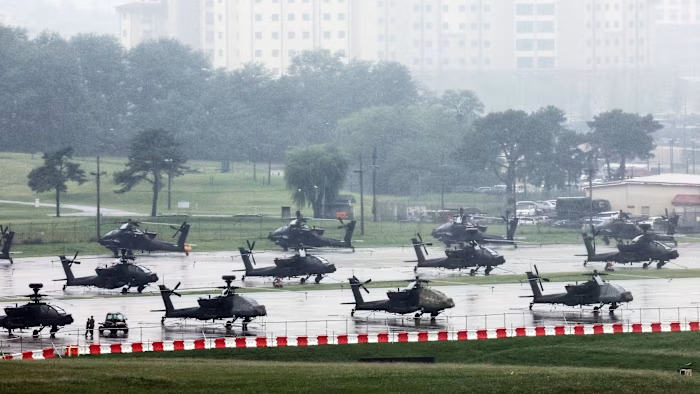
Thousands of South Korean and US troops were this week supposed to be continuing 11 days of military exercises intended to demonstrate readiness to defend against an attack from North Korea. Instead, the troops packed up on Friday, day five — after Donald Trump announced on the eve of the drills that he was scaling them back as they sent a “hostile” signal to a country that he said had been “unthreatening and respectful” during his presidency. The president’s move appeared part of a new diplomatic overture towards North Korea’s leader Kim Jong Un — which received an initial brush-off from Pyongyang. But what came across as a snub to a key US partner provides further evidence that the US under Trump can no longer be counted on as a reliable ally in the Asia-Pacific.
Trump has used the decades-old annual exercises with South Korea — long viewed by Pyongyang as a provocation — as a bargaining chip with the North before. The president cancelled the drills in 2018 during his first administration, taking some US officials by surprise, before Trump and Kim met three times for what proved to be unsuccessful talks on denuclearisation.
But his new tilt towards Kim’s dictatorship in the North, at the apparent expense of democratic South Korea, is as shocking as it is puzzling. The North Korean leader has strengthened his position in the seven years since his meetings with Trump, giving him little incentive for new talks. North Korea has substantially expanded its nuclear arsenal; even Trump this week claimed it now had “57 very powerful” weapons, but South Korean estimates are considerably higher. Kim has also deepened economic and military co-operation with Russia, sending troops to support Vladimir Putin’s war in Ukraine. He has insisted he will resume talks with the US only if Washington drops its insistence on denuclearisation.
Trump’s overture to Pyongyang has prompted speculation that he is seeking a diplomatic success elsewhere as he struggles to end his ill-advised war against Iran. He also linked his downgrading of the exercises in South Korea to Seoul’s refusal to provide military assistance in the Middle East conflict.
But in stark contrast to his treatment of Tehran, the US president appears in effect to be rewarding Kim’s defiance at a moment when the North Korean leader’s rhetoric has become increasingly hostile towards South Korea, and his military has acquired modern battlefield experience in Ukraine.
The president’s treatment of Seoul is deepening concern across Asia-Pacific about US reliability under Trump as the region confronts an increasingly assertive China. Just as his erratic policy is reordering defence arrangements in Europe and the Middle East, it should be an incentive for democracies in east Asia to strengthen mutual relationships as far as possible and create their own security frameworks — including seeking closer ties with India and south-east Asian democracies. It makes particular sense for South Korea and Japan, which have closely aligned interests despite their difficult history, to co-operate directly and lessen their reliance on America as the hinge.
If Asia-Pacific democracies take more responsibility for their own security — as in Europe — that may be one positive spin-off from Trump’s behaviour. Current US policy, however, is making it harder for both South Korea and Japan to ignore the once taboo question of acquiring a nuclear deterrent. The debate remains at an early stage, and both countries are signatories to the Nuclear Non-Proliferation Treaty. But the fact such ideas are starting to become thinkable shows how US policy under Trump — despite the ostensible ambition to restrain Iran and North Korea’s nuclear programmes — now risks undermining decades of non-proliferation efforts elsewhere.
