


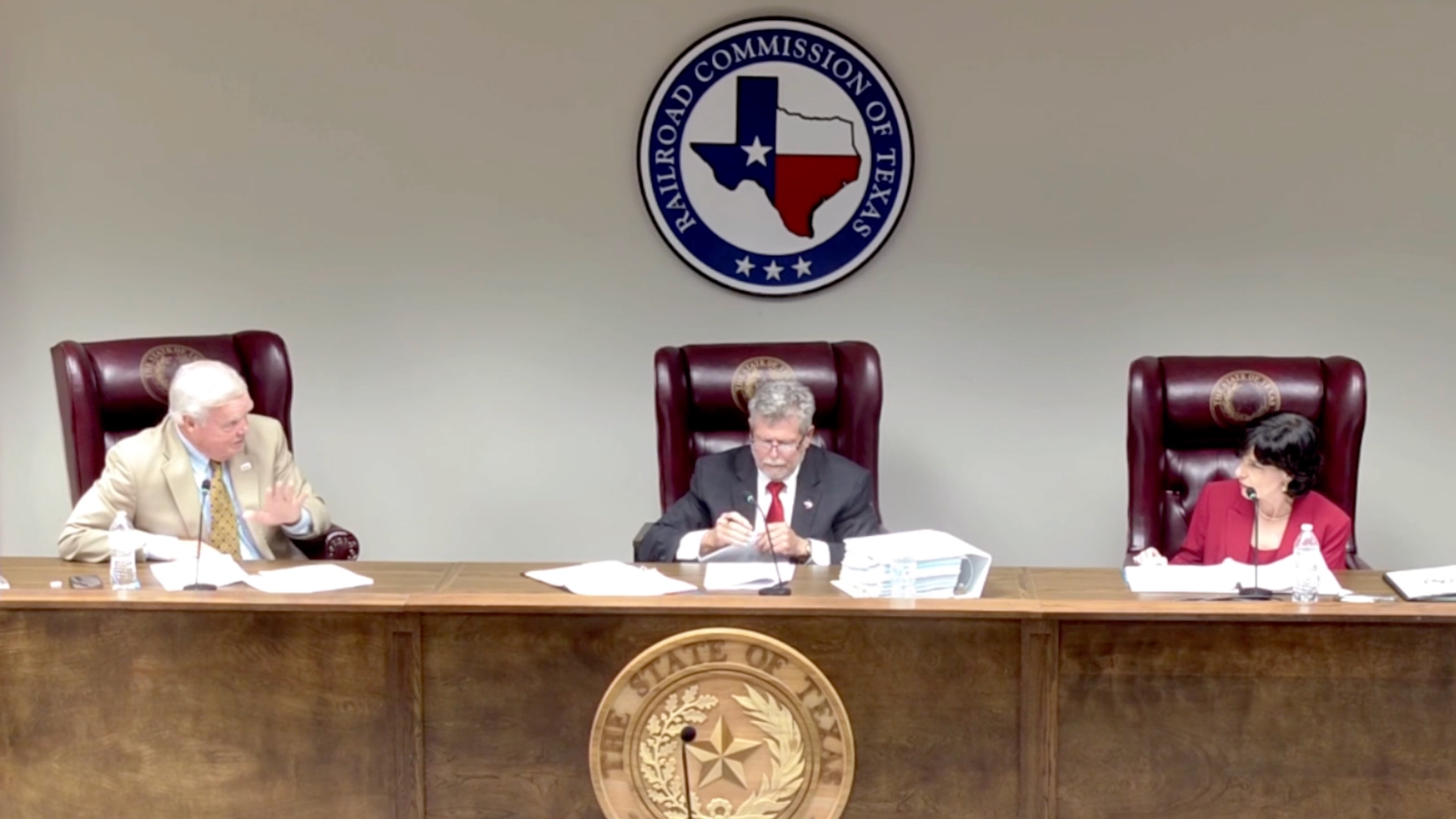
The three elected officials who regulate the oil and gas industry in Texas hold an open meeting each month in Austin to vote on matters from pipeline violations to permit renewals.
Members of the public can register to speak for up to three minutes at the end of each meeting. People often travel hundreds of miles from South Texas, the Permian Basin and the Gulf Coast for the opportunity to speak directly to the officials who have the final say in oil and gas regulation in Texas. The commission does not accept public comment over the phone during these meetings.
This week the commissioners adopted a new public participation policy by a 2-1 vote. The new policy will remove the public comment agenda item at monthly meetings. Going forward, commissioners can individually request a public comment agenda item. If no commissioner makes a request, there will be no guaranteed public comment.
The new policy includes other changes, including more frequent “listening sessions” where residents can bring issues to commission staff. However, the commissioners do not attend these sessions.
The new policy was not circulated to the public before Commissioner Wayne Christian introduced it Tuesday. It appeared that the other two commissioners had not read it beforehand, as they quickly paged through a printout while sitting on the dais. The policy was not read into the record prior to a vote.
Commissioner Christi Craddick voted against the new policy, saying she thought people should have the opportunity to speak at open meetings. The motion carried with votes from Commissioners Christian and Jim Wright.
Virginia Palacios, executive director of the nonprofit watchdog Commission Shift, has provided public comment at almost every open meeting since 2021. Palacios registered to give comment on the proposed policy, but the commissioners did not call on her. She spoke during the general comment period after the commissioners’ vote.
“You just approved an agenda item on public participation without allowing public participation,” Palacios said.
Craddick cut in to remind her that public comment cannot address items that were already posted and voted on. “You are not to speak about things that were posted,” she said.
“I wanted to point out the irony,” Palacios responded.
“The new policy expands opportunities for public participation by providing listening sessions at least once a month,” Commissioner Christian told Inside Climate News. “These sessions provide a more meaningful forum where Texans can ask questions, raise concerns, and engage directly with agency staff who can help get them answers or elevate issues when appropriate, rather than being constrained by the legal and procedural limitations of a formal open meeting.”
“I’m not sure why expanding Texans’ ability to engage with our agency would be framed negatively—the entire purpose of this policy is to make the RRC more accessible to the people we serve,” he said.
“This updated policy outlines various methods and procedures for members of the public who want to share comments with the RRC and emphasizes the expanded outreach and accessibility provided by the RRC’s Office of Public Engagement,” said Railroad Commission spokesperson Bryce Dubee.
The Office of Public Engagement hosts online listening sessions and educates the public about the Railroad Commission.
A staffer for Commissioner Wright declined to comment. Commissioner Craddick’s office did not respond to a request for comment.
Long-Standing Calls for More Transparency
Texas residents and advocacy groups have long called for changes in public engagement at the Railroad Commission. Many say the agency’s name is the root of the problem. The commission was founded in 1891 to regulate railroads. It no longer regulates railroads and for decades has regulated the largest oil and gas industry in the country.
A Texas Sunset Advisory Commission Review, which evaluated state agencies, recommended in 2016-17 changing the Railroad Commission’s name to “eliminate confusion” and “increase transparency.”
“Transparency demands that the agency’s name reflect its actual mission,” the Sunset Advisory Commission wrote.
The Railroad Commission has not acted on that recommendation.
When Commissioner Christian introduced the policy change Tuesday, he appeared poised to address this issue.
“We are elected by millions of Texans across this state,” he said. “When they go to the polls and they’re not informed on what the heck they’re voting on. … I think that’s a big disservice to the voters of this state.”
However, his proposal focused on introducing options for public comment by phone and in-person during listening sessions. These sessions are organized by the Office of Public Engagement, but the commissioners do not attend. The new policy will increase the frequency of listening sessions.
Christian failed to explain that unlike the existing policy—where a public comment agenda item is automatically included at every meeting—the new policy states that commissioners must request ahead of time an agenda item for public comment.
“I have a concern,” said Commissioner Craddick. “It says that we’re getting rid of our normal posting for public participation in our open meeting.
“Some people have abused the issue,” she continued. “But I do believe some people want to talk to us as commissioners and as elected officials.”
Commissioner Christian responded that the opportunity to give public comment “would be at the discretion of the commissioners.”
In a blog post, Palacios wrote that the listening sessions should not substitute for open meetings, which are the only opportunity for the public to communicate “simultaneously and efficiently” with the elected commissioners.
About This Story
Perhaps you noticed: This story, like all the news we publish, is free to read. That’s because Inside Climate News is a 501c3 nonprofit organization. We do not charge a subscription fee, lock our news behind a paywall, or clutter our website with ads. We make our news on climate and the environment freely available to you and anyone who wants it.
That’s not all. We also share our news for free with scores of other media organizations around the country. Many of them can’t afford to do environmental journalism of their own. We’ve built bureaus from coast to coast to report local stories, collaborate with local newsrooms and co-publish articles so that this vital work is shared as widely as possible.
Two of us launched ICN in 2007. Six years later we earned a Pulitzer Prize for National Reporting, and now we run the oldest and largest dedicated climate newsroom in the nation. We tell the story in all its complexity. We hold polluters accountable. We expose environmental injustice. We debunk misinformation. We scrutinize solutions and inspire action.
Donations from readers like you fund every aspect of what we do. If you don’t already, will you support our ongoing work, our reporting on the biggest crisis facing our planet, and help us reach even more readers in more places?
Please take a moment to make a tax-deductible donation. Every one of them makes a difference.
Thank you,

Reporter, El Paso, Texas
Martha Pskowski covers climate change and the environment in Texas from her base in El Paso. She was previously an environmental reporter at the El Paso Times. She began her career as a freelance journalist in Mexico, reporting for outlets including The Guardian and Yale E360. Martha has a B.A. in Environmental Studies from Hampshire College and a master’s degree in Journalism and Latin American Studies from New York University. She is a former Fulbright research fellow in Mexico. Martha can be reached on Signal at psskow.33.
