


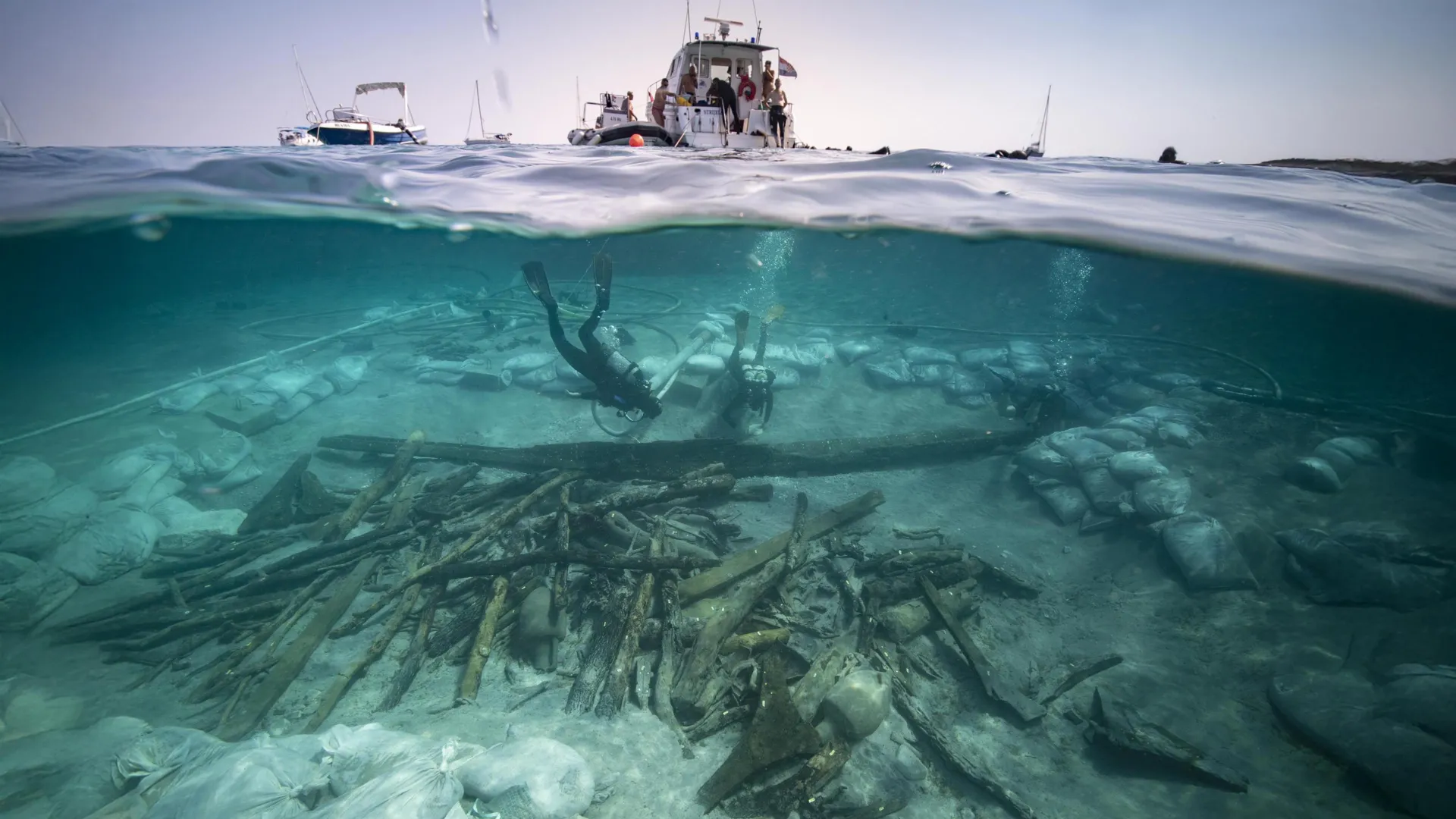
For as long as people have traveled by sea, ships have needed protection from water, salt, microorganisms, and marine animals such as worms. Yet until the mid-20th century, researchers paid relatively little attention to the non-wood materials used in ancient shipbuilding. Waterproofing materials in particular remain understudied.
A new study published in Frontiers in Materials is helping fill that gap. Researchers in France and Croatia analyzed the protective coating on the Roman Republic shipwreck Ilovik-Paržine 1, which sank about 2,200 years ago off the coast of what is now Croatia.
“In archaeology, little attention is paid to organic waterproofing materials. Yet they are essential for navigation at sea or on rivers and are true witnesses of past naval technologies,” said first author Dr. Armelle Charrié, an archaeometrist at the Laboratory of Mass Spectrometry of Interactions and Systems in Strasbourg. “Studying the coatings, we found two different kinds on this vessel: one made of pine tar, also called pitch, and the other of a mixture of pine tar and beeswax. Analysis of pollen in the coating made it possible to identify the plant taxa present in the immediate environment during the construction or repairs of the ship.”
Pine Tar and Beeswax Protected the Hull
The wreck was discovered in 2016, and both the vessel and its cargo have been investigated several times since then. This study is the first to combine molecular and pollen analysis to identify the ship’s coatings and reconstruct the vegetation present when those materials were produced and applied to the hull.
The research was carried out through a collaboration between the Department for Underwater Archaeology of the Croatian Conservation Institute and the ‘ADRIBOATS’ program of the Centre Camille Jullian at Aix-Marseille University in France.
“Some regions throughout the Adriatic have particular characteristics that led local populations to develop a specific shipbuilding style,” said Charrié. “Only studies like ours offer an overview of these traditions which bear witness to genuine know-how and diverse traditions.”
To investigate the coatings, the researchers performed structural, molecular, and pollen analyses. They used methods including mass spectrometry, which can identify and measure unknown substances within complex organic mixtures.
The team analyzed 10 coating samples to determine the biological origins of the natural materials used on the vessel. Molecular fingerprinting revealed compounds associated with pine trees, showing that every sample was dominated by heated coniferous resin or coniferous tar, also called pitch.
One sample, however, contained a different formulation made from beeswax and tar. This mixture – known to Greek shipbuilders as zopissa – improves the adhesive’s flexibility and is easier to apply when hot.
Ancient Pollen Preserved in Sticky Pitch
Because pitch is naturally sticky, it can capture pollen from nearby vegetation and preserve it for long periods. By studying the types of pollen trapped in the coatings and measuring their relative abundance, the researchers were able to narrow down where some of the pitch may have been produced or reapplied during repairs.
The pollen recovered from Ilovik-Paržine 1 pointed to a wide range of environments. Some came from landscapes typical of Mediterranean and Adriatic coasts and valleys, including forests of holly oak and pine as well as matorral – a kind of Mediterranean shrubland – where olive and hazel trees grow.
Alder and ash pollen indicated vegetation associated with riverbanks and seashores, which occur along the coast and in the nearby hinterland. Small amounts of fir and beech were also present. These trees are associated with mountainous terrain and are characteristic of the north-eastern Adriatic coast, where the mountain ranges of Istria and Dalmatia lie relatively close to the sea.
Evidence of Repeated Repairs Across the Adriatic
The analysis also suggests that the vessel received four to five separate batches of coating over time. The stern and central section appear to have been covered with the same material, while researchers identified three distinct coating batches at the bow.
That pattern may indicate that the ship was repaired repeatedly, with materials obtained from different locations around the Mediterranean.
Earlier research on the vessel’s ballast pointed to Brundisium – today Brindisi – on the south-eastern coast of Italy as the place where the ship was built. The new pollen evidence suggests that some of its coatings may also have been applied in that area.
Other layers, however, may have been added along the north-eastern Adriatic coast, close to where the wreck was ultimately found.
“While it seems obvious that ships sailing long distances need repairs, it’s simply not easy to demonstrate this,” concluded Charrié. “Pollen has been very useful in identifying different coatings where the molecular profiles were identical.”
