


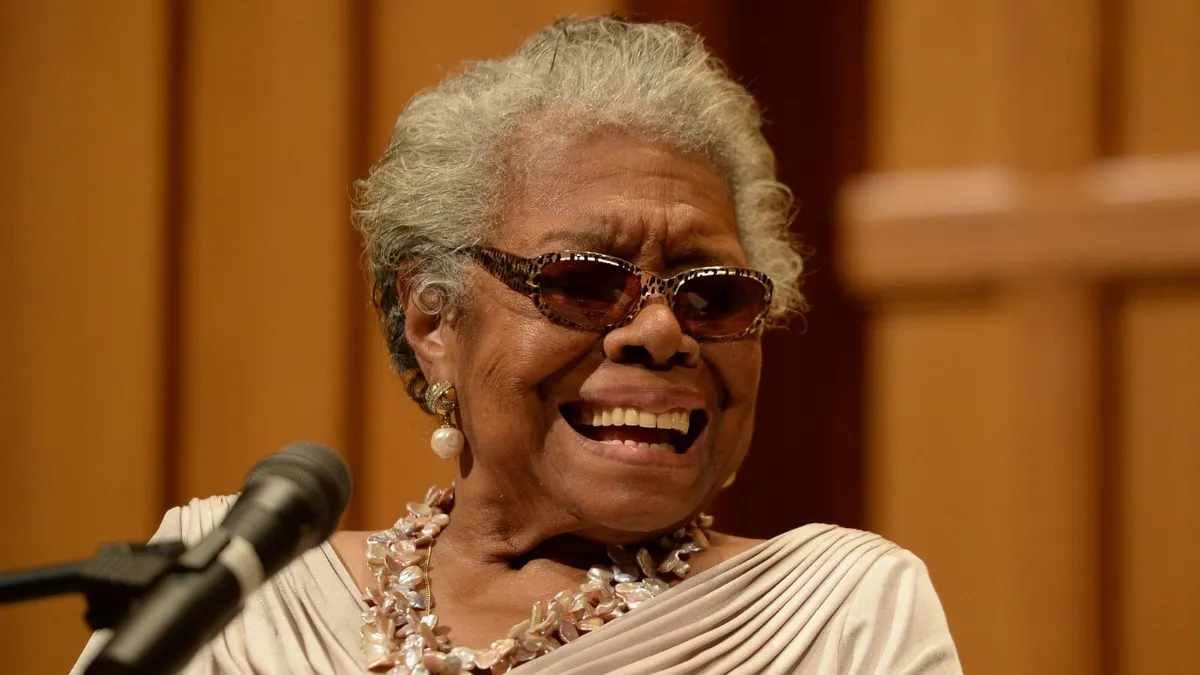
Poet and author Maya Angelou said or wrote, “Forgive yourself for not knowing what you didn’t know before you learned it.”
For years, people have shared memes and posts claiming celebrated poet and author Maya Angelou, who died in 2014, said or wrote, “Forgive yourself for not knowing what you didn’t know before you learned it.”
In one example, on Oct. 4, 2023, a Facebook user posted (archived) the quote’s text with a photo of Angelou.

(Ravenous Butterflies accessed via Facebook)
The quote appeared with Angelou’s name on Facebook (archived), Goodreads, Instagram (archived), Reddit (archived), X (archived) and YouTube (begins 1:53:36).
In short, no evidence confirmed Angelou ever said or wrote, “Forgive yourself for not knowing what you didn’t know before you learned it.” Research pointed to author Doe Zantamata as the quote’s true originator.
Searches of X found the earliest post (archived) with the exact quote — without Angelou’s name — on July 18, 2013. A different search found Angelou’s name didn’t appear with the quote, at least not on what was then called Twitter, until a Nov. 6, 2015, tweet (archived).
The July 2013 post lacking Angelou’s name linked to a Pinterest pin (archived) with a watermark reading “thehiyl.com,” referencing Zantamata’s Happiness in Your Life blog. She originally posted the quote days earlier on July 9, attributing the thought to herself. Two days later, someone managing the Facebook page for the late author and motivational speaker Zig Ziglar reposted (archived) the same meme.

(Doe Zantamata accessed via Pinterest)
Via email, Zantamata confirmed to Snopes her authorship of the quote and told us about the process inspiring her to write the text. That correspondence and variations of the quote, including a very similar quote from 1975, appear later in this article.
Other sources consulted in our research included the Filmot.com YouTube captions search tool, the Google Books (archived) literary archives and the Newspapers.com newspaper archives. All three websites featured authors and creators inaccurately attributing the quote to Angelou. Further searches of DuckDuckGo and Google failed to locate information confirming Angelou originated the quote.
Zantamata’s inspiration
Zantamata — the genuine author of the quote, according to all available data — told us she first posted the quote and meme as her original work in her July 2013 blog post. Then, she published the quote in one of her books. She said the quote’s misattribution with Angelou’s name began after the poet’s 2014 death:
There was a flurry of online articles, tributes, and quote posts going up all over social media. One day I saw my quote with her name as the author. I commented on the post, and my comment was deleted. This then happened several more times, and then I gave up trying to correct them.
First I was a bit flattered that someone would mistake my work for hers, but then after awhile people would comment when I posted my own quote and claim it was Maya Angelou!
Zantamata told us the inspiration for the quote arrived while writing her thoughts about self-forgiveness:
I was writing some things about self-forgiveness, and had the realization that you can’t hold yourself responsible for what you couldn’t possibly have known. You had to learn it first. So there shouldn’t actually be anything to forgive yourself for in those cases since you weren’t knowingly doing something wrong. I distilled it down to a shorter quote.
She added, speaking factually, “With Maya Angelou, it will be impossible to find my quote with her name attached before the day of her passing. But yes, millions of times since.”
Variation of the fake Angelou quote
On Aug. 16, 2026, the India-based publication The Economic Times published a “quote of the day,” falsely crediting Angelou with a variation of Zantamata’s quote. That quote read, “Forgive yourself for not knowing what only time could teach.”
An X search for the exact quote variation found no posts older than January 2026, whereas a Google search failed to find any record of the quote before December 2025 — more than 11 years after Angelou’s death.
We emailed The Economic Times to ask for evidence and to request comment, and will update this article if we receive further details.
Angelou’s thoughts on self-forgiveness
While Zantamata originated the exact quote investigated in this article, that doesn’t mean Angelou didn’t express similar thoughts about self-forgiveness.
In the 1990s, Linda Wolf, the cofounder of a youth advocacy organization, interviewed Angelou. A partial transcript, including some questions apparently altered for a younger audience, appeared in the winter 1995/1996 issue of Generation NExT magazine.
The apparent original, unsanitized transcript appeared in the 1997 book “Daughters of the Moon, Sisters of the Sun: Young Women & Mentors on the Transition to Womanhood.” The book credited both Wolf and Karen Wind Hughes as authors.
In one answer, Angelou talked about forgiveness with thoughts similar to Zantamata’s (in particular the sentence we bolded below):
WOLF: After all you’ve been through, including being raped as a child, how did you continue to have good feelings for yourself, to like yourself?
ANGELOU: I don’t know if I continue, even today, always liking myself. But what I learned to do many years ago was to forgive myself. It is very important for every human being to forgive herself or himself because if you live, you will make mistakes – it is inevitable. But once you do and you see the mistake, then you forgive yourself and say, “Well, if I’d known better I’d have done better,” that’s all. So you say to people you think you may have injured, “I’m sorry,” and then you say to yourself, “I’m sorry.” If we hold on to the mistake, we can’t see our own glory in the mirror because we have the mistake between our faces and the mirror; we can’t see what we’re capable of being. You can ask forgiveness of others, but in the end the real forgiveness is in one’s own self. I think that young men and women are so caught by the way they see themselves. Now mind you, when a larger society sees them as unattractive, as threats, as too black or too white or too poor or too fat or too thick or too sexual or too asexual, that’s rough. But you can overcome that. The real difficulty is to overcome how you think about yourself. If we don’t have that we never grow, we never learn, and sure as hell we should never teach.
Around one year before Angelou’s death, she shared a tweet (archived) from her official Twitter account about forgiving oneself, reading in part, “You forgive yourself for every failure.” The tweet appeared to reference an interview with entertainment icon Oprah Winfrey.
Theodora Wells’ 1975 quote
During our research, a Newspapers.com search located a quote similar to that of Zantamata’s 2013 quote in a California newspaper article from the 1970s.
On May 14, 1975, The Sun-Telegram newspaper, now the San Bernardino Sun, interviewed (archived) Theodora W. Wells of Beverly Hills, describing her as a communications and training consultant, businesswoman and divorced mother of two sons. The article told of Wells speaking at workshops about women breaking out of the traditional “female role.”
The end (archived) of the article contained the quote, reading, “As a ‘solid gem of wisdom,’ Ms. Wells concluded: ‘It is okay to forgive yourself for not knowing yesterday what you know now. But let us be sure to take today.'”
Wells died in 2012. Her obituary described her as a “feminist, critical thinker, writer, charming, engaging woman,” adding she was “passionate about personal choice and was committed to advancing the role of women in society.”
For further reading, we previously investigated another alleged Angelou quote reading, “Never make someone a priority when all you are to them is an option.”
