


Unlock the White House Watch newsletter for free
Your guide to what Trump’s second term means for Washington, business and the world
Canada and the US say they are closing in on a deal over hundreds of billions of dollars’ worth of trade as a midnight deadline looms, but many are sceptical of a breakthrough in the volatile relationship.
“We’re very close,” said Dominic LeBlanc, Canada’s minister for US trade, when leaving a meeting in Washington on Thursday afternoon.
Earlier in the week, US President Donald Trump announced a three-day pause on threatened additional tariffs against $20bn worth of imports from Canada as part of a tentative deal for broader concessions on steel, aluminium and lumber.
“We feel confident that we’ve reached an agreement,” said US trade representative Jamieson Greer on Wednesday.
But on Friday, Canada and the US were still locked in talks.
“A deal is welcome if it reduces tariffs hurting Canadian business and if it creates a little more certainty for Canadian exporters,” said Stephen de Boer, Canada’s former World Trade Organization representative.
“Unfortunately, there is nothing to suggest that US trade policies will not continue to be erratic and the US will continue to be an unreliable trading partner,” he said.
The Trump administration’s long list of complaints has focused on lifting provincial bans on US alcohol sales and a freeze on companies’ access to procurement tenders, such as one affecting Elon Musk’s Starlink satellite service used in remote parts of the country.
Trump also hinted at possibly reviving the ill-fated Keystone XL oil pipeline that ships oil from Canada to the US Gulf Coast, as part of a future deal.
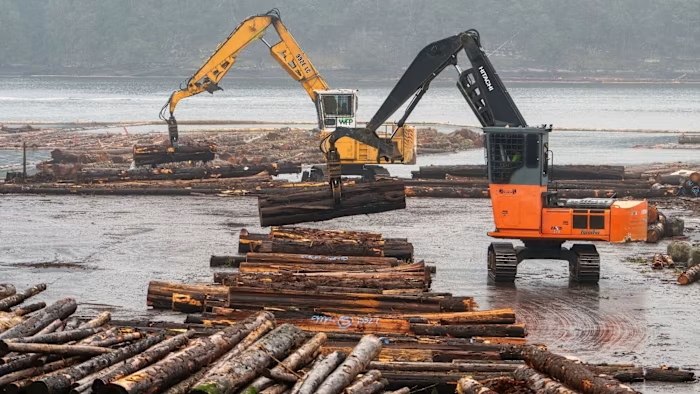
Canada is seeking relief on 50 per cent tariffs on its steel and aluminium sector, 25 per cent on auto as well as tariffs and anti-dumping levies on lumber that over the past 18 months have forced factory closures and job losses.
But as Canada pushed ahead to finalise a deal before the Friday night deadline, some of the country’s provincial premiers — in particular those who have industries bearing the brunt of US tariffs — remained sceptical.
Wab Kinew, premier of Manitoba, told reporters on Thursday that Canada’s Prime Minister Mark Carney practically “begged” premiers to restart selling US alcohol, while Quebec’s Christine Fréchette said a deal was not imminent.
“While Donald Trump’s threats continue to loom over Quebec, my priority remains the same: to protect our workers, our jobs and our businesses, and to avoid an escalation of tariffs,” she posted on X on Thursday.
Canada’s dairy industry has been a common target of Trump, who regards the “supply management system” that supports smaller farms as “discrimination” against the US.
Ontario premier Doug Ford, one of Canada’s most outspoken critics of Trump’s tariffs, which threaten to wipe out the province’s $55bn in auto exports, has been quiet this week due to the sensitivities of the discussions.
The trade negotiations are proving a leadership test for Carney, whose stunning 2025 election victory harnessed Canada’s anti-US sentiment with a defiant agenda to challenge Trump.
But as US tariffs hurt Canada’s economy, Carney has more recently adopted a conciliatory approach by promoting a “Fortress North America” partnership while agreeing to a series of concessions and cutting some retaliatory measures.
This week, Leger, one of Canada’s top polling agencies, reported 56 per cent of Canadians want the federal government to take a hard line with the US, compared with 31 per cent who favour flexibility if needed.
“Canadians are watching what the country gives up, how firmly the government negotiates and, for many, whether the final deal warrants a new political mandate,” said the pollsters.
