


- The proposal represents Spain’s latest effort to advance protection of 30% of its waters by 2030.
- It looks to protect 22,405 square kilometers (8,651 square miles) of marine waters, primarily in the eastern North Atlantic Ocean around the Canary Islands, as well as four sites in the Mediterranean Sea.
- Conservation groups have raised concerns in recent years about the state of Spain’s marine protected areas, highlighting a significant discrepancy between areas designated “on paper” and those that are subject to effective protection.
The Spanish government has launched a consultation process to establish 23 new marine protected areas (MPAs) in Canary Islands waters and the Mediterranean Sea as part of efforts to meet a national commitment to protect 30% of its waters by 2030.
The proposal, put forward by Spain’s Ministry for the Ecological Transition and the Demographic Challenge (MITECO) in July, aims to protect 22,405 square kilometers (8,651 square miles) of marine waters primarily in the eastern North Atlantic Ocean around the Canary Islands, part of a region known as Macaronesia. It also covers areas of the Mediterranean off the coasts of Valencia, Almería, Granada and the Balearic island of Mallorca.
The proposal includes 21 new sites of community importance (SCIs) under the Natura 2000 network. Seventeen of these are in Canary Islands waters covering 2,209 km2 (853 mi2), while four more in the Mediterranean Sea will cover 5,341 km2 (2,062 mi2). In addition, two new special protection areas (SPAs) will cover 14,855 km2 (5,736 mi2) of offshore waters around the Canary Islands.
The plan, the ministry writes in the proposal, “will increase the area of marine waters under Spanish sovereignty or jurisdiction that are protected by 2.08 percentage points, bringing the total to 24.53%.” The proposal is now open for public consultation until Sept. 15.
Natura 2000 SCIs and SPAs are tools established under the Habitats Directive, a key instrument through which the EU has committed to protecting natural habitats threatened by human activity as part of its Biodiversity Strategy for 2030. The proposed areas are intended to protect a range of marine habitats and species.
The 21 SCIs focus on plants and non-avian species of animals, including seagrass meadows (Posidonia oceanica and Cymodocea nodosa), reefs and submarine canyons, as well as areas supporting cetaceans, marine turtles and other species of conservation interest. The two SPAs focus on seabirds, such as the Barolo shearwater (Puffinus baroli) and Bulwer’s petrel (Bulweria bulwerii), as well as important feeding grounds for additional seabirds and other protected species.
“The Canary Islands are in the heart of the Macaronesian waters,” Carlos Mallo Molina, founder of the Canary Islands-based NGO Innoceana and member of the MPAs Canary Islands project, told Mongabay.
According to Molina, the Spanish proposal is a significant milestone towards protecting this area, which contains exceptional biodiversity. “All of that region is a hotspot for whales,” he said. “The islands itself are in the middle of the ocean, so they are almost like giant pinnacles showing up, and there are a lot of sharks, there is seagrass, we have deep corals, we have a lot of species.”

Marine protected areas vs paper parks
To meet its international commitment to protect at least 30% of its seas and oceans by 2030, as set out in the Kunming-Montreal Global Biodiversity Framework, Spain has so far designated marine protected areas (MPAs) covering approximately 240,000 km2 (nearly 92,700 mi2), equivalent to 22.5% of the total area of its waters.
In 2023, the European Commission launched an infringement procedure against Spain for violating the Habitats Directive, deeming the number, size and location of the sites proposed by the country for the Natura 2000 network to be insufficient. That same year, MITECO approved the creation of seven new marine sites within the Natura 2000 network, followed by five more in 2025.
“We think that Spain is in a good direction in terms of designation,” Helena Álvarez, a senior marine scientist at the U.S.-based NGO Oceana, told Mongabay. “The problem comes when you compare the area designated with the areas that have an actual management plan.”
Oceana and other conservation groups have repeatedly raised concerns about the state of Spain’s MPAs, highlighting a significant discrepancy between areas designated “on paper” and those that are subject to effective protection.


According to Álvarez, that discrepancy can be attributed to two things: Delays in adopting management plans for already-designated MPAs; and insufficient protection measures, even in areas where management plans have been put in place, allowing destructive activities such as bottom trawling to continue.
“Sometimes they fish more inside designated Natura 2000 [sites] than outside, which is nonsense in terms of conservation,” she said.
Oceana, together with the U.K.-based NGO ClientEarth, sued the Spanish government in 2024 and again in 2025 over its issuance of licenses that systematically allow bottom trawling in MPAs without carrying out the environmental impact assessments required under EU law. “For us this is a misinterpretation of the Habitats Directive,” Álvarez said.
According to a 2025 study published in Marine Policy, 63% of the area covered by Spanish MPAs in the Mediterranean Sea is not protected strictly enough to effectively safeguard biodiversity.
Álvarez also highlighted Spain’s delay in meeting another target set out in the EU’s biodiversity strategy: Placing 10% of its waters under “strict protection“, meaning that the areas are left undisturbed from human pressures. “Spain is very far” from meeting this target, she said, “At the moment, less than 0.1% of its waters are considered strictly protected.”
According to a report published in January by MPAs Canary Islands, the situation in the Canary Islands is even worse. There are already 39 marine areas linked to the Natura 2000 network within the Canary Islands Marine Demarcation, an area of approximately 486,000 km2 (187,646 mi2), over which Spain exercises jurisdiction, But only 11% of these are actively managed and less than 1% can be classified as “fully protected”.

“They are in the papers, but we are waiting for management plans to be effective and for budgets to be deployed,” Innoceana’s Molina said. The campaigner added that he hopes, after the approval, that the new proposed MPAs will undergo a participatory process to ensure the involvement of various local and national institutions, the private sector and civil society groups.
Mongabay contacted MITECO for comment, but did not receive a response by time of publication.
Under the Habitats Directive, once the Spanish government’s formal consultation period concludes in September, the European Commission will have to approve the designations. Spain will then have six years to develop the corresponding management plans.
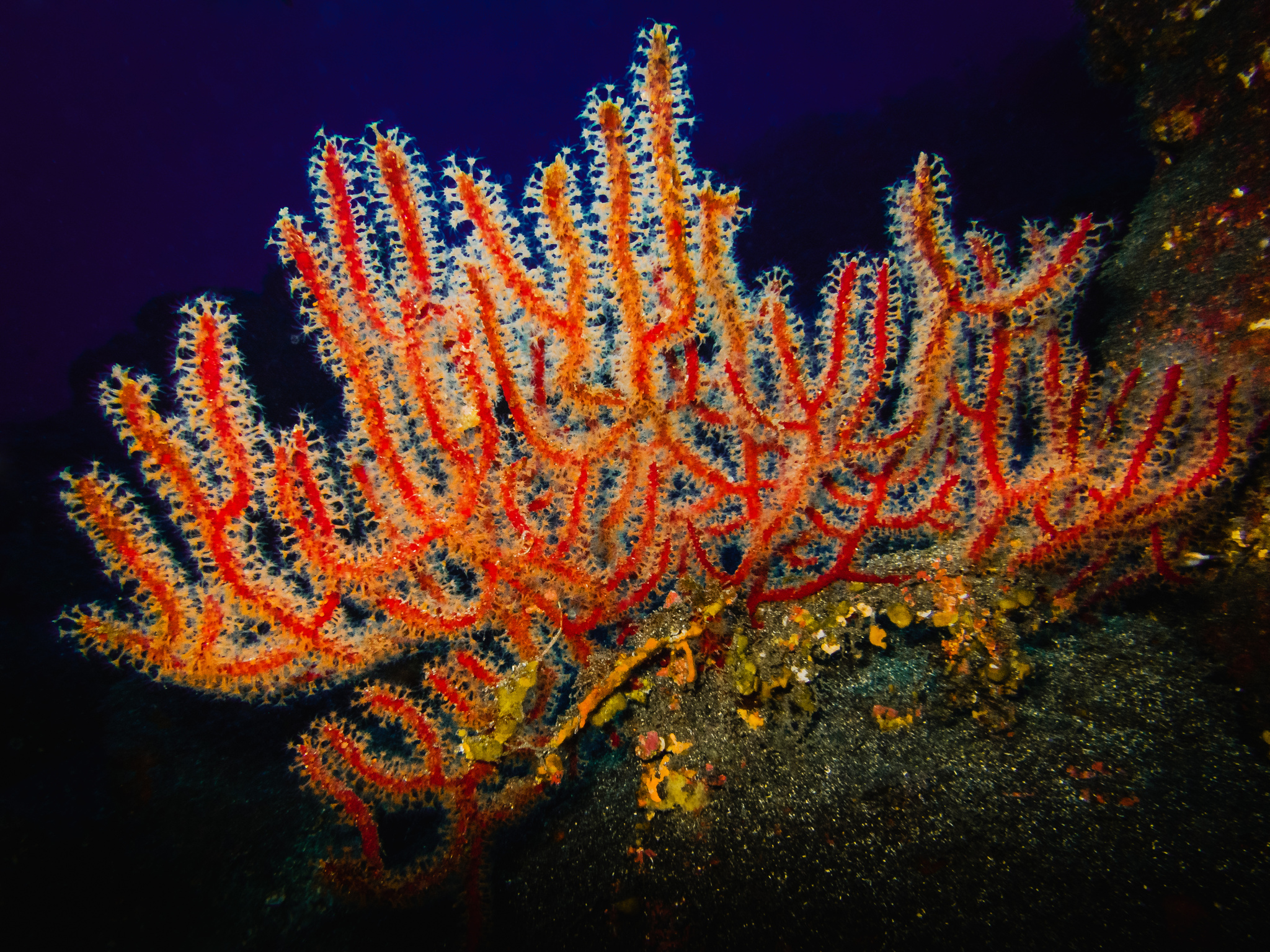
Banner image: Found across the Canary Islands, the scarlet sea fan (Leptogorgia ruberrima) is a soft octocoral that provides shelter and food for many fish and other marine organisms. Image by thorsten72 via iNaturalist (CC BY-NC 4.0).
Azores dodges proposal to overturn no-fishing zones in its giant new MPA network
Citation:
Castro-Cadenas, M. D., Barreiros, M., Bas, M., Ortega, M., Claudet, J., Coll, M., & Sbragaglia, V. (2025). Fishing activities within Spanish marine protected areas in the Mediterranean Sea. Marine Policy, 177, 106686. doi:10.1016/j.marpol.2025.106686
Feedback: Use this form to send a message to the editor of this post. If you want to post a public comment, you can do that at the bottom of the page.

