


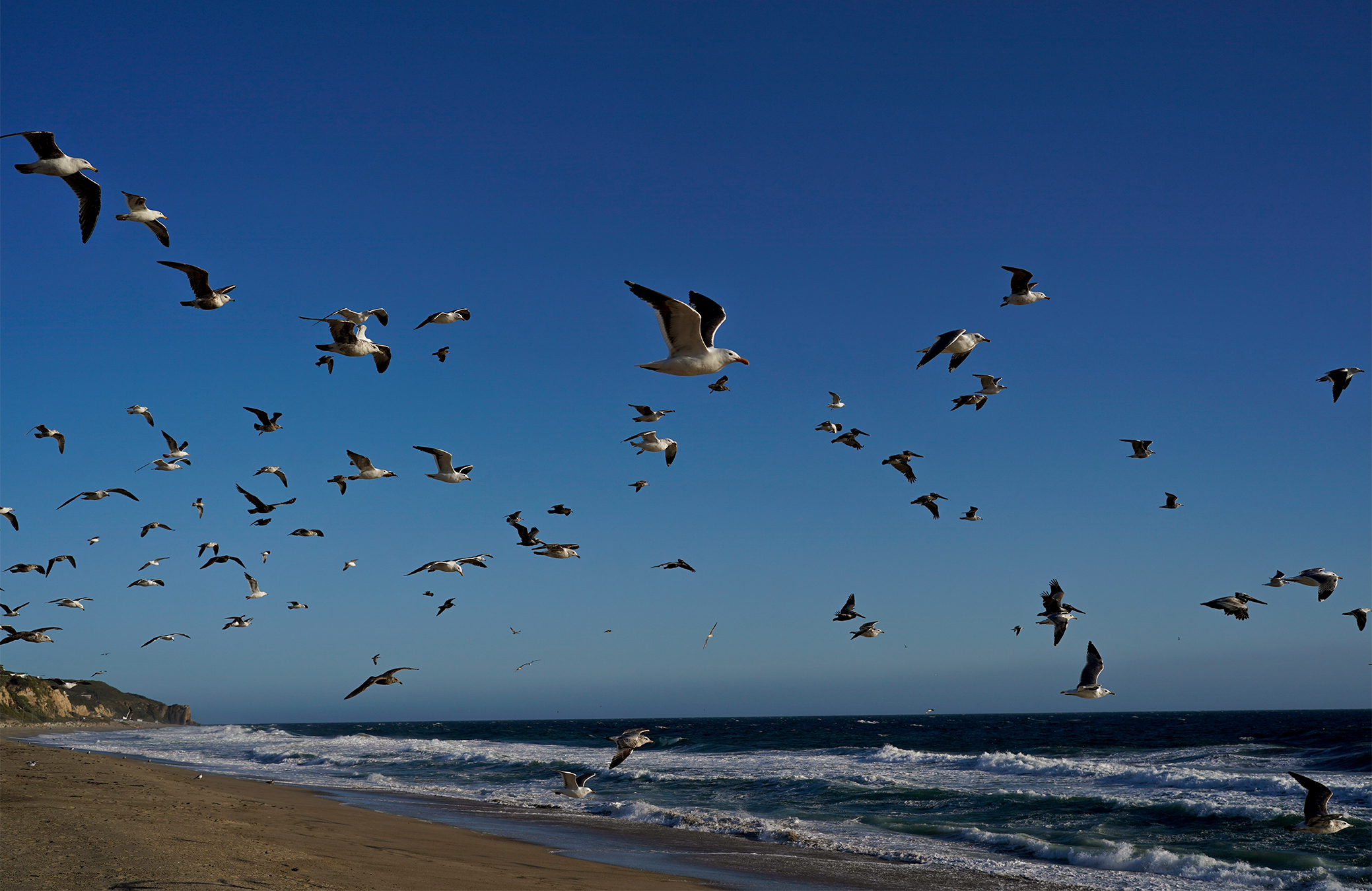
- Seabirds are the most threatened group of birds, with more than 30% at risk of extinction. Migratory seabirds are especially vulnerable.
- Researchers have described six marine flyways used by migratory pelagic seabirds, aerial corridors that cross the national waters of 56 countries; the high seas are used by at least 151 species.
- In March, the U.N. Convention on Migratory Species adopted a resolution on marine flyways, creating a structure for international cooperation on protections.
- Researchers are using seabird tracking data to identify key sites along marine flyways that need protection or mitigation measures against threats.
Arctic terns make the longest migration of any creature on Earth, with some Sterna paradisaea clocking more than 80,000 kilometers (49,709 miles) a year, flying from the Southern Ocean to their breeding grounds in the Arctic — and back. For a tiny bird, weighing less than an iPhone, it’s an astounding feat.
South polar skuas (Stercorarius maccormicki) trace a similar figure eight around the Atlantic Ocean as they move between breeding colonies on Antarctic islands and the Arctic.
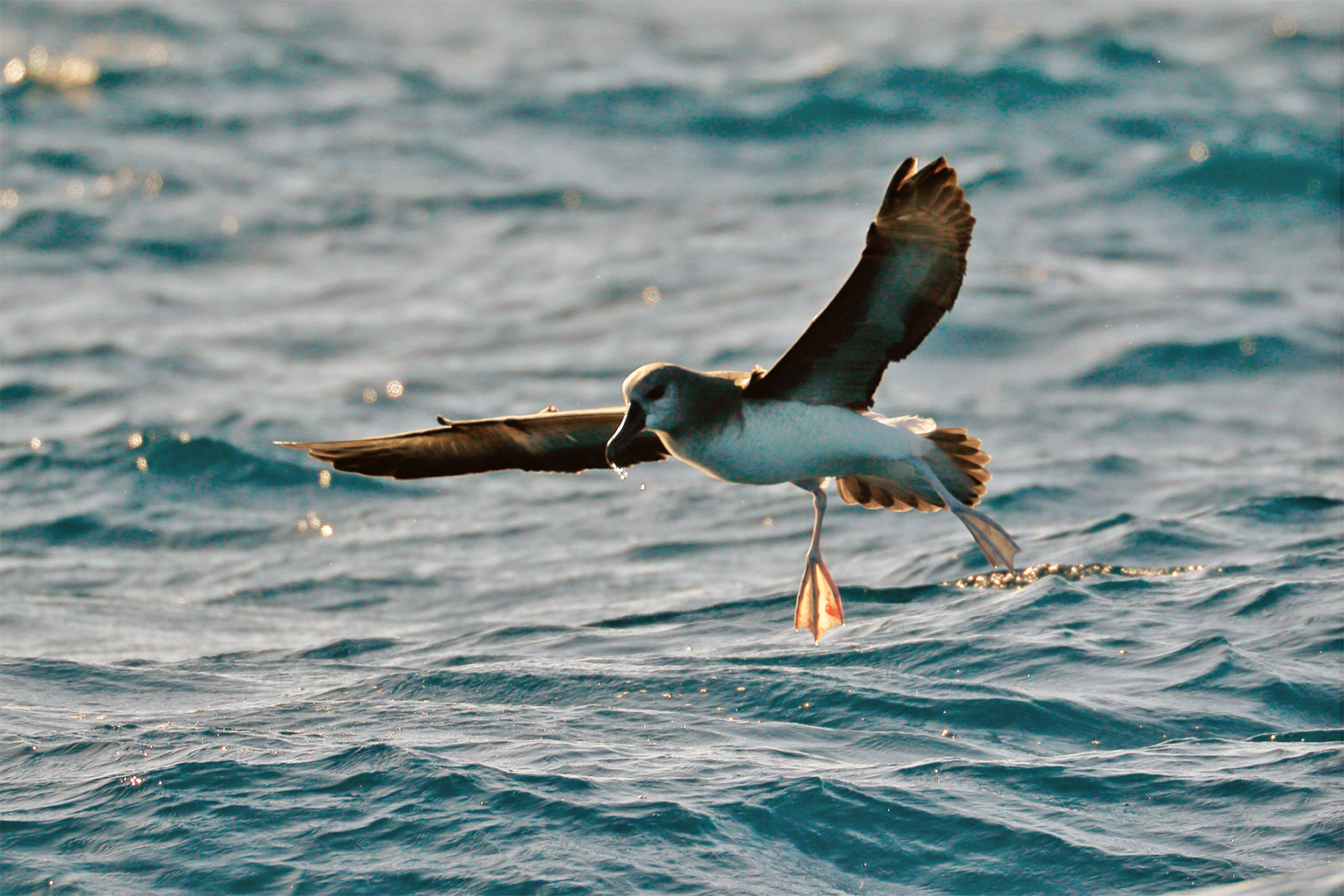
In the Southern Ocean, grey-headed albatross (Thalassarche chrysostoma) breed on South Georgia Island. During the rest of the year, they fly a circle around Antarctica, covering roughly 22,000 km (13,670 mi) in as little as 46 days.
The journeys of these and other migratory pelagic seabirds are almost beyond comprehension, and largely unseen. But with advances in tracking, researchers have realized seabirds fly broadly predictable paths over the open ocean.
Last year, researchers used tracking data to identify six marine flyways that cross the Atlantic, Pacific, Indian and Southern oceans and touch the waters of 56 countries. A team of nearly a hundred were involved, led by researchers from the nonprofit BirdLife International, and their findings were published in the journal Global Ecology and Biogeography.
Seabirds are the most at-risk birds, with more than 30% globally threatened. For migrants, life on the wing is especially perilous. They face myriad threats across multiple jurisdictions in national waters and on the high seas, at their breeding colonies, at stopovers during migration and on the open ocean.
In March, the U.N. Convention on the Conservation of Migratory Species of Wild Animals (CMS) formally recognized marine flyways. Researchers hope the move will bring governments and conservationists together for more coordinated conservation action for winged wanderers.
Figuring out flyways
Flyways are birds’ broadly predictable migratory routes between breeding and non-breeding areas. Decades ago, researchers mapped at least four terrestrial flyways used by shorebirds and raptors that fly over continents and coastal areas. These terrestrial flyways fostered international cooperation and drove investment for conservation.
“On land, since the 1980s, flyways have become a tool for conservation to bring all the different relevant governments and other stakeholders to the table,” Aline Küehl-Stenzel, senior marine policy manager at BirdLife International, told Mongabay in a video call.
For example, the East Asian Australian Flyway (EAAF) Partnership, initiated in 2006, brings together 42 partners, including 18 national governments. In 2021, the Asian Development Bank launched the Regional Flyways Initiative to raise $3 billion for conservation of key sites along the flyway.
“The oceans have been a gap … they’re ‘the new kid on the block,’” Küehl-Stenzel said.
The paths of migratory pelagic seabirds — more than half of all seabird species — have, until recently, been a mystery. These are species that spend most of their lives over the open ocean, often breeding on remote islands, far from human eyes. But the development of tracking technology, including lighter tags with longer battery life, means researchers are now piecing together their journeys.
In 2004, BirdLife International launched the Seabird Tracking Database (originally called Tracking Ocean Wanderers), a centralized collection of data from around the world that now includes at least 169 seabird species.

In their 2025 study, a team led by the organization’s researchers analyzed data from 48 migratory pelagic seabird species — from albatrosses and shearwaters to terns and storm petrels — to delineate six marine flyways.
Some flyways follow prevailing wind and ocean currents. Others link highly productive upwelling sites, which serve as abundant marine buffets, or remote islands where birds gather to breed. A species may travel along an entire flyway, only a section, or use more than one of these aerial routes.
An updated analysis published in March 2026 found at least 151 seabird species use the flyways; nearly 42% of these birds are threatened with extinction.
“With the growth in tracking data that has really come about over the last … 30 years now, we’ve really been empowered to understand more about how animals use the ocean, especially seabirds,” says Lily Bentley, a post-doctoral researcher at the University of Queensland. “Given the effectiveness of the flyways as a policy tool on land … I think it’s really important that we have a similar mechanism for seabirds in the ocean.”
By describing the flyways and key stopover sites, experts can mitigate threats across a species’ entire journey, said Joanne Morten, who was the lead author on the 2025 study and serves as marine science officer at BirdLife International.
“Very few people have the privilege to see [seabirds] in the middle of the oceans, and yet, they are threatened by our activities — and they need coordinated conservation action,” Morten said.
A seabird hotspot in the North Atlantic
Pushing off from Southampton, England in 2017 aboard the RRS Discovery research vessel, Ewan Wakefield and his fellow researchers didn’t quite know what they would find. They were headed for the North Atlantic, specifically to a fracture zone where undersea formations pull bands of warm and cold currents, creating conditions that are unusually amenable to life.
Several researchers, including scientists at Birdlife International and Wakefield, had noticed a constellation of locations around the fracture zone that pointed to sizable seabird aggregations. But no one had been there. Wakefield, then a post-doctoral fellow at the University of Glasgow in Scotland, was hoping to ground-truth the data with on-site observations.
For about two weeks in the summer of 2017, the ship tacked a sawtooth pattern north to south, across a patch of ocean the size of France. On deck, the team scanned air and sea with binoculars, glassing for birds. They also took water samples and other measurements to better understand why seabirds congregate there and how they influenced the ecosystem.
For a biodiversity hotspot, the abundance of life wasn’t immediately apparent, Wakefield said. It’s only if you’ve been at sea before and are accustomed to the usual emptiness that you appreciate the signs of relative plenty, he said: Seabirds wheeling overhead, the regular appearances of dolphins and occasional sightings of rare cetaceans like beaked whales.

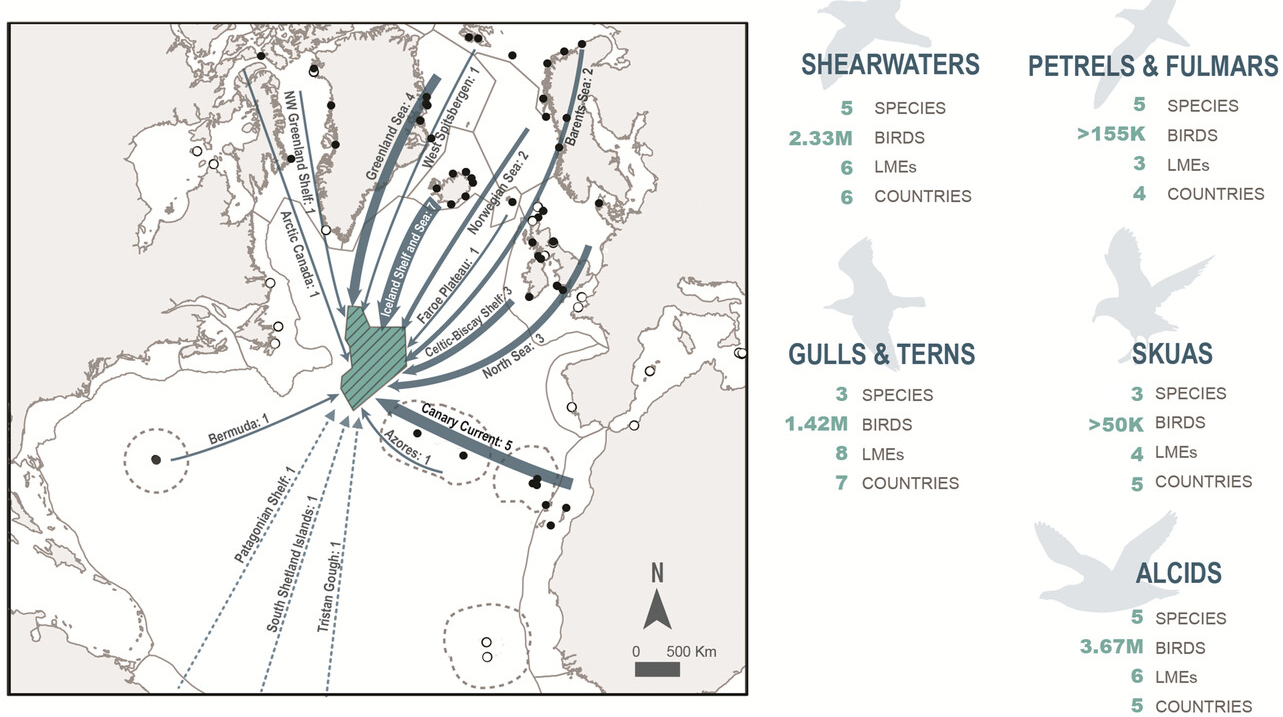
In all, the expedition recorded nearly 7,500 seabirds from 18 species including shearwaters, petrels, gulls, terns and many other groups, and the team published that tally in the journal Progress in Oceanography, with Wakefield as lead author.
Their observations aligned closely with analysis largely drawn from the Seabird Tracking Database. A Conservation Letters study, led by BirdLife International, reported 21 bird species flocking to the area, and estimated their abundance at 2.9 to 5 million, depending on the season. Those birds came from at least 56 breeding colonies in 16 countries.
In 2021, the site was designated as the North Atlantic Current and Evlanov Sea-basin (NACES) Marine Protected Area (MPA). It falls under the OSPAR Convention, also known as the Convention for the Protection of the Marine Environment of the Northeast Atlantic, a European seas management agreement signed by 15 countries.
At 595,000 km² (229,731 mi²), this is the largest MPA outside of Antarctica, larger than the total land of Germany and the United Kingdom combined. It’s also the first High Seas MPA mapped using seabird tracking data, Küehl-Stenzel said — and it also benefits pelagic fish, sharks, whales and other sea life.
“Seabirds really guided us to this place, but there’s coupling throughout the food chain, from the seamount up to the different food levels,” Küehl-Stenzell said.

Identifying key sites along the flyways
Now, there’s a renewed push to identify priority areas for conservation, with a global commitment to protect 30% of oceans by 2030 under the U.N. Convention on Biological Diversity and the High Seas Treaty, in effect since January.
“[T]he big question is, ‘so where are those important marine areas?’” Küehl-Stenzel said.
To understand high-priority sites within flyways — for example, breeding colonies, key feeding grounds or the presence of rare or endemic species — researchers at BirdLife International are using seabird tracking data to identify key biodiversity areas (KBAs). They plan to map these sites across all six marine flyways by 2030.
One place they’re looking is the South Tasman Sea between Australia and New Zealand, where a volcanic labyrinth creates an undersea world teeming with life. This attracts some of the highest densities of seabirds in the world, with more than 150 species recorded.
And it’s not just birds. Humpback and blue whales, 66 shark and five sea turtle species, as well as other marine megafauna gather in these waters.
Key biodiversity areas have already been identified in parts of the Tasman Sea. Now with the High Seas Treaty in effect, researchers are using seabird tracking data to find valuable sites outside of national jurisdictions.
“We want to have a really good evidence base to identify areas that are important, which can then be handed to decision-makers and policymakers and planners,” said Bentley, who is working with BirdLife International researchers on the project. Those areas could be formally protected, or other mitigation measures could be put in place, Bentley said.

Mitigating threats along the flyways
Globally, longline fisheries are one of the greatest threats to seabirds, with albatrosses, petrels and other seabirds, eager for a meal, often ending up snagged by baited hooks.
By overlaying seabird tracking and Global Fishing Watch data (showing vessel’s commercial fishing activity), researchers are pinpointing high risk areas for seabirds, and working with stakeholders on mitigation, said Tammy Davies, marine science coordinator at BirdLife International.
“That can then tell you, ‘Okay, this is a high-risk area, and these are actually the flag states that have a great responsibility for the seabird risk within this area,’” Davies said.
The good news is that there are low-cost mitigation measures that are especially effective when used in combination: Fishing at night rather than during the day, using weighted hooks, and affixing colored streamers to lines, called tory lines. One study estimated that using two out of three of these mitigation measures reduces seabird bycatch by more than 90%.
Invasive predators, like rats and cats, also pose a significant threat to seabirds, particularly for island-breeding colonies. It’s another threat that highlights the need for a flyways approach, Bentley said.
“If you’ve got invasives on your island and you’re spending heaps of money and time controlling those predators — which might be killing chicks and eggs — but then all of those birds are flying off and immediately getting killed in an unregulated longline fishing industry … it’s like all of that investment is kind of for nothing. That’s why we need to have this coordination across the cycle,” Bentley said.
However, some threats are hard to tackle, requiring broad international cooperation even beyond the flyways scale.
“Marine protected areas and other kinds of protection mechanisms, like flyways … can often go a long way to protecting against a lot of threats like fisheries, but one thing they often don’t do well is plastics, because plastics don’t respect man-made borders,” said Jennifer Lavers, a researcher at Adrift Lab, a research cooperative.
Climate change is also having dramatic impacts on seabirds in ways researchers are only beginning to understand. It’s well known that seabirds are sensitive to large-scale climatic changes, like air and ocean temperatures, Lavers said. But more recently, the catastrophic impacts of marine heatwaves — intense spikes in ocean temperatures — have become apparent. For example, in Australia, marine heatwaves killed an estimated 629,000 seabirds in 2023-2024, according to a study led by Lavers.
She also recently published research documenting increasing wildfires burning on critical island breeding colonies, destroying a standard belief that islands are havens.
“There really is that perception that, like, ‘we can stuff things up on the mainland, but we’ve got our islands’ — so seabirds are in some sense a little bit protected,” Lavers said. “It turns out that actually, they’re really vulnerable.”

An explosion of tracking data
With advances in tracking technologies, researchers are learning new things about seabird migration and threats along the flyways.
“An unwritten rule of tracking sea birds … is they always do something more extreme than you thought they were going to do,” Wakefield, now at the British Antarctic Survey, said. “They go further. They go to more places. They go faster.”
Much of the early seabird tracking data was on larger birds like albatrosses, but with technological advances, including lightweight, solar-powered GPS tags, researchers can now track smaller birds.
Some of these tags can transmit highly accurate position data via satellite for months or years. That’s a big change from archival tags, which store data “onboard,” meaning the animal had to be recaptured to download the data. But, for now, these next-gen satellite tags are expensive.
Still, the explosion of seabird tracking studies in recent years has been phenomenal, Wakefield said. Combining tracking with other kinds of data and analysis — for example, “biologgers,” small electronic devices that record animal movements and environmental data — gives a fuller picture of where seabirds are going and why.
“[T]he jigsaw is now coming together — and tracking is central to that,” Wakefield said.
Banner image: Many think of wildlife corridors as connected landscapes, but across the globe, animals on land, in freshwater, in the sea and in the skies need to safely move to find food, water, to find a mate and reproduce. Flyways are aerial avian corridors. Image by AP Photos/Jae C. Hong.
Ruth Kamnitzer is a freelance journalist living in southeast British Columbia. She writes about biodiversity, climate change and people working hard to make the world a better place.
Half of seabirds are declining. Protecting marine flyways could help save them
How saving birds protects the planet: Interview with author Scott Weidensaul
Rachel Carson’s ‘Silent Spring’ 60 years on: Birds still fading from the skies
Citations:
Egevang, C., Stenhouse, I. J., Phillips, R. A., Petersen, A., Fox, J. W., … Silk, J. R. (2010). Tracking of Arctic terns Sterna paradisaea reveals longest animal migration. Proceedings of the National Academy of Sciences, 107(5), 2078-2081. doi:10.1073/pnas.0909493107
Morten, J. M., Carneiro, A. P., Beal, M., Bonnet‐Lebrun, A. S., Dias, M. P., Rouyer, M. M. … Davies, T. E. (2025). Global marine flyways identified for long‐distance migrating seabirds from tracking data. Global Ecology and Biogeography, 34(2), e70004. doi:10.1111/geb.70004
Morten, J. M., Küehl‐Stenzel, A., Baker, G. B., Taylor, G. A., Garcia Alonso, V. A., Jones, V. R., … Davies, T. E. (2026). Using the marine flyways concept to accelerate ocean conservation. Journal of Applied Ecology, 63(3). e70339. doi:10.1111/1365-2664.70339
Wakefield, E. D., Miller, D. L., Bond, S. L., Le Bouard, F., Carvalho, P. C., Catry, P., …Matthiopoulos, J. (2021). The summer distribution, habitat associations and abundance of seabirds in the sub-polar frontal zone of the Northwest Atlantic. Progress in Oceanography, 198, 102657. doi:10.1016/j.pocean.2021.102657
Davies, T. E., Carneiro, A. P., Tarzia, M., Wakefield, E., Hennicke, J. C., Frederiksen, M., … Dias, M. P. (2021). Multispecies tracking reveals a major seabird hotspot in the North Atlantic. Conservation letters, 14(5), e12824. doi:10.1111/conl.12824
Henry, L., Cleland, J., Gebruk, A., Schubert, R., Penna, A. D., Gaube, P., … Roberts, J. M. (2026). Mesoscale eddies in the subpolar North Atlantic: Their ecological importance and conservation significance. Progress in Oceanography, 103760. doi:10.1016/j.pocean.2026.103760
Da Rocha, N., Oppel, S., Prince, S., Matjila, S., Shaanika, T. M., Naomab, C., … Crawford, R. (2021). Reduction in seabird mortality in Namibian fisheries following the introduction of Bycatch regulation. Biological Conservation, 253, 108915. doi:10.1016/j.biocon.2020.108915
Dias, M. P., Martin, R., Pearmain, E. J., Burfield, I. J., Small, C., Phillips, R. A., … Croxall, J. P. (2019). Threats to seabirds: A global assessment. Biological Conservation, 237, 525-537. doi:10.1016/j.biocon.2019.06.033
Lavers, J. L., Fulton, W., Stuckenbrock, S. … Bond, A. L. (2026). Estimating the total mortality of seabirds following a marine heat wave. Conservation Biology. e70273. doi:10.1111/cobi.70273
Steel, A. C., Munro, G. … Lavers, J. L. (2026). From the sub-Antarctic to the tropics, five island biodiversity strongholds threatened by wildfire. Biological Conservation, 318, 111859. doi:10.1016/j.biocon.2026.111859
FEEDBACK: Use this form to send a message to the author or editor of this post. If you’d like to post a public comment, you can do so at the bottom of the page.

