


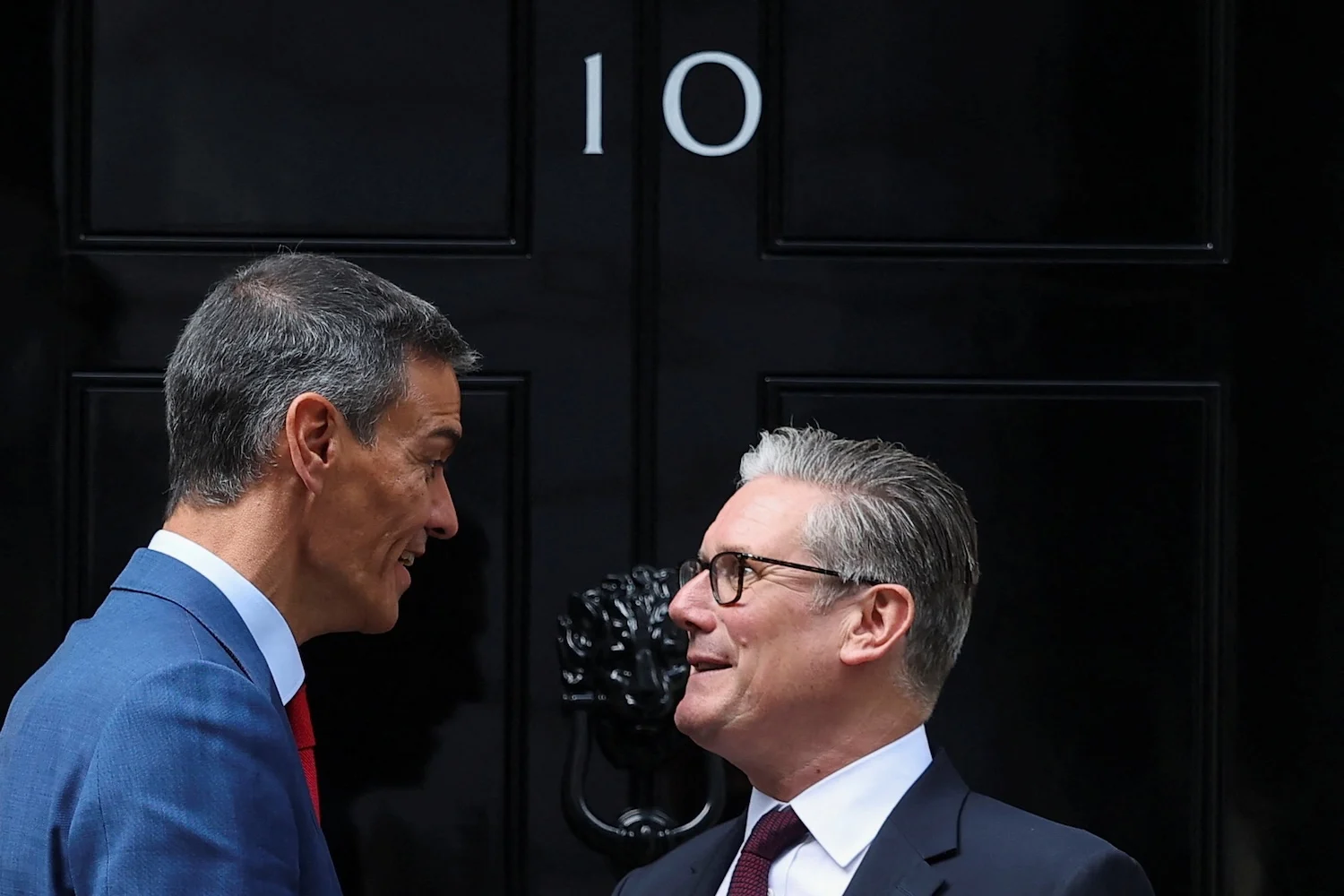
Last month, British Prime Minister Keir Starmer resigned from his post and was replaced by Andy Burnham, the former mayor of Greater Manchester. Starmer’s downfall was precipitous and embarrassing. He held office for less than two years after being elected in a landslide 2024 vote that saw his Labour Party oust the long-ruling Conservatives.
Starmer’s fate contrasts starkly with that of his Spanish counterpart and ideological peer, Prime Minister Pedro Sánchez. Christened by the New Statesman as “Europe’s left-wing icon,” Sánchez recently entered his eighth year in office and is gearing up for reelection next year. He has weathered the COVID-19 pandemic; the surge of the far-right Vox party; corruption scandals involving members of his own family; and a host of calamities, including some of the worst wildfires in Spanish history and an immigration crisis that last month saw some 70,000 people storm Ceuta, a Spanish enclave in northern Morocco.
Last month, British Prime Minister Keir Starmer resigned from his post and was replaced by Andy Burnham, the former mayor of Greater Manchester. Starmer’s downfall was precipitous and embarrassing. He held office for less than two years after being elected in a landslide 2024 vote that saw his Labour Party oust the long-ruling Conservatives.
Starmer’s fate contrasts starkly with that of his Spanish counterpart and ideological peer, Prime Minister Pedro Sánchez. Christened by the New Statesman as “Europe’s left-wing icon,” Sánchez recently entered his eighth year in office and is gearing up for reelection next year. He has weathered the COVID-19 pandemic; the surge of the far-right Vox party; corruption scandals involving members of his own family; and a host of calamities, including some of the worst wildfires in Spanish history and an immigration crisis that last month saw some 70,000 people storm Ceuta, a Spanish enclave in northern Morocco.
The two leaders’ divergent paths are striking considering that Sánchez leads a very fragile coalition government; his Spanish Socialist Workers’ Party (PSOE) does not even hold the largest number of seats in the Congress of Deputies, Spain’s lower house of parliament. That distinction belongs to the conservative People’s Party, or PP. In the 2024 U.K. elections, on the other hand, Labour won 411 out of 650 seats in the House of Commons, giving Starmer one of the largest working majorities in British history, which he then failed to exploit. And while both leaders must contend with separatist parties, Scottish separatists are a picture of loyalty compared to the Catalans.
Much about Sánchez’s and Starmer’s political fates can be gleaned from the state of their respective economies. Fueled by a post-pandemic tourism surge, Spain has become Europe’s fastest-growing economy, with growth reaching 2.9 percent in 2025, far outpacing the eurozone average of 1.5 percent. In 2024, the Spanish economy expanded by almost 4 percent, leading the Economist to rate Spain as the world’s top rich economy for that year. Britain, on the other hand, has had a harder time rebounding from the pandemic. Compared to Spain, economic growth in Britain has been lackluster, increasing to 1.3 percent in 2025, up from 1 percent in 2024.
But there is more to the story. For starters, historical forces shaped the political fortunes of Sánchez and Starmer. Traditionally one of Europe’s most politically explosive environments, Spain has enjoyed remarkable stability in recent decades. Since the introduction of a new democratic constitution in 1978 that ended 40 years of military dictatorship, Spain has had only seven leaders, with an average stay in office of six years. By contrast, Britain, a bastion of political continuity in the postwar era, has become ungovernable in recent years. Since the 2016 Brexit referendum, six prime ministers have been sworn in. One of them, Liz Truss, was in office for only 49 days.
Ideological cohesion within the left is another issue. Sánchez’s leftist coalition is anchored on two main parties—the PSOE and Sumar, itself a multi-party electoral alliance of as many as 15 progressive parties. But there is very little daylight among them on the major issues—they all support immigration and European integration and are fiercely opposed to the U.S.-Israeli war on Iran. Despite ruling as a single entity, meanwhile, Britain’s Labour Party seems incapable of speaking with one voice, much less acting in unison. A case in point is immigration, which is tearing the party apart. As he tried to deal with a challenge from the right, Starmer took a hard line, claiming last year that immigration has turned Britain into “an island of strangers.” That remark, for which he has expressed regret, dismayed many members in his party.
The war in Iran also exposed significant fault lines within Labour. Starmer attempted to tread a delicate balance on the conflict by allowing U.S. President Donald Trump to use U.K. bases only for “defensive” purposes. That position stood in stark contrast to Sánchez’s decision to fully bar the United States from using jointly operated Spanish-U.S. military bases in Spain to fight the war. But Starmer’s more cautious approach did not do him any favors, instead creating considerable consternation within Labour’s progressive wing.
Ultimately, it was their capacity to lead and survive (or not) that made the biggest difference between Sánchez or Starmer. This is also the realm where Burnham and other left-wing leaders—British or not—can learn the most from Spain’s prime minister. As The American Prospect put it, Labour (under Starmer) had “everything going for it except leadership, vision, and nerve.” The incongruity with Sánchez could not be starker. His time in office is a masterclass in what it takes for a left-wing politician to succeed in a hostile environment.
Much has been made of Sánchez’s capacity to lead with conviction. Among his core beliefs is that leftist leaders cannot succeed by emulating their right-wing counterparts. (Starmer’s waffling on immigration might be a case in point.) But not enough has been said about Sánchez’s audacity, which I previously detailed in the New York Times.
Sánchez became prime minister in 2018 by staging a political comeback unlike any other in contemporary European politics. In 2016, after a disastrous loss in that year’s general election, followed by his resignation from the Congress of Deputies, Sánchez regained control of the PSOE via a primary election in which he ran against his party’s establishment. He then persuaded the PSOE to organize a no-confidence vote against then-Prime Minister Mariano Rajoy of the People’s Party, who was embroiled in a flurry of political scandals. Sánchez, who at the time was not a sitting member of parliament, emerged as Spain’s next leader. It was the first time in Spanish history that anyone had reached power by removing a sitting prime minister.
Sánchez has governed with the confidence of someone who was handed an electoral mandate. Among other policy accomplishments, he has increased the minimum wage by some 60 percent; reformed labor laws to protect women and LGBTQ+ people from workplace discrimination; enacted Europe’s most generous immigration policy (including amnesty to some 500,000 undocumented workers earlier this year); removed former dictator Francisco Franco’s remains from state property; and enacted a reparations law to bring some measure of accountability to Franco’s victims.
Sánchez’s foreign policy has been just as bold. Before becoming the global face of opposition to the Iran war, Spain was the only NATO member to oppose an increase in military spending and to openly confront Washington on its tariffs. Sánchez was also the first major European leader to label the war in Gaza as genocide and one of the first to recognize Palestine as a state. These policies have made Sánchez the darling of progressives abroad while boosting his popularity at home, which in recent months has been hurt by a web of corruption scandals involving his wife and brother. The controversies have led the opposition to call for early elections and may put Sánchez’s reelection in doubt.
It’s an open question whether Burnham can overcome the structural forces undermining political stability in Britain, many of them set in motion by Brexit. Not surprisingly, some political forecasters have already predicted his failure. But at least when it comes to leadership, there are reasons to believe that he might fare better than his predecessor.
For one thing, there are echoes of Sánchez’s audacity in Burnham’s rise to power. Like Sánchez, Burnham previously resigned from parliament after failing to achieve the goals of leading his party and country. But he managed to reinvent himself away from the spotlight and, with the help of a skillfully plotted comeback, was able to get party insiders—rather than the electorate—to put him in office. Burnham resigned from his job as mayor of Greater Manchester only last month so that he could run for a parliamentary seat and then replace Starmer. That was in no small measure an act of political opportunism; as recently as last year, Burnham said that he was not interested in becoming prime minister. But he quickly changed his mind after dozens of Labour legislators declared their desire for new leadership and pledged to support him.
Burnham’s capacity to lead is also enhanced by his background. Unlike Starmer, whose appeal rested on the perception that he was not a career politician, Burnham, like Sánchez, has made politics his career. Burnham is also a party man, having been a central figure in Labour for decades. He can draw on this experience to maneuver the various factions within the party and keep potential challengers at bay.
Luckily for Burnham, his predecessor gave him the gift of an early departure. Britain’s next elections are not expected until August 2029, which gives him plenty of time to try and right the ship. As he attempts this feat, the so-called “King of the North” would do well to look south for survival strategies.
