


- Mongabay interviewed Francisco Hernández Cayetano, president of the Federation of Ticuna and Yagua Communities of the Lower Amazon, about substance abuse problems affecting Ticuna youth.
- He says many youth are addicted to drugs and alcohol, which they picked up while working as coca harvesters for drug traffickers due to a lack of alternative employment options.
- The arrival of narcotraffickers, as well as illegal miners, has also led to deforestation and water pollution in Peru.
- In this interview with Mongabay, Hernández describes efforts to bring Ticuna leaders from the Amazon’s tri-border area together to discuss solutions to their shared problems.
Francisco Hernández Cayetano, president of the Federation of Ticuna and Yagua Communities of the Lower Amazon (FECOTYBA), is raising the alarm about the latest threats related to drug trafficking in the Amazon’s tri-border area.
Living along riverbanks and lowland forests in the remote area where Peru, Colombia and Brazil meet, the Ticuna and Yagua people find themselves in a hotspot for crime — and it is embedding in their communities. Tri-border areas in the Amazon often have a weak state presence that allows drug traffickers and other criminal groups to move drugs, gold and timber freely. As a 2024 report by Crisis Group, an independent organization, revealed, criminal activities in these areas can bring insecurity, violence and environmental damage to Indigenous peoples and their territories.
“Our concern is very strong because most of the communities — almost 60 to 70% of the forests — are deforested due to drug trafficking,” Hernández tells Mongabay. “This causes certain problems, for example, children working in the [coca] fields, as well as women. It’s hitting us hard, especially the Ticuna youth.”
Hernández, who comes from a Ticuna community known as Cushillo Cocha in the lowland rainforest region, says that the arrival of drug traffickers and illegal miners has brought social instability, deforestation and the contamination of waterways by chemicals used for mining and cocaine production.
It has also created the conditions for a serious substance abuse problem among Indigenous youth. Drawn to coca fields for work, Ticuna children start smoking, taking drugs and drinking alcohol. He says the problem has been exacerbated by a lack of alternative employment opportunities, which has left families with little choice but to take their children to pick coca for drug traffickers.
“It’s become somewhat institutionalized; it’s almost normal for families, and that worries us,” he says.
In this interview with Mongabay, Hernández highlights the impact of these threats, as well as efforts to bring Ticuna leaders from all three countries together to discuss solutions to their shared problems. This is critical due to a lack of state presence in these remote areas, he says.
The interview was translated from Spanish and edited for clarity.
Mongabay: What are the main threats affecting Ticuna and Yagua communities at present?
Francisco Hernández Cayetano: Like in all regions of Peru, we are threatened by drug trafficking and illegal mining, and there is a lot of deforestation caused by them. Our concern is very strong because most of the communities — almost 60 to 70% of the forests — are deforested due to drug trafficking. And nowadays, illegal mining is also becoming quite prevalent.
This causes certain problems, for example, children working in the [coca] fields, as well as women. All of this leads to children smoking, using drugs and drinking alcohol at a young age. It’s hitting us hard, especially the Ticuna youth.
This is a problem, and deforestation is also causing our rivers to dry up and pollute our streams. Most of our streams are small and narrow, where maceration processes [the breakdown of organic materials] happen. All the chemicals they use in the process end up in these streams. This scares away the fish that are the food source for our people, the Ticuna community. This worries us tremendously because it’s devastating everything. It’s affecting the people, nature and the fish. It’s a huge problem we’re facing today.

Mongabay: Are the Ticuna youth leaving the communities, or are the substance problems happening inside the communities?
Francisco Hernández Cayetano: It’s in the community. In almost all the communities. And of course, this has a huge impact on families and the community in general.
It’s become somewhat institutionalized; it’s almost normal for families, and that worries us because we want the [criminals] to leave, and the State has also abandoned this part of the border. It further complicates the situation because if the State invested more in short, medium and long-term productive projects, then things would change.
It’s very difficult to find work or legal economic opportunities in that border area. The only option families have is to take their children to the [coca] harvest. It harms their schoolwork, and they learn a lot there because they’re surrounded by adults who are drinking, using drugs and getting high. There are things happening that go against children’s rights.
I see that the children, the parents, the families are really suffering. I believe the basic conditions of all the communities should be improved.
Given this situation, we, as the Ticuna people, who live here in Colombia, Brazil and Peru, have proposed a cross-border Ticuna congress in our community a month ago. The purpose of this congress was to review the conditions between the countries. We are working together to unify ideas and present the agreements we have reached to each state.
I believe that the only way to consolidate our needs and find solutions is through dialogue. The situation has been somewhat difficult for us because the Peruvian side is a bit complicated, while Brazil is somewhat more advanced, and Colombia is somewhat [advanced] as well. Unfortunately, the Peruvian side is almost completely inactive.
Therefore, through this collaboration among our communities from Brazil, Colombia and Peru, we have reached several agreements. Throughout this year, we will be taking the agreements to the Parliament of Brazil, the Parliament of Colombia and the Parliament of Peru to see how the state can guarantee our basic needs, which we can consolidate in each community in our area. We have already held the assembly, and now, we need to develop our roadmap, because we have created a Ticuna cross-border platform, made up of 18 people: Six from Colombia, six from Peru and six from Brazil.
We have to meet at the end of August to plan our roadmap and see how we can properly register the platform in Brazil, Colombia and Peru, so that it becomes more legally compliant.
Mongabay: You also mentioned that the drug traffickers and illegal miners have deforested forests inside your communities. Do you know who is responsible?
Francisco Hernández Cayetano: Today, we are seeing illegal mining coming in from the Atacuari River area. Drug trafficking is linked to all sorts of illegal activities. It has deforested most of our Ticuna community’s forest. These are mostly people from Colombia, and also people from the high Andes who have come from the Peruvian highlands. They are the ones who have deforested.
The Ticuna people themselves don’t do the deforestation; it’s outsiders who come to do these illegal activities in this part of the mountain.
The Comando Vermelho (CV) and dissident factions of the Revolutionary Armed Forces of Colombia (FARC), and a lot of other people, are involved in these activities. In this part of the border, we find all sorts of things. It’s a bit complicated. We are told that the CV group is there and that the FARC dissidents are there. But since there are a lot of people moving around in this area, we don’t know who they are; we can’t differentiate, but they are there.

Mongabay: Ticuna communities form part of the Yavari-Tapiche Territorial Corridor initiative, which supports the titling and protection of reserves for Indigenous Peoples in Isolation and Initial Contact (PIACI) across a 16-million-hectare (39.5-million-acre) tropical forest region across Peru and Brazil. The challenges your communities face may be able to tell us a lot about what the PIACI might be experiencing. What is your relationship with the PIACI and how might the threats you have described impact them?
Francisco Hernández Cayetano: Just two years ago, we began fighting for the situation of the corridors, and as part of that, we created a platform in ORPIO [the Regional Organization of Indigenous Peoples of the East] called the PIACI Platform. Its purpose is to coordinate efforts and develop a roadmap to determine how we can protect our PIACI brothers and sisters. That’s what we’re currently working on.
Our responsibilities include several things, such as establishing sanitary cordons, protecting the forests within the corridors, the ravines and the rivers. We’re taking various actions, and we also traveled to Lima to visit all the relevant public institutions so they understand the situation of our PIACI brothers and sisters. As a federation, we’re raising awareness of their plight so that [contacted] communities and the government itself will make promises to [protect voluntarily isolated peoples].
We fully understand their circumstances. That’s why we do awareness-raising work in some [contacted] communities. Not all of them, because they’re far away. Without a budget, it’s difficult to reach some communities. But we manage to make them understand that, please, we have to protect [voluntarily isolated peoples]. We mustn’t deforest their lands. We mustn’t allow miners or coca growers to enter. No way.
But while we try to get the message across, another group comes along and spreads misinformation. They go to the communities and claim that what we’re doing to protect them is a lie. That we don’t see [voluntarily isolated peoples], that they’re being deceived, that we just want to take over their territories to control them.
But honestly, we don’t do that. On the contrary, we distribute information and copies of newsletters from ORPIO, so the community can understand. But even so, there are groups of people who have paid an organization called ONAJECPIN [National Organization of Special Justice for Indigenous, Native and Peasant Peoples], an institution that has been spreading misinformation to the communities. This has been a hard blow for us, and they have even filed complaints against us for informing the communities.
They don’t want people to know [about the PIACI], because there’s timber and gold in their area. They don’t want to lose that. There are groups of businesspeople who have been doing this behind our backs. We’ve had a serious problem with them. We’re trying to find ways for the communities to understand, but due to a lack of basic necessities, it’s difficult to make them fully understand because [ONAJECPIN] are already there, bringing things to the communities. We can’t confront them because they have more resources, and we have almost nothing. This has been going on for the last two years.
And we even made it known to the communities that this organization was anti-PIACI, anti-Indigenous people. So, we filed a complaint with the Ombudsman’s Office, informing them that these groups do not represent us. They are illegally entering our communities, deceiving and defrauding them. But within a week, we received complaints because the Iquitos Ombudsman’s Office had contacted them, as they have a very strong connection. That’s why we have a tremendous distrust of the Ombudsman’s Office. They filed complaints against us.
We’re still looking into the situation, but nowadays, the [Ticuna] communities have almost realized that what we’re doing is right, while [ONAJECPIN] were doing the wrong thing by entering the communities, deceiving and defrauding them. I think we’ve had some success in that regard.
[The National Organization of Special Justice for Indigenous, Native and Peasant Peoples (ONAJECPIN) declined to speak to a non-Peruvian reporter.]

Mongabay: Experts have predicted the arrival of a very strong El Niño — a climate phenomenon that causes changes in rainfall and temperature patterns — later this year. How might drought or other climate changes exacerbate the issues the community already face?
Francisco Hernández Cayetano: Two years ago, we had the worst drought ever seen in our Amazon. It was a terrible drought — many fish died and the elderly drank from streams where fish were contaminated, which caused stomach problems. We want to install potable water in the communities, because without it, we can’t do anything, but unfortunately we haven’t accomplished much.
We’ve made several appeals [to the government], but no one has responded. We’ve tried to find a way for our society to see that the Indigenous communities, the children and the elderly are suffering because of the water issue. No one has responded. This upcoming drought, hopefully it won’t be too severe.
Mongabay: What are the main health issues you are seeing in the communities?
Francisco Hernández Cayetano: Fevers, headaches, flu, stomach infections and other problems. There is also a big malaria issue.
During the last drought, we had problems getting the sick out quickly; it was complicated. They had to walk for hours. We had many complications because we had never seen anything like it. We had never had the Amazon dry up, nothing like it, never. It’s the only time we’ve seen anything like this in the 21st century.
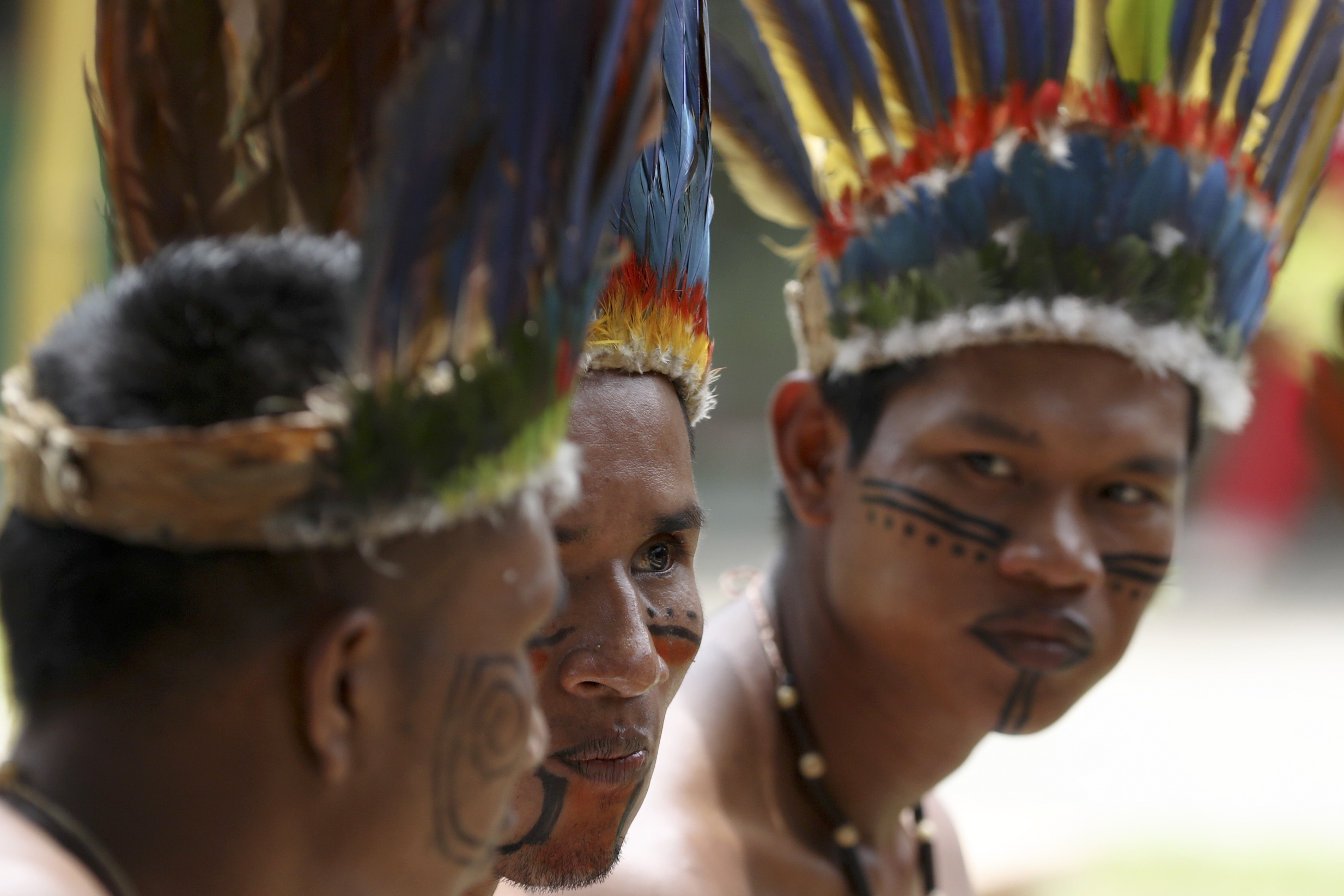
Banner image: Representatives of the Huitoto and Ticuna indigenous communities sit outside the room where leaders of several South American nations that share the Amazon are meeting, in Leticia, on Colombia’s Amazon river border with Brazil and Peru. Image by AP Photo/Fernando Vergara.
Report finds 226 Indigenous land defenders in Peru at risk of violence
On Peru’s border, the Tikuna tribe takes on illegal coca growers

