


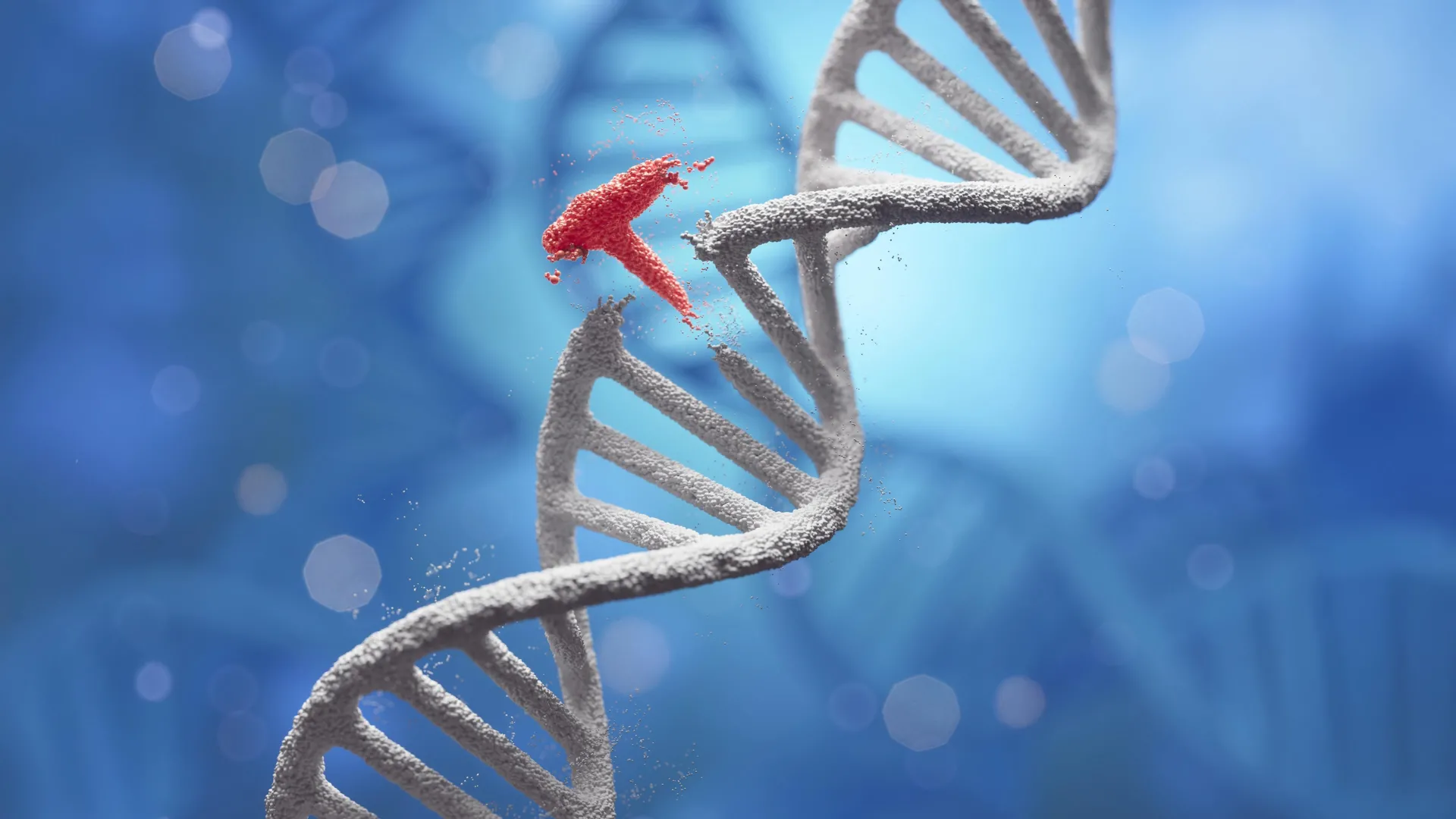
DNA consists of long molecular chains that carry the genetic instructions needed for life. In genetic engineering, researchers cut DNA at carefully chosen locations and connect those pieces with other DNA sequences. This process supports a wide range of applications, including improved crop breeding, treatments for genetic diseases, and the creation of animal models used in drug development.
To efficiently connect short pieces of DNA, scientists rely on overhanging sequences called sticky ends. These exposed sections help DNA fragments bind to one another. Producing the right sticky ends, however, requires highly precise cutting at specific locations, something existing technologies do not always handle well.
Researchers in Japan have now developed a method that uses silver nanoparticles to cut and reconnect DNA at targeted sites. The technique produced DNA assembly efficiencies two to five times higher than those achieved with conventional restriction enzyme methods. The findings were published in Nucleic Acids Research.
Limitations of Conventional DNA Assembly
Standard methods for assembling long DNA molecules typically use restriction enzymes to make cuts and T4 DNA ligase to connect the resulting fragments. Restriction enzymes, however, can only recognize and cut certain DNA sequences. They also tend to produce sticky ends that are relatively short, which can reduce the efficiency of the joining process.
Seeking an alternative, a team led by Professor Hiroshi Abe and Assistant Professor Masahito Inagaki at Nagoya University, working with Professor Natsuhisa Oka at Gifu University, investigated whether chemical reactions could be used to cut DNA at selected locations instead of relying on restriction enzymes.
The researchers revisited a reaction first reported between 1990 and 1992 in which silver ions cut 3′-thiol-modified DNA at specific sites. They tested whether this reaction could be used to create useful sticky ends. Silver ions were effective at cutting the DNA, but they also attached nonspecifically and caused precipitation. As a result, only about 14% of the DNA could be recovered, far too little for practical applications.
Silver Nanoparticles Improve DNA Recovery
The team next replaced silver ions with silver nanoparticles. The researchers reasoned that nanoparticles could be separated from the reaction mixture through centrifugation, which could make it easier to recover the DNA afterward.
Initial experiments found that DNA cleavage efficiency reached about 50% at 70°C and almost 100% at 95°C within two hours. Those temperatures, however, can damage long DNA molecules, creating another obstacle for practical use.
To solve this problem, the researchers coated the nanoparticles with polyethylene glycol (PEG), a water-soluble polymer, to improve their stability and dispersion. The coating raised DNA cleavage efficiency from 36% without PEG to 92% with PEG at 37°C over 31 hours. “In the end, we optimized the conditions to a practical level and, under ambient temperatures, achieved PEG-modified cleaving efficiency above 91% at 50°C within just one to two hours,” stated Inagaki, the study’s first author.
The nanoparticle approach provided another important advantage. Unwanted DNA fragments remained attached to the nanoparticle surfaces, while the desired fragments containing sticky ends stayed in solution. This built-in purification effect raised the final DNA recovery rate from 14% to 98%.
Longer Sticky Ends Boost DNA Joining
Silver nanoparticles also allowed the researchers to produce DNA fragments with 8-base sticky ends, which are difficult to generate using conventional restriction enzymes. When the scientists used T4 DNA ligase to connect those fragments, joining efficiency was about twice as high as with traditional methods.
The improvement became even greater with longer overhangs. Using an 18-base overhang, the researchers achieved a joining efficiency of 44%. By comparison, a conventional 4-base overhang produced an efficiency of only 8%, giving the new approach a fivefold advantage.
To test whether the method could work in a practical biological setting, the team assembled a DNA fragment that encoded green fluorescent protein (GFP). They then introduced the assembled DNA into human HeLa cells. The cells successfully expressed GFP, confirming that the DNA had been assembled accurately.
Potential Uses in Gene Therapy and Synthetic DNA
Inagaki commented, “We believe this technology will be useful for synthesizing genomic DNA, with many possible applications in areas such as mRNA library establishment for cancer vaccines and gene therapy, as well as the development of artificial protein drugs and genome crops.”
The researchers now want to determine whether the technique can move beyond connecting just two DNA fragments at a time. He also explained the next step: “We have shown that two DNA fragments can be joined. Now, we need to confirm whether multiple fragments can be joined at the same time — a key step for building genome-scale DNA.”
This work was supported by the Japan Science and Technology Agency (JST) (JPMJCR18S1, JPMJCR23N1, JP25H00427, JP24H00737, JP22H02219, JP22K21346 International Leading Research), and Japan Agency for Medical Research and Development (AMED) [JP22gm0010008 (LEAP), JP25ak0101289, JP223fa827 (SCADA), JP243fa827032 (SCADA), JP23bm1223009, JP24ek0109697, JP25ama221315, JP25km0405209, JP25ama221230; JP23fk0210133) and Tanaka Kikinzoku Memorial Foundation [Precious Metals Research Grants 2021 Silver Award to M.I.]. Funding to pay the Open Access publication charges for this article was provided by the Japan Science and Technology Agency.
