


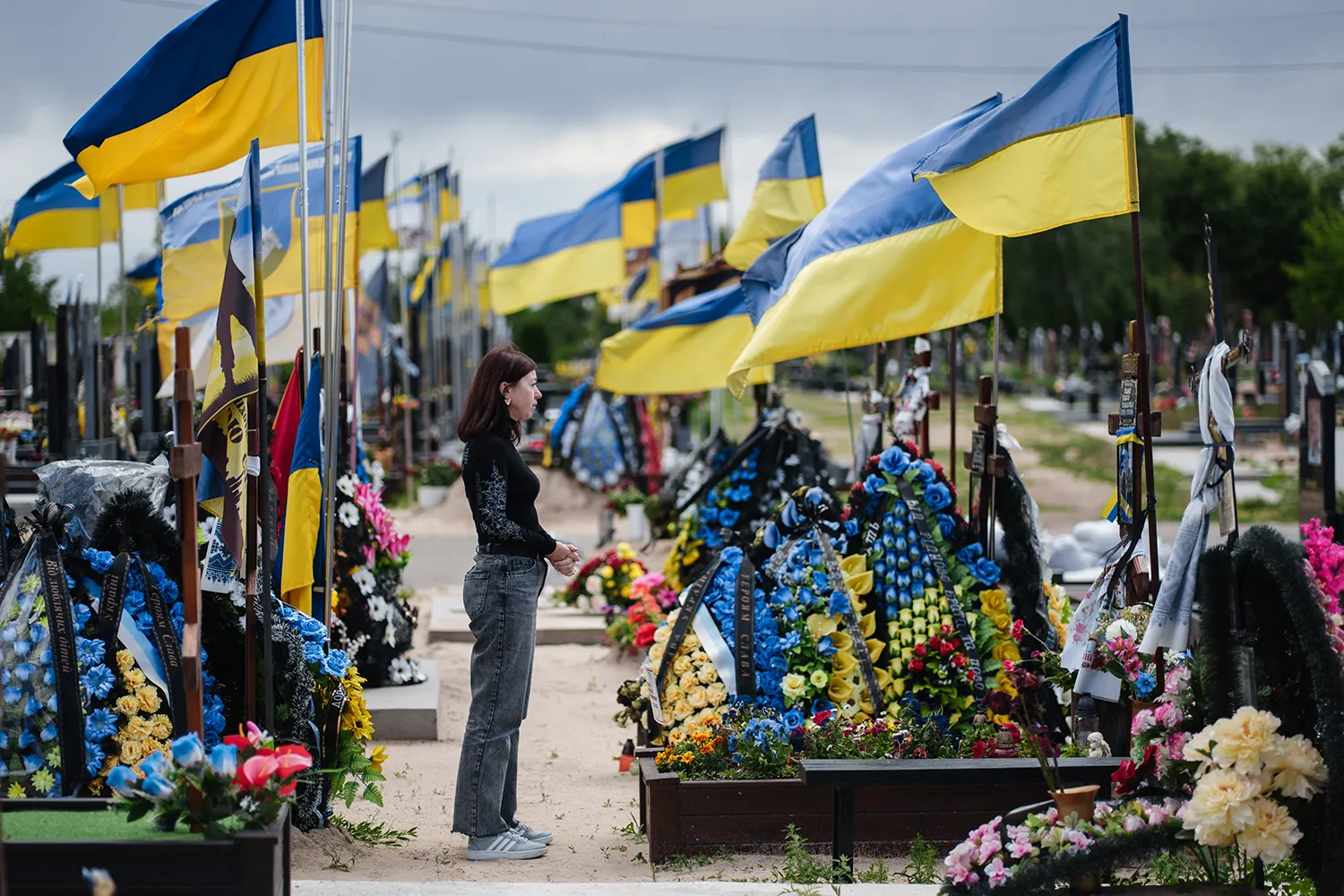
Ulyana was living at her parents’ home in Ternopil in western Ukraine when she received the news that her husband of five years, a Ukrainian soldier named Vlad, had reportedly died by suicide in 2023 while at a military base near the front lines.
Following Russia’s full-scale invasion in February 2022, Ulyana and their then-two-year-old son had moved to Ternopil as Russia began to occupy parts of the Kyiv region. Vlad stayed behind and joined Kyiv’s territorial defense, which was comprised of volunteers who took up arms alongside the military to halt Russian advances.
When Ulyana and her mother-in-law saw Vlad’s body in the morgue, she was in denial. As his mother cried out, “Oh, Vlad! Oh, Vlad!” Ulyana said, “Is it really him? I don’t think it is.”
At her two-room apartment in Kyiv, Ulyana asked to be referred to by her first name, and the identity of her son withheld, because few in her life know that Vlad’s official death ruling is labeled as a suicide, including her son.
Ukraine pays out compensation to war widows and families of fallen soldiers under certain circumstances, provided certain criteria are met. But in cases where a soldier’s death has been declared as a suicide, which Ukraine classifies as a noncombat loss, war widows and families are not entitled to receive any compensation.
At the start of the war in 2022, the government announced that a one-time payment of 15 million Ukrainian hryvnias (approximately $335,000) would be offered to the families of soldiers killed while defending their motherland on the front lines, known as a “gray certificate.” In September 2024, the government introduced a second option, the so-called “black certificate,” which allows families to claim 2.7 million hryvnias ($60,400) over seven years and is typically issued when a soldier dies while on duty, but not at the front, unlike the gray certificate.
At first, Ulyana said Vlad’s brigade told her that her husband had died from a self-inflicted gunshot wound to the head. She told Fuller that she refuses to accept this, noting that just hours before his death, they had spoken on the phone and discussed buying a new tactical vest for him. She also told Fuller that she believes that Vlad was murdered by someone in his assault brigade, an allegation that she cannot prove and says the military has denied.
In her small bedroom, Ulyana pulled out a box from under a desk with items belonging to Vlad—the official notice of his death, his military identification card, and his death certificate. It showed that his cause of death was empty and was left blank when she received it. With no official cause given, her compensation claim is in limbo.
Ulyana hired a lawyer to argue that her husband had been killed by someone in his brigade and died as a hero of Ukraine, but the court case has continued for years.
“I don’t think our government cares … we have no rights. I’m the wife of a soldier who died. Do I feel pain differently?” Ulyana said.
In the country’s western city of Lviv, Roman Lykhachov, an independent lawyer who works with Ukraine’s military and their families, said that he has handled hundreds of cases involving war widows unable to receive payments since the start of the war.
Lykhachov said that he has represented cases of service members who were murdered by their fellow soldiers, but it is a rare occurrence. “In such cases, we involve investigators, and we push them to investigate,” he said.
Ulyana said that she wants recognition not only for herself, but also for her son, who is now six. They have not received any state social benefits because of Vlad’s suicide status. This means not receiving the one-time payment of 3 million hryvnias ($67,000) upfront, with the rest distributed every month for roughly six and a half years.
Ulyana is also not entitled to other social benefits that come with the compensation, including free medicine with a doctor’s prescription, priority health care service, a 50 percent discount on rent and utility bills, and scholarships for children.
She receives a social security pension from her late husband of 4,700 hryvnias a month ($105), which, in a country where the average monthly salary is $700 and the minimum wage is $204, does not pay for much. Amid rising living costs and an inflation rate of 8.6 percent, it barely covers rent and food.
Before Vlad died, Ulyana relied on his civilian income and later his military pension for getting by. In the aftermath of his death, she started working remotely as a sales representative. But it does not make up for the significant amount of money and security that comes with receiving state compensation.
Leha holds a photo of her husband while posing for a portrait in Kyiv on May 29.
Olena Bieliachkova, an advisor to Ukraine’s Office of the Military Ombudsman, an advisory body under the country’s president that is tasked with protecting the rights of servicepeople, told Fuller by email: “It’s understandable that families have distrust toward military units, especially in cases where the cause of death is listed as suicide.”
“These circumstances require more detailed investigation and clarification of all facts,” Bieliachkova said. “In such proceedings, it’s important to fully carry out the initial investigative actions after a deceased service member’s body is discovered.”
“Indeed, many families disagree with the experts’ conclusions and with the military unit’s actions during the internal investigation into the circumstances of the service member’s death,” she added.
Ukraine’s Ministry of Defense, the government body that handles compensation claims on a case-by-case basis, did not respond to a request for comment.
Ulyana is part of a group of war widows who believe Ukraine has deemed that their husbands did not die in the right way, as determined by the military, and that their sacrifices were not great enough. The war has killed 55,000 Ukrainian soldiers, according to figures given by President Volodymyr Zelensky in February.
In search of support and for women in similar circumstances, who feel cast aside as collateral war damage, Ulyana turned to an online community, a nongovernmental organization called the All-Ukrainian Association of Families of Unrecognized Defenders.
Its Facebook group has 931 members, and it helps war widows and families struggling to claim compensation by getting in touch with lawyers, organizing meetings with armed forces, and lobbying lawmakers.
From the group, Fuller spoke with 20 women who were unable to receive compensation after the death of their husbands, partners, brothers, and/or sons who served in Ukraine’s military. Of that figure, there were 12 war widows; five of the husbands died by suicide, two died in car crashes, and two died of sustained injuries after being discharged and sent home.
“We have a mass problem because there are many of us, and it’s no longer a problem of one or two people. It’s a problem that hundreds of people have,” said Nataliia Vozna, who founded the organization after her son, Anton, a 20-year-old border guard, drowned alongside another soldier while patrolling the Dnipro River in April 2023.
Initially, Anton’s death was ruled by the Ministry of Defense as not occurring in the line of defending Ukraine. But after two and a half years of fighting in court with a lawyer, Vozna eventually received the 2.7 million hryvnias in compensation. But she knows that others are not as fortunate.
“These soldiers might not have died in a way that our country considers defending the homeland, but still, this person died while defending the state, and they gave up a lot,” Vozna said.
“Families shouldn’t have to prove that their relatives gave their lives, their time, for the country, that they really defended the state; they weren’t just at home,” she said.
It is not known how many war widows have received compensation or how many have sought claims and been rejected. The government does not disclose the data.
But legal experts in Ukraine that Fuller spoke to—Lykhachov, who heads his law firm, and Legal Hundred, a nonprofit that offers free legal advice to veterans and their families—said that they know of, or have supported, a combined estimated total of 1,000 families who have not received the compensation they believe they are legally entitled to since the war began in 2022.
Unclear payment rules have left hundreds of war widows and the families of fallen soldiers with nothing, according to Yulia Morii, head of Legal Hundred.
The complex cases that are not clear-cut, she said, can include soldiers who die in noncombat-related deaths, like car crashes, from heart attacks after returning from dangerous assault missions, or from pneumonia after weeks spent in frozen temperatures, or death by suicide.
Bieliachkova said she has seen cases in which the circumstances surrounding a service member’s death “were assessed superficially, without full and proper investigation.”
“The hardest part is that it’s not always possible to help a family or give them what they’re hoping for,” she said.

Leha stands in her apartment in Kyiv on May 29.
It was three years ago when Kateryna Karmazina-Abubakarova received a call from a military officer and learned that her husband of 10 years, Timur, had died in a car accident while on duty near the front lines.
The 27-year-old soldier had turned off his car headlights to go undetected by Russian drones that often flew above as Moscow’s troops advanced throughout eastern and southern Ukraine.
According to Karmazina-Abubakarova, on the night of the fatal accident, Timur initially did not see an abandoned military truck in his path. He swerved to avoid it and crashed into an incoming military car. The impact killed him and the driver of the other car.
“When I found out that Timur died, I let out a howl that sounded like a wounded animal,” recalled the 32-year-old.
She said that according to the official notification of Timur’s death, which she received from the military, her husband was killed while carrying out a combat mission in defense of the homeland. This opened the route for financial reparations that could help Karmazina-Abubakarova and her daughter, Ustinya, now four, to rebuild their lives.
However, according to the widow, the Ministry of Defense later ruled to revoke the status. She said that the ministry then launched criminal proceedings against Timur, arguing that he was the one who had caused the car crash that killed another and therefore not entitled to compensation. The court case to determine what happened in the traffic accident is still ongoing, Karmazina-Abubakarova said.
To challenge the ministry’s ruling, she hired a lawyer and took legal action. For the last two-and-a-half years, she and the lawyer have fought in court to prove that Timur did die defending Ukraine, given that he was following military orders and on an assignment to report to his commander near the front lines when his car crashed.
In May, in a separate case, Karmazina-Abubakarova said that a court officially recognized that Timur did die defending his country, the key requisite needed to claim compensation. But since his death occurred in a car crash, the ministry has still not awarded the compensation, she said.
She feels betrayed and believes the decision to be a “huge injustice.”
“We consciously gave our lives, the life of our family, everything for our independence, for our state,” Karmazina-Abubakarova said. “[Timur] simply had the bad luck to die not from a shell, or a bullet, or a missile, but from a road accident that occurred in the conditions of war. I simply understand now that justice doesn’t exist … we don’t have the support that the state promised to military personnel and their families.”
During their married life, the couple could not save much money or buy their own home, and following Timur’s death, Karmazina-Abubakarova was unable to keep up with the rent for their apartment in Zviahel, a city in the northern Zhytomyr region of Ukraine.
The loss of Timur’s income forced the widow and her daughter to move in with her parents and her two sisters in a small apartment in Zviahel. Even with Timur’s small military pension paid into her account, Karmazina-Abubakarova was struggling to make ends meet.
“It’s very difficult for us to get by without him. There have been moments when I was genuinely worried that we would have nothing to live on,” she said.
She returned to work at a charity called Eleos-Ukraine, which provides support to vulnerable people in Ukraine. “Thanks to caring people, volunteers who supported us for some time while my child was still very small, we somehow held on,” she said.
Lykhachov has handled other cases involving soldiers killed in car crashes, which he said makes it hard for war widows and relatives to receive compensation—even when soldiers were on duty and near the front lines.
“The law defines that a soldier’s family gets no social protection in the case where the soldier breaks traffic rules. They committed a crime in this way; [the government doesn’t] care if they are in a war zone. It’s not an exception,” he said.
Back in Kyiv, Ulyana said that since her husband’s death, she has tried not to cry in front of her young son as a way to shield him from her pain.
“What keeps me going is the hope that we will still achieve justice,” she said.
Olena Lysenko in Kyiv contributed to the reporting.
