


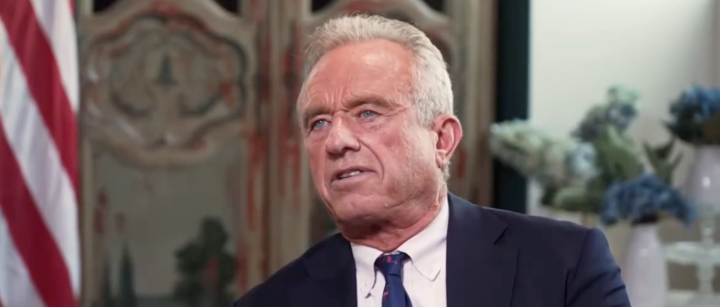
Following an executive order that called for breaking up the combination measles, mumps and rubella, or MMR, vaccine, Health and Human Services Secretary Robert F. Kennedy Jr. said that a “recent” study “just came out” that “very strongly supports” the idea. But there’s no evidence of any such credible study, past or present.
In a CNN interview that aired on Aug. 15, Kennedy defended President Donald Trump’s Aug. 10 executive order on childhood vaccines, which among other things, asked officials to begin pursuing a way to offer single-disease shots. Those vaccines have not been available in the U.S. for nearly two decades. The combination MMR vaccine has been in use for more than 40 years.
The order did not present a scientific reason to split up the shot, but while signing the document, Trump falsely claimed that in contrast to single vaccines, the combination shot is “quite lethal” and that breaking it up “will have a huge impact on autism.”
The president doubled down the next day, claiming that given separately, the MMR is “fine,” but when combined, the vaccine is “sort of like a nuclear weapon, according to some.”
In the CNN interview, after the host noted that the current Centers for Disease Control and Prevention’s website says there is no evidence showing a benefit to separating out the MMR vaccine, he asked Kennedy who was right — Trump or the CDC.
Kennedy replied that the CDC website “probably is outdated.”
“There is a recent study that just came out that supports President Trump on that,” he continued. “It looks at the timeline for when the autism epidemic began and … it’s a synthesis of — essentially a meta review — of all the existing science. And it very strongly supports the president.”
Later, Kennedy again suggested that new evidence had emerged, saying that “particularly in light of recent science,” he thought people “should have that option if they want to go with a single antigen vaccine.”
Throughout the interview, he emphasized that while he thought the MMR was effective in preventing measles, he did not think there was enough evidence on its safety, including on whether the shot causes autism. The MMR vaccine has been rigorously studied and no credible link to autism has been found.
We searched PubMed, the National Library of Medicine’s online database of the biomedical literature, but did not find any new study suggesting that the MMR vaccine needed to be split up. Experts, too, said they were not aware of one.
“There are no data to suggest that the measles, mumps, rubella vaccine, if divided into its three component parts, will make the vaccine safer,” Dr. Paul Offit, a pediatrician and vaccine expert at Children’s Hospital of Philadelphia, told us.
“Quite the opposite,” he added. “It will mean that children will get six shots instead of two. It means that there will be a delay in when they receive these shots, which will only increase the period of time during which children are susceptible to these diseases with no benefit.” (The MMR is typically given in two doses at 12 to 15 months and 4 to 6 years.)
“Since the current combined MMR vaccine is safe, it does not make sense” to split it up, Dr. Andrew Pollard, an immunologist and director of the Oxford Vaccine Group at the University of Oxford, told us.
“There is no safety problem that is trying to be fixed by separating MMR and doing so would take a tremendous amount of time and effort” since those shots aren’t currently licensed, Daniel Salmon, a vaccinologist and director of the Institute for Vaccine Safety at Johns Hopkins University, told us. “This is a solution in search of a problem.”
HHS did not respond to our inquiry asking what study Kennedy was citing or whether the CDC website would be revised.
Contrary to Kennedy’s claim, in our search, one recent study, published on July 28 in the Pediatric Infectious Disease Journal, supported the safety of the combined shot. Consistent with many previous studies, it analyzed electronic medical records from more than 2.5 million American children and found no association between the MMR vaccine and autism.
Similarly, we also identified a review published last month that compared the vaccination policies for mumps in the U.S. and Japan. It noted the shortcomings of the Asian country’s approach. In the CNN interview, Kennedy briefly mentioned Japan, saying the country has “a single vaccine … and it works for that population.”
As we’ve noted before, and as Dr. Jake Scott, an infectious disease specialist at Stanford Medicine explained in the same CNN segment, Japan did discontinue its combination MMR vaccine in 1993 after a rare side effect was observed with that vaccine’s mumps component, which was never used in U.S. vaccines. Autism rates did not decline after Japan stopped using the MMR shot.
Today, however, Japan doesn’t split out all of the components. Instead, there is a combination measles and rubella vaccine, along with an optional mumps standalone vaccine. And the country may be moving back to a fully combined vaccine. In May, Japan licensed a new combination MMR vaccine with a mumps component similar to the one used in the U.S. and much of the rest of the world.
According to the recent review, Japan’s policy has not been very successful in controlling mumps, in contrast to the U.S., which still has some outbreaks but is not plagued by the same large-scale issues.
“Low vaccination coverage has led to a lack of herd immunity and recurrent epidemics, and ‘mumps deafness’ is an unresolved public health concern,” the review states. Mumps is usually mild, but the disease can cause complications, including brain or testicle inflammation. Deafness, usually in a single ear, might occur in as many as 1 in 1,000 cases, according to a study in Japan.
Years of relying on separate shots has also likely contributed to low vaccination rates for measles. A massive measles outbreak in 2001 infected more than 250,000 children, and Japan was for many years a major source of imported measles cases in the U.S. Scott, who wrote about this concern in October 2025 when health officials first broached the idea of separating out the MMR, said then that Japan “provides a cautionary tale.”
A ‘Junk’ Autism Review
We did identify a paper that Kennedy might have been thinking of, but it is not new evidence, nor is it published in a reputable journal.
“It’s junk and would never be published in a legitimate medical journal,” Salmon told us.
The paper, which purports to be a review on the “determinants” of autism, is from May 2026 and roughly matches Kennedy’s description of a study looking at a “timeline.” It was mentioned in a Children’s Health Defense news story about Trump’s executive order. Children’s Health Defense is the nonprofit that Kennedy used to lead and that has long been a source of inaccurate vaccine information.
Citing Dr. Andrew Wakefield, the British physician who fraudulently proposed the MMR vaccine might cause autism in 1998 and first suggested the vaccine be split up, the CHD story described the paper as a “comprehensive review” that “identified vaccination as the leading ‘modifiable risk factor’ for the condition.”
Wakefield is in fact one of the authors of the paper, as are several other individuals, such as Peter McCullough, whom we and others have fact-checked before for sharing inaccurate medical information.
The paper appears in an outlet called the Journal of Independent Medicine, which is not indexed on PubMed — a very basic indicator of at least some reliability — and is published by a group that has promoted unproven treatments for COVID-19.
“This is a narrative review of previous studies,” Anders Hviid, head of the epidemiology research department at the Statens Serum Institut in Denmark, who has studied the MMR vaccine in large studies in his home country, told us. There is a short section titled “Compound Vaccination,” he said, “but there is no evidence there to suggest breaking up the vaccine would be beneficial.”
“There is no credible study which links MMR vaccine to autism and a very large body of data which finds no association between vaccination and autism,” Pollard said.
If there were a legitimate new study showing a problem with the combined MMR vaccine, which has been used for decades and given globally to more than a billion people, it would almost certainly be major news. Offit said in that case, scientists would act upon that information.
“Historically, when vaccines have been shown to be harmful, we do act on it,” he said. “We care about vaccine safety deeply — deeply. And that’s why we are very responsive to studies that are well done, well controlled, and published in reputable journals and reproduced by others.”
“That’s not this,” he said, of Kennedy’s claim. “This is just a sort of vague handwaving reference to a study that doesn’t exist.”
Splitting the Vaccine Could Lower Vaccination Rates
Multiple experts told us that splitting up the MMR vaccine was not necessary and was unlikely to happen — but if it did, it would not lead to greater vaccine uptake, as Kennedy suggested.
Kennedy said in the CNN interview that if single-disease shots were available, “maybe then more people are going to end up taking the vaccine because they don’t want to take all three.”
While that’s possible in some cases, vaccine experts told us it’s likely that more people overall would miss one or more shots or be left unprotected for longer periods of time.
“I think splitting up MMR will lead to lower uptake,” Hviid said, noting the burden of six appointments rather than two. “Some of these will be postponed or missed completely. I am speaking as a parent myself here.”
He cited a 2017 study that found that kids in the U.S. who get combination shots when they are available were more likely to complete their vaccination schedule and to do so on time. Scott, the Stanford doctor who fact-checked Kennedy’s claims for CNN, also pointed to this study.
“Delaying vaccines or separating doses unnecessarily does not make vaccination safer and can leave children unprotected,” the World Health Organization said in a statement two days after Trump signed the executive order.
When “vaccines are split and more doses or visits are needed,” Pollard said, “the result is that doses are missed and protection in the population drops. This is very dangerous in the cases of these viruses, not least with outbreaks of measles already [o]ngoing,” he said in an email. “[T]he last thing we need for the health of our children is to have more doses missed.”
Kate Yandell contributed reporting to this story.
Editor’s note: FactCheck.org does not accept advertising. We rely on grants and individual donations from people like you. Please consider a donation. Credit card donations may be made through our “Donate” page. If you prefer to give by check, send to: FactCheck.org, Annenberg Public Policy Center, P.O. Box 58100, Philadelphia, PA 19102.
