


Follow ZDNET: Add us as a preferred source on Google.
ZDNET’s key takeaways
- Manufacturers profit twice: on sale, and on cloud storage.
- Think in $/GB, not GB; that’s what storage really costs.
- A gigabyte of storage is not as much as you think.
Modern smartphones are a perfect vehicle for upselling, allowing manufacturers to profit twice: once on the sale, and again on cloud storage services further down the line.
Soldered-in storage — plus the death of the microSD slot on most phones — makes it easy to trigger buyer anxiety and push people toward buying more storage than they need. Once they’ve bought a device and let digital clutter pile up, as it inevitably does, tech companies bank on the fact that nobody has time to clean out their files, so users pay again, this time for cloud storage to back everything up.
Also: This $50 power bank is safer than my lithium-ion battery – and it’s coming on my next flight
Note that much of what I’m writing about here also applies to laptops, although you have greater flexibility for adding external storage to these devices.
Think in dollars, not gigabytes
When people buy or upgrade their smartphones, they’re mostly driven by a price in their head. But during the purchase process, they’re faced with a storage upsell. For only a few hundred dollars, they can double their storage.
That sounds like a good idea, right? At the price point, they’re optimistic that their shiny new purchase will last them at least three years. That belief convinces them that the upgrade is worth it. After all, storage is tight on their current phone, and they had to delete the farm simulator game they’d not used in a few months to make room for photos of their breakfast.
However, this approach is wrong. Stop thinking about storage in terms of gigabytes, and start thinking about how much storage costs you.
Also: I tried a solar-powered AirTag alternative that lasts 2 years – and looks like my Apple Watch
Let’s take the iPhone 17 Pro Max as an example. I’m choosing this because the device has four different storage options, which makes my example clearer.
This model comes in 256GB, 512GB, 1TB, and 2TB options, and the handsets are priced at $1,199, $1,399, $1,599, and $1,999, respectively. If you divide that price by the capacity, you get a basic cost per gigabyte for each handset of $4.68/GB, $2.73/GB, $1.56/GB, and $0.98/GB.
Apple pricing makes more sense when you think $/GB.
Adrian Kingsley-Hughes/ZDNET
But rather than dividing the total cost by the storage capacity, I’d much rather think of marginal costs, or the extra cost per gigabyte when you step up a storage tier. The 512GB model costs $200 more than the 256GB model, so the marginal price per gigabyte is $0.78/GB. I’ll also extrapolate this cost structure to the lower-price model, and the price per gigabyte for the 256GB model is also $0.78/GB.
Also: How much storage does your phone really need in 2026? Probably less than you think
We can do the same calculation for the 1TB and 2TB upgrade options, which both come out at $0.39/GB.
So, there you have it. That’s how much each gigabyte is costing you.
How much space is a gigabyte?
It’s not as much as you think.
Depending on the camera settings, you get about 300 lower-resolution photos per gigabyte, 150 per gigabyte for high-quality photos, and as few as a dozen pictures in pro-grade RAW settings.
Video is worse, with a gigabyte holding about 15 minutes of lowest-quality 1080p video. Once you turn up the settings, that gigabyte can be gone in under two minutes (less if you choose professional RAW formats).
Remember that every gigabyte can cost close to a dollar’s worth of space on your phone. And this is before you pay to back up those photos or videos.
Also: This 6-port USB-C charger replaced my ugly power brick – and powers my entire desk
Apps can also be gigantic. Looking at the last few apps that have updated on my iPhone, the Facebook app is close to half a gigabyte, WhatsApp is another third of a gigabyte, and Facebook Messenger is a quarter of a gigabyte. TikTok and X, neither of which I use, are another gigabyte and half a gigabyte respectively.
OK, what about solutions?
I’ve spilled a lot of pixels here on the problem, so let’s now look at how you can free up tens of dollars’ worth of storage space.
Operating systems don’t make it easy to clean up your smartphone. Features that would be helpful to the owners — such as being able to pull up a list of apps that haven’t been used in weeks, months, or even years and might be deletable, or having the ability to compress old photos and videos — would hit the company’s bottom line.
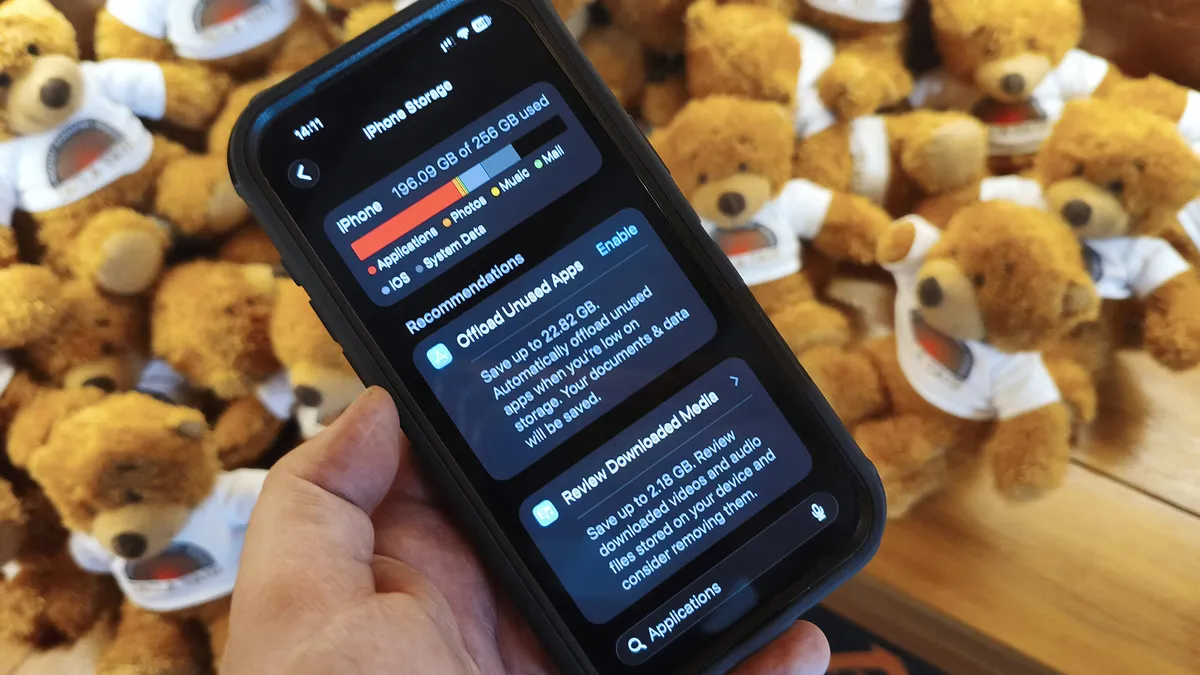
Sure, you get simple tools to manage storage, and iOS and Android allow you to remove application files to free up space while preserving all the data (called offloading on iOS and archiving on Android). However, these features could be a lot better.
Also: You’re charging your phone all wrong: 6 common myths, debunked
Remember what I said at the beginning about smartphones being an upsell tool? Well, some features nudge you into buying cloud storage. For example, both Apple and Google have a feature built into their mobile platforms that keeps a low-res version of photos on the device while uploading the full-resolution image to the cloud.
In iOS, this feature is called Optimize iPhone Storage (find it by going to Settings, tapping your name at the top, then iCloud, Photos, and turn on Sync this iPhone and then choose Optimize iPhone Storage) and on Android it’s called Storage Saver (this is in the Google Photos app, and you can find it by opening the app, tapping on your profile picture or initials at the top, tapping on Google Photos settings, then Backup, selecting Backup quality and choosing Storage Saver).
But remember, as you’re going snap-happy on your smartphone, this process is consuming expensive storage space.
If you want to save space, here are my suggestions.
Also: How much RAM does your phone really need in 2026?
First, if you are a shutterbug, you need a way to manage your photo and video library. I know some people love to do this manually — one of my friends does a photo purge during every flight — or you can use an app to help.
On my iPhone, I use MacPaw’s CleanMyPhone regularly, while for Android I’ve had success with AVG’s Memory Cleaner. These apps will scan your archives, searching out duplicates and near-identical photos, as well as those bad, blurry, or poorly lit captures that should never see the light of day, and are best forgotten.
If, like me, you’re a bit of an app hoarder, here’s how I go about getting rid of them.
Every so often I go through my apps and find a handful — between half a dozen and a dozen — that I don’t think I need anymore, and I offload/archive them. If I need them, they get restored, and I’ve lost nothing. If not, I’ve clawed back the space.
Occasionally, I’ll take things a step further and do some hardcore decluttering, go through all my offloaded and archived apps, and delete them completely.
Also: Why Apple’s iOS 26.6 is worth installing (it’s not just for the 91 security fixes)
Don’t want to spend money on cloud storage? Remember that you can use the USB-C port on your smartphone to connect external storage. This approach is not as easy or as convenient (or as safe) as cloud, but it’s cheap, and totally under your control.
Don’t want your data lying about on an unencrypted drive? Get a hardware-encrypted drive. They’re dearer and look like something James Bond would use, but they’ll keep your data safe from prying eyes.
You can also wipe your phone’s cache, a move that’s more likely to boost performance (and possibly stability) than free up much space, but it’s worth doing every so often.
Another thing I’ve done is turn off download media in my chat apps — I don’t want all that stuff in my camera roll. I’ve also learned to stream media, such as videos and audiobooks, rather than download them, but I have an unlimited data plan so it doesn’t cost me extra, and your mileage may vary here. Depending on how many memes and videos your friends send, this could save you a lot of space. Every app is different, so do some research on how to tweak the settings for the tools you use.
Finally, have an idea of how much storage you might need when you upgrade. Another friend of mine dropped $2,000 on the biggest iPhone going, and discovered they use less than 300GB of space. They could have saved $600.
I count myself as a huge geardo, but I don’t see any point in throwing money at tech companies who are already drowning in cash.
