


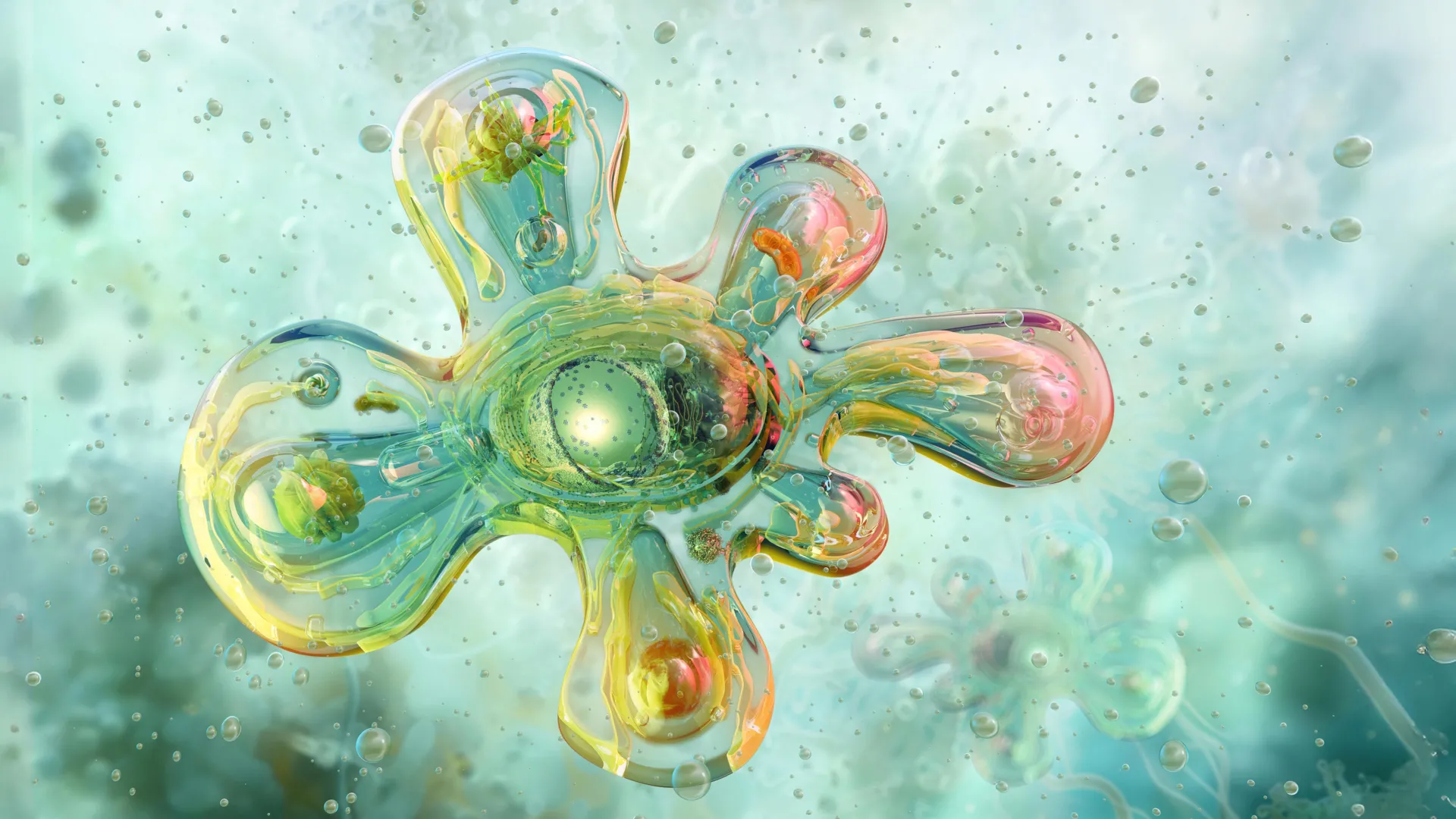
The search for life on Mars or on icy moons such as Europa and Enceladus may capture more attention, but another major astrobiology mystery is much closer to home. Scientists are still trying to understand when the first eukaryotes appeared on Earth and how those organisms helped set the stage for complex life.
That question matters because microbial organisms dominated Earth for roughly 90 percent of the planet’s history. Reconstructing the transition from a world populated almost entirely by microbes to one filled with plants, animals, and fungi could also help scientists understand whether complex life might develop elsewhere in the universe.
From Microbes to Complex Life
Life originated on Earth more than 3.5 billion years ago, according to Ross Anderson, a paleontologist at the University of Oxford in the U.K. Cyanobacteria and oxygen-producing photosynthesis were present by at least 2.3 billion years ago, while eukaryotes had appeared by at least 1.7 billion years ago.
Algae followed at least one billion years ago and probably emerged even earlier. Animals appeared at least 570 million years ago, and possibly somewhat before that.
To reach the common ancestor shared by the plant and animal kingdoms, Anderson says researchers must look back to around 1.6 billion years ago.
Crown eukaryotes, which are among the earliest eukaryotic forms scientists are trying to trace, played a crucial role in the emergence of complex life on Earth. Anderson considers eukaryotes to represent the planet’s first complex life.
What Makes Eukaryotes Different?
Eukaryotic cells contain a nucleus that encloses their DNA. They also contain organelles, which are specialized structures inside the cell. One example is the mitochondrion, which helps provide the energy needed to support more demanding forms of life.
Eukaryotes ultimately gave rise to complex multicellular organisms and large visible life forms. Every animal, plant, and fungus around us today is eukaryotic.
Finding their earliest ancestors, however, is extremely difficult.
Organisms older than 500 million years did not yet possess shells or skeletons. Because those hard structures had not evolved, paleontologists must rely on rare environments capable of preserving fragile cells and soft tissues.
That leaves scientists with relatively little information about how life changed during an enormous span covering about 90 percent of Earth’s history.
Searching for the Transition to Multicellular Life
Anderson’s research focuses on one of the biggest transitions in biological history: how Earth changed from a planet dominated by bacteria into one inhabited by complex multicellular organisms.
Because fossils of these early multicellular organisms are difficult to find, he studies the chemistry of ancient rocks to identify the environments most likely to have preserved them.
Another major obstacle is time itself. Eukaryotic microfossils have endured billions of years of geological alteration and degradation, making already tiny remains even harder to detect.
Scientists do know that the transition from single-celled life to multicellular organisms happened more than once in different parts of the world. Anderson is particularly interested in understanding how that process eventually produced the remarkable diversity seen among animals today.
Much of the foundation for modern animal diversity appeared around the Ediacaran/Cambrian transition roughly 540 million years ago. This period marked a major evolutionary shift from predominantly soft-bodied organisms toward the Cambrian explosion, when animals with greater mobility, shells, and skeletons became increasingly prominent.
Where Scientists Search for Ancient Microfossils
Finding fossils from much earlier periods requires searching in places where delicate biological material had an unusual chance of surviving.
Anderson and his colleagues are especially interested in a roughly 100sq. km region near Svalbard, Norway. About 80 degrees North, this remote island area was once covered by a shallow sea.
Australia has also produced important evidence. Just last year, researchers there discovered some of the oldest known eukaryotic microfossils, dating to roughly 1.75 billion years ago.
Ancient coastal environments are especially promising places to search. Eukaryotes living in these settings would have had access to abundant nutrients and organic material, conditions that could have supported greater diversity and the development of multicellularity.
Researchers often target pristine locations or regions that have received relatively little scientific sampling. Anderson specializes in studying areas where enormous deposits of clay may have helped preserve ancient eukaryotic remains.
Today, many of the best places to conduct this work are deserts or Arctic landscapes. With little or no vegetation covering the ground, ancient rocks remain exposed and accessible.
Why the Fossil Hunt Is So Difficult
Even in ideal locations, finding eukaryotic microfossils is an enormous challenge. The organisms were microscopic, lacked protective hard tissues, and have been exposed to billions of years of geological degradation.
According to Anderson, one of the greatest problems is simply that the fossil record from this period remains poorly sampled.
Researchers are nevertheless making progress. Scientists are becoming better at identifying the types of rocks most likely to contain early fossils, providing new evidence that can help reconstruct the history of Earth’s earliest life.
What Earth’s Earliest Life Could Tell Us About Alien Life
The search has implications far beyond understanding Earth’s biological past.
Anderson says much of his work involving clay deposits was originally motivated by the search for life on other planets. By learning which environments preserve ancient organisms on Earth, scientists may become better equipped to recognize possible signs of life elsewhere.
Understanding how life emerged and became increasingly complex on our own planet is therefore an important part of astrobiology. If scientists want to estimate how likely life is to arise and evolve elsewhere, they first need a clearer picture of how that process unfolded here on Earth.
