


Stay informed with free updates
Simply sign up to the Middle Eastern politics & society myFT Digest — delivered directly to your inbox.
The writer is author of ‘Black Wave’ and an FT contributing editor
Headlines from the Middle East are dominated by war, death and destruction but last week Lebanon and Syria made the news for a different reason — their own efforts to improve the application of justice and the search for accountability.
In abolishing the death penalty, with no exceptions, Lebanon delivered a progressive, historic first in the region. Across the border, in Syria, a court sentenced former president Bashar al-Assad to death in absentia for premeditated murder, among other charges, in the 13-year war he waged against his own people.
But what does justice mean in a time of war and upheaval? And what kind of accountability can truly be achieved while further crimes and political accommodations are still under way?
Lebanon has had a moratorium on death penalties since 2004, but in a region where human rights are rarely mentioned its justice minister Adel Nassar described abolition as “an essential message in favour of fundamental rights”.
To be fair, among Arab League countries, Djibouti removed capital punishment from its penal code in 1995, but it is in the Horn of Africa. In the Middle East, Israel abolished the death penalty for ordinary murder in 1954, retaining it only for wartime crimes against humanity. Nazi official Adolf Eichmann was notably executed under it in 1962
But in March, the Israeli Knesset passed a law making capital punishment mandatory for terrorism. The law, sponsored by the far right after October 7, is written in a way that excludes Jewish Israelis, in effect making it only applicable to Palestinians. Israeli civil and human rights organisations have criticised it as enshrining a two-tiered justice system.
Lebanon’s achievement was marred just one day later when parliament passed a general amnesty law that will benefit hundreds. The country last voted on a general amnesty in 1991 in order to absolve everyone, from warlords to snipers, of the horrors of the civil war.
This time around, the amnesty was partly designed to reduce prison overcrowding. But it has long been demanded by political and sectarian factions — Sunnis looking to absolve Islamists; the Shia militant group Hizbollah trying to release members of the community imprisoned on drug-related offences. Amnesties can help countries move on from conflict but, handed out without a truth and reconciliation process, they promote impunity.
Still, the abolition opens new avenues for justice. Lebanon could now ask for the extradition of a Bulgarian man involved in the shipping of explosive materials, which resulted in the devastating Beirut port explosion of August 2020. Bulgaria has refused to extradite him because of the death penalty. Hoping to set a regional example, Lebanon is also pondering whether to refuse the extradition to Syria of former regime officials for trial in courts that still hand out death penalties.
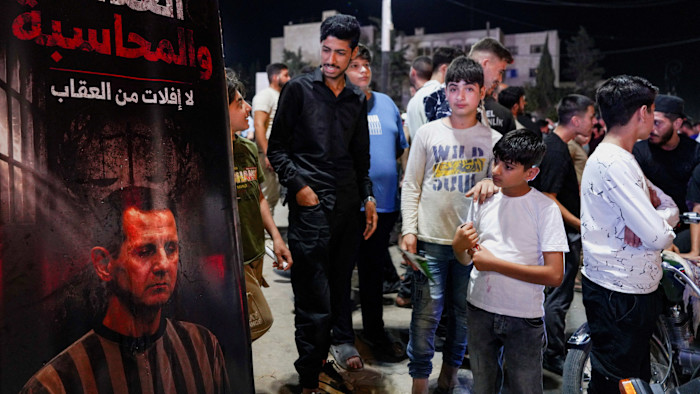
Last week in Damascus, former president Assad, his brother Maher and several former regime officials were sentenced to death in absentia. After four months of trial, the outcome was met with cries of joy by victims of the regime’s brutal war, oppression and forced disappearances.
Atif Najib, a cousin of Assad and political security chief in Deraa province, where the spark of the 2011 civilian uprising was lit, was the only regime figure to appear in court, behind bars, in a striped prison uniform. He denied all accusations and said he felt no remorse. Syria has no laws on war crimes or crimes against humanity, so the prosecutors filed individual homicide cases, flattening the enormity of the crimes.
Short of a full national reconciliation process, Syrians may be deprived of a true sense of accountability. A process driven by the current authorities also risks being selective, motivated by the need to assert legitimacy and power. Trials in absentia are flawed but, with the death penalty still in force, Syria will struggle to extradite regime officials. This makes the quest for accountability feel fragile and somewhat rushed.
In 1965, Martin Luther King Jr said the “arc of the moral universe is long but it bends towards justice[ . . .] How long? Not long.” Despite war and turmoil, there are shy shoots of green in Lebanon and Syria. But the original saying from 1853 by an abolitionist minister, Theodore Parker, expresses the uncertainty around this arc much better. “I cannot calculate the curve and complete the figure by experience of sight. I can divine it by conscience.”
