


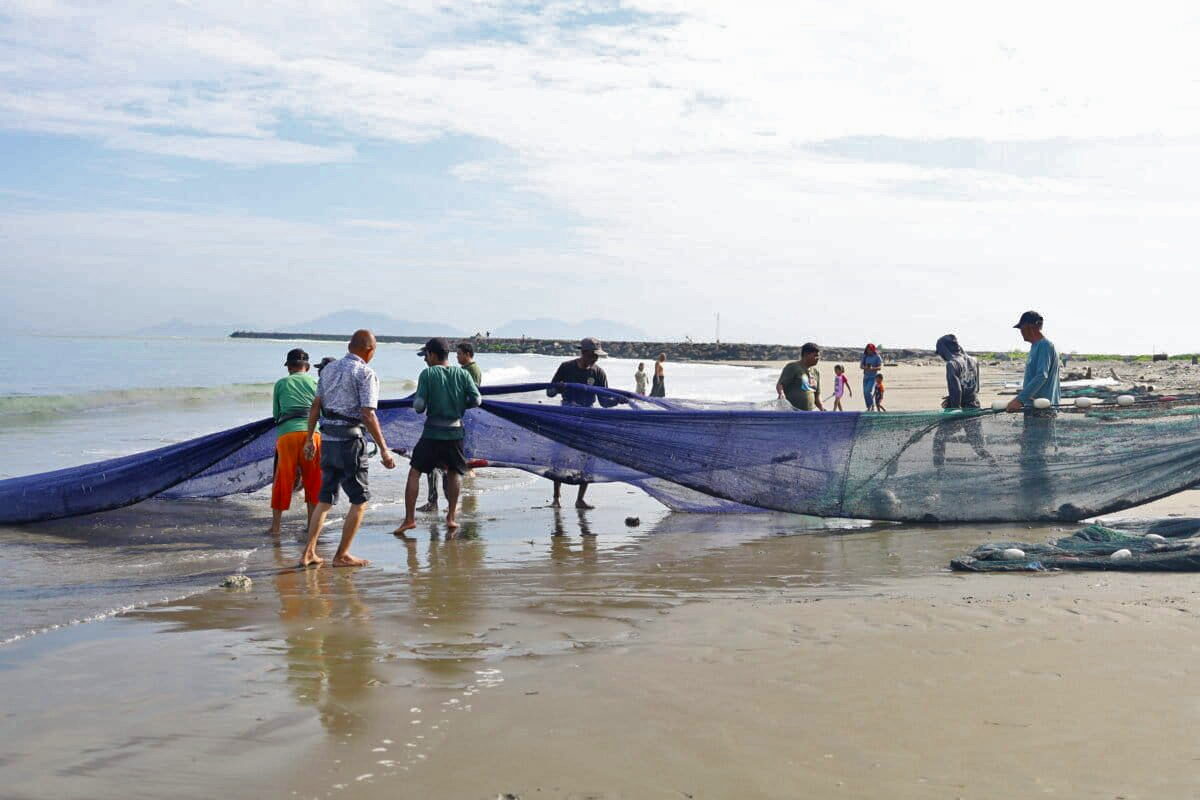
- Coastal communities in Indonesia’s Aceh province have practiced community fish trawling since the time of the Aceh Sultanate, but the tradition today exists in only a handful of communities across the semiautonomous province.
- The customary panglima laot, a customary fishery lead, at one beach in the Aceh capital Banda Aceh, told Mongabay Indonesia that the customary rules included environmental protections such as requirements not to take threatened species.
- However, this traditional fishing practice is under threat due to the increasing burden of plastic and other household waste accumulating in nearshore waters and along beaches.
- For many, the time and cost required to patch holes in giant fishing nets can make the cost of doing business unviable, leading some fishers to abandon the tradition for jobs elsewhere.
BANDA ACEH, Indonesia — Seven fishers moved in concert along the shore of Gampong Jawa Beach in Banda Aceh, Indonesia’s westernmost city, hauling in a blue net nearly half a mile long from the Indian Ocean.
“Forward … Keep it going … Now, move back!” instructed Surya Abid, the panglima laot, or “sea commander,” of the Gampong Jawa community.
The practice known as tarek pukat is a form of community fishing dating to the Aceh Sultanate, which ruled here from the 15th century until defeat to the Dutch colonial navy in 1903. Its rules are overseen by the panglima laot, an Indigenous Acehnese institution that governed fishing through customary law long before the existence of the modern Indonesian state.
Toward the end of 2004, a 9.1-magnitude earthquake under nearby Simeleue Island triggered the infamous Indian Ocean tsunami — a disaster that, in Gampong Jawa, wiped out more than 90% of the population. Memorials in and around Banda Aceh are built 30 meters (100 feet) high to honor those lost and remind future generations of the wave height that left 167,540 people dead or missing in Indonesia alone.
Today, only a small number of fishers still work together handling these vast nets to catch fish, following unwritten customary rules to protect threatened marine species including sea turtles and their eggs. In Gampong Jawa, those rules are overseen by Surya, the local panglima laot.

Waste collection
The tarek pukat tradition is still practiced in a handful of coastal areas of Aceh, where custodians like Surya strive to preserve the culture despite the arrival of more efficient means of fishing.
A more recent threat to this fishing tradition is the oppressive volume of single-use and other plastic waste littering the waters off Aceh, which can jam the nearshore fishery due to ocean currents or heavy rain.
“The challenges are weather, environmental damage, and seasonality — but now the added difficulty is garbage,” said Gemal Bakri, who runs the local coastal nonprofit Jaringan KuALA.
When these nearshore blooms of plastic prevent the tarek pukat fishers from working, some who own boats might fish independently, while others often take temporary casual jobs in construction.
“If there’s trash, that means we’re just spectators,” Surya said. “If we press on, the net will tear and we’ll get no results — and then we’ll end up exhausting ourselves repairing the net.”
Sometimes patching the net can take four days, with the repair bill running up to as much as 7 million rupiah ($390), or nearly twice the monthly minimum wage for Aceh province.
Azwir Nazar, secretary of the panglima laot fishery office, said the added difficulty presented by ubiquitous plastic waste means that some are leaving the tarek pukat tradition behind.
“In the end many lose interest in trawling and they’ll go and find more lucrative jobs,” Aziz said. “I can’t stop them because they need to support their families.”

Landfill adjacent
Asnawi, in charge of waste management at the Banda Aceh municipal environment department, said much of the household waste generated in the city ends up at the landfill by Gampong Jawa Beach.
Last year, the amount of waste dumped at this site reached 90,783 metric tons, almost 250 metric tons a day, around the same weight as a wide-body commercial airliner. The landfill has operated over its intended capacity since 2019, he said.
Asnawi said that in addition to the waste generated on land, ocean currents often deposit a mucky carpet of trash onto Gampong Jawa Beach, despite the best efforts of sanitation workers clearing up litter from the beach every other day.
“It’s difficult if it comes in from the open sea,” Asnawi said. “We pick it up today, and tomorrow there’ll be more.”
Indonesian President Prabowo Subianto this year declared a “war on waste,” setting 2029 as the deadline to tackle Indonesia’s mounting waste crisis. A collapse in March this year at Indonesia’s largest landfill, just outside Jakarta, buried seven sanitation workers and injured six.
The country generates about 3.2 million metric tons of plastic waste annually, according to the U.N. Environment Programme. Meanwhile U.N.-brokered efforts to agree a global treaty on plastics remain stuck over disagreements among countries on national production limits.

Asnawi said the high volume of landfill waste also stemmed from failure to separate organic and plastic waste at the source, blending perishable and plastics together into Banda Aceh’s already bloated landfill capacity.
To help address this, Banda Aceh’s government has launched a waste collection program across 16 neighborhoods, enabling community-run centers to separate and sell recyclable waste.
The government has also installed floating blocks in major rivers to block exits to the sea, where Surya’s colleagues say they hope to preserve their fishing livelihood.
Aceh province enjoys semiautonomy from the Indonesian government, and the formal authority to manage marine resources here rests with the panglima laot.
Once Surya and the Gampong Jawa fishers heave the net ashore, the proceeds are sold and cut among members of the cooperative.
A bumper catch might yield as much as 6 million rupiah ($340) apiece, Surya said, but he added those days are now rare.
“When the fish are few and far between, they might take home only 40,000-80,000 rupiah [$2.25-$4.50] per person,” he said.
For the seven Achenese fishers moving in unison along the Gampong Java shoreline, maintaining the tradition is about preserving a culture as well as a traditional livelihood in spite of these modern pressures.
“It would be a shame if the trawl net in Gampong Jawa wasn’t around anymore,” Aziz said. “And it also attract tourists — a lot of people come just to see the trawl net.”
Banner image: Fishers haul a seine net onto the shore of Gampong Jawa. This activity had been halted for nearly a month due to the large amount of debris washed ashore by the westerly monsoon winds. Image by Nurul Hasanah/Mongabay Indonesia.
This story was first published here in Indonesian on July 27, 2026.
New coalition focuses on ‘reuse’ to tackle top polluter Indonesia’s plastic waste problem
As plastic talks wrap up in Canada, fishers in Indonesia count the costs
Cite this article
Nurul Hasanah (2026). Aceh’s community fishers struggle to preserve tradition amid blooms of plastic pollution. Mongabay Conservation news. DOI: https://doi.org/10.66709/news-326365

