


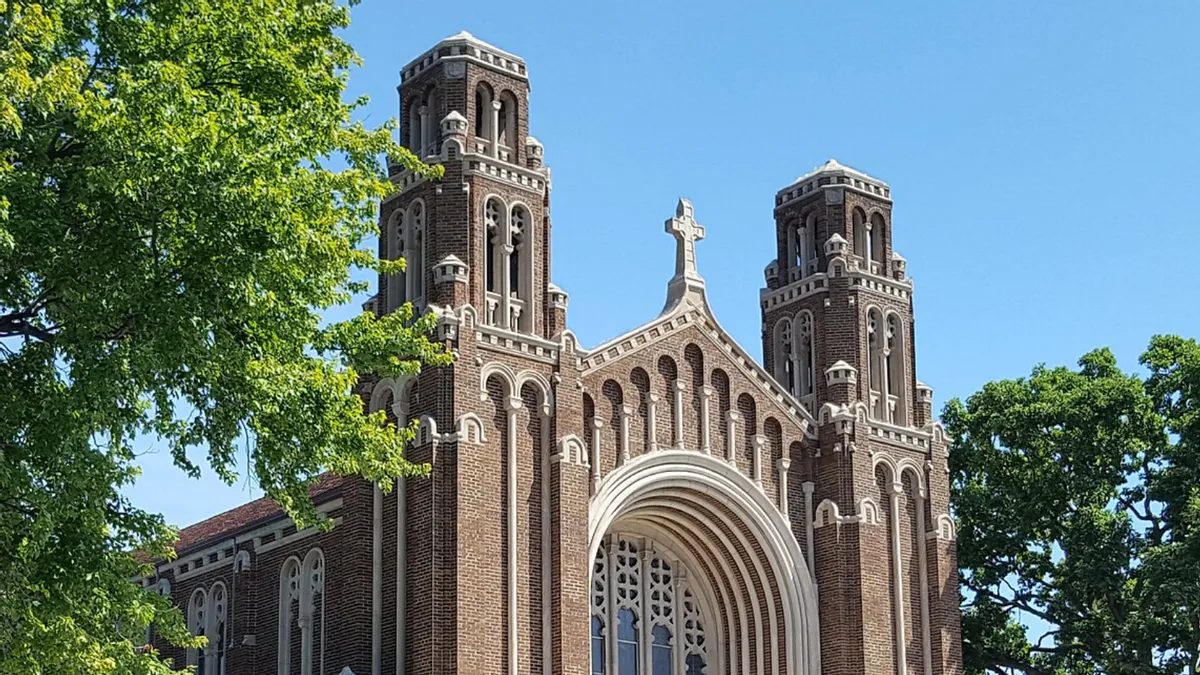
In July 2026, Muslims in Dearborn, Michigan, demanded that churches stop ringing bells on Sundays.
Dearborn had a documented local dispute over mosque loudspeakers used for the Islamic call to prayer in 2025. But local reporting described complaints about those broadcasts, not Muslims demanding that churches stop ringing bells.
In August 2026, a rumor recirculated on social media that Muslims in Dearborn, Michigan, demanded that churches stop ringing bells on Sundays.
One X post (archived) spreading the claim started:
In Dearborn Michigan: Muslims DEMAND submission!!
In Dearborn Michigan, Muslims are now demanding that CHRISTIAN CHURCHES stop ringing their bells on Sundays. This is real and their reasoning should terrify every Christian American.
Muslims are saying “According to Sharia Law, church bells cannot be louder than our Islamic call to prayer. We are the majority in this city and you HAVE TO respect us, our laws, and our religion.”
Versions of the rumor spread across multiple social media platforms, including X, LinkedIn and Threads.
However, the rumor appeared to spread only through social media posts, which did not identify who allegedly made the demand, which church or churches were targeted, when it happened or where the quoted statement came from. We found
We contacted the city of Dearborn for comment and asked whether it was aware of any incident matching the claim. We will update this article if we receive a response.
Complaints about mosque loudspeakers
The rumor may have grown out of a real, but different, noise dispute in Dearborn. Local reporting showed the city had recently dealt with complaints from some residents about mosque loudspeakers used to broadcast the Islamic call to prayer. In October 2025, Detroit-area news outlet WXYZ reported that some Dearborn residents had complained about outdoor calls to prayer that could be heard on loudspeakers throughout the city.
According to WXYZ, the Islamic Institute of Knowledge on Schaefer Road broadcast the call to prayer by loudspeaker twice a day for about two minutes. The outlet reported that Dearborn resident Andrea Unger had raised concerns at City Council meetings, saying she did not want to hear the loudspeakers in her yard or home.
The same report quoted Fouad Berry, a board member at the Islamic Institute of Knowledge, saying the mosque had stopped broadcasting the early-morning prayer after complaints came in “just to be respectful to the community.” Also according to the report, Dearborn police Chief Issa Shahin said at an Oct. 7, 2025, City Council meeting that mosques could be cited if they used loudspeakers before 7 a.m. or exceeded permitted decibel levels.
Detroit news station WKBD also reported on the mosque loudspeaker complaints. According to that report, Unger presented a signed petition at a City Council meeting concerning the use of an outdoor loudspeaker at the Dearborn Community Center, one of several mosques in Dearborn that had received noise complaints.
WKBD reported that Dearborn officials conducted decibel tests at some mosques and found instances of a mosque violating the city ordinance. The outlet also reported that Nabeel Bahalwan, director of the Dearborn Community Center, said the mosque was within allowable noise limits and did not want to bother neighbors.
None of that reporting described Muslims demanding that church bells be silenced. Rather, it described residents’ complaints about mosque loudspeakers and city officials’ efforts to enforce Dearborn’s secular noise rules.
Dearborn’s noise rules
Dearborn’s code also does not support the post’s framing. The city’s general noise regulation prohibits “unreasonably loud, disturbing, unusual or unnecessary noise” that disturbs or endangers the comfort, peace, health or safety of others. The provision does not mention Shariah, Islam, mosques, churches or church bells.
A separate section restricts the use of loudspeakers or similar devices between 10 p.m. and 7 a.m. when the sound creates a noise disturbance across a residential property line. That rule applies to loudspeakers “for any purpose,” rather than to one religion or type of house of worship.
What we know about Dearborn’s demographics
The post’s description of Dearborn as a “Muslim-majority town” was not supported by an official religious count.
Dearborn is known for its large Muslim and Arab American communities. However, the census-related figure often cited in coverage of the city concerns ancestry, not religion. Detroit news station WDIV reported that U.S. Census Bureau data showed people of Middle Eastern or North African ancestry made up 54.5% of the city’s population. In other words, the 54.5% figure measured Middle Eastern or North African ancestry, not Muslim identity.
The federal government does not have an official count of Dearborn residents by religion. Pew Research Center has reported that U.S. census forms do not ask about religion, and that the decennial census has never directly asked Americans about their religion. The Census Bureau also has said (Page 22) it does not collect data on religious affiliation in its demographic surveys or the decennial census.
Some nongovernmental groups compile religious-demographic estimates. For example, the Association of Religion Data Archives’ 2020 U.S. Religion Census includes data for the Detroit-Warren-Dearborn metropolitan area, but not a city-level count for Dearborn itself.
Snopes has previously fact-checked similar false claims tying Dearborn or Michigan communities to Islamic law, which is commonly referred to as Shariah. In 2017, we found that a viral image did not show a KFC in Dearborn using separate lines for men and women, but the photo was actually taken at a KFC in Saudi Arabia. In 2018, we investigated a claim from a satirical website that a so-called Shariah zone in Michigan had banned bacon and required women to wear burqas in public.
