


- Officially recognized as a collection of quilombos, or traditional Afro Brazilian communities, by the government in 2023, Brejão dos Negros is still awaiting the land titles it has been demanding for 20 years.
- The federal land reform agency has demarcated more than 8,000 hectares (19,800 acres) of the territory, but the communities have been authorized to use less than a tenth of this area.
- This delay has left them vulnerable to land disputes; the encroachment of shrimp farms into mangrove areas, which harms fishing and shellfish gathering; and increased salinization of the São Francisco River, which affects their crops and hinders their access to potable water.
- Seeking new income sources, the community members are turning to pesticide-free farming; one of the communities has become the largest producer of agroecological rice in Sergipe state.
BREJÃO DOS NEGROS, Brazil — It’s hard to tell where one ends and the other starts. Here on Brazil’s Atlantic coast, where the São Francisco River meets the sea, waves ripple across the crystal-clear water. In the vast blue expanse, the green of islands and islets blends with fertile lands covered in Atlantic Forest remnants, white dunes, small docks, marginal lagoons, and mangroves — a biological heritage that serves as a nursery for countless marine species.
But this beauty has not always belonged to those who lived there. Remnants of cotton plantations and more than 20 mills tell of an era before the so-called Golden Law of 1888 abolished slavery in Brazil. This region once held the largest number of enslaved people in the lower catchment area of the São Francisco River. Because of its dense native forests, it was also an ideal refuge for those who managed to escape, which earned it the name Refúgio dos Negros.
Even after abolition, the people who lived off artisanal fishing and farming here enjoyed little real freedom. The land where they had lived on and worked for generations was claimed by local landowners who, with or without legal titles, exercised uncontested dominance. According to residents of the Brejão dos Negros Quilombola Territory — a group of traditional communities, or quilombos, founded by formerly enslaved Afro-Brazilians — fences and cattle grids went up everywhere, making them feel like prisoners in their own land.
“It was like this: if you harvested a field of rice, two-thirds would go to the landowner and one-third would be yours,” says Marília dos Santos, gesturing as she speaks. “And all the operating expenses would still be discounted from your share.”
Santos, who arrived in the area in the mid-1970s, says much has changed since the days of the sharecroppers known as meeiros, a system where “sharing” was a euphemism for a deeply unequal split.
The meeiro was a landless worker who farmed a large landowner’s estate and split the harvest in half (meio) in exchange for using the land. According to historical research about the area, this sharecropping system, known as meação, was common along the entire length of the São Francisco. In practice, the relationship was highly exploitative. Expenses were deducted even from the disproportionate division described by Santos, reducing workers’ earnings to almost nothing. For generation after generation, riverfolk in the Lower São Francisco remained tied to the land, captive to landowners who controlled everything from the harvest to their very right to stay.
Santos commands the respect typically shown to elder women here; when she speaks, the other community members, or quilombolas, fall silent. We are in a conversation circle in Resina, one of the main quilombos that make up the Brejão dos Negros Quilombola Territory, some 120 kilometers (75 miles) from Aracaju, capital of the state of Sergipe.
Sitting in a circle, community representatives trace their history from labor exploitation to their recognition as a quilombola territory — the result of intense mobilization and resistance. Despite INCRA, Brazil’s federal agency for land reform, having already demarcated the territory, land titles have not yet been issued. Five communities self-identifying as quilombos make up the wider Brejão dos Negros Quilombola Territory: Resina, Santa Cruz, Carapitanga, Brejo Grande, and Brejão dos Negros. Each has its own association representing the local population.
‘We thought it was normal’
In the sharecropping era, the oppression didn’t stop at the harvest. Manoel Silvino Santos, who began working in the fields at age 10, describes his life then as that of a “trapped slave.” There were no schools for the workers’ children. While the landowners’ children studied in the cities of Penedo or Aracaju, children like Santos were limited to whatever they could learn at home, within wattle-and-daub walls. “Historically, we have only worked to make others rich, to put landowner’s children through school so they would become lawyers, judges or prosecutors while our children still live in poverty,” Santos says.
When residents tried to bring electricity to the village, they were given a generator and wiring by a supportive neighbor in the village of Cabeço. But the landowner’s response was immediate. “He asked by whose order we had light in Resina and said ‘take it down, because Resina is mine,’” Marília dos Santos says. Under threat, the residents had to dismantle their own wiring and return to using kerosene lamps and candles. “It was a sad life we had in here,” she recalls, her eyes welling with tears.
“We didn’t understand that we were being exploited. We thought it was normal and they were being good by letting us work the land,” says Maria Izaltina Santos. She is the president of the Association of the Remnant Community of the Brejão dos Negros Quilombo, the parent organization based in Santa Cruz that legally represents the wider quilombola territory.
In the 1990s, the introduction of mechanized rice cultivation made sharecroppers obsolete. Without farm work, families turned to the mangroves to survive. Gathering crabs, shrimp and shellfish, alongside artisanal fishing, suddenly became their only way to make a living. Those with backyards grew what they could, but their primary income came from the mangroves.
Eventually, this source also came under threat. The landowners, who no longer needed manual labor for planting, continued to claim ownership of riverbanks and lagoons. Driven by disputes with other land grabbers in the region, they tightened their grip. Access to the mangroves, the river and the marginal lagoons became increasingly restricted as they installed more fences and hired armed gunmen. Just as on the land, the communities lost their freedom of movement in their own territory; for the quilombola, everything was being privatized and their struggle to remain there was entangled in the conflicts raging behind the fences.

The search for origins and the awakening of identity
The turning point came from outside, wearing a cassock and asking uncomfortable questions. In 2005, Father Isaías Nascimento arrived in Brejo Grande, the municipality where the quilombos are located. Working with Cáritas Arquidiocesana Nordeste 3, a Catholic social justice organization, he began to question the exploitation and the communities’ identity. “What was our history? We didn’t even know our own history,” Izaltina Santos says.
“The struggle started in 2005, but since 1982 the rural workers’ union movement in Brejo Grande, along with some artisanal fishers, had been demanding public policies for social inclusion,” Father Nascimento says. They wanted land reform, which never reached the municipal authorities in Brejo Grande due to pressure from large landowners and local power brokers. At the time, more than 40% of the municipality’s land was in the hands of a single family, according to Nascimento. “There were more than 500 poor families in need of land.”
Marília dos Santos remembers that time vividly: “The priest sat people down under a tree and laid out the history for everyone.” He then asked who had the courage to take up the struggle. She was one of the first to step forward: “Let’s fight.”
That was when the seed of quilombola identity began to germinate. Marília’s son, Jonatas dos Santos, says that until then, no one knew they were quilombolas or that they had a legal right to the land. “We were descendants of enslaved people, and every community descended from enslaved people is the rightful owner [of these lands], that’s what we were told,” he says. The process enabled the communities to recognize their ancestors and remember that many were also Indigenous people who had been evicted, enslaved or killed.
The search for their origins, however, ran into resistance from elders who were reluctant to speak about the past, even when confronted with the physical remnants of slavery, such as the thick, darkened wooden posts with iron rings still visible near Brejo Grande. “My mother said it was from the time of captivity, but I think many people made a pact with the landowners. They didn’t want to talk about it,” Izaltina Santos says.

To better understand these confusing stories, the communities requested certification from the Palmares Cultural Foundation, the government-funded body that grants official recognition of quilombos. They received recognition in 2006, the same year they founded the Santa Cruz Association. INCRA then carried out the first registration. Their struggle for recognition merged with that of neighboring communities threatened with eviction: Resina, Brejo Grande, Carapitanga, and Brejão dos Negros. The community members self-identified as quilombolas and formed a collective territory.
But official recognition sparked immediate conflict. The construction company Norcon, which is now in judicial recovery, wanted to build a luxury resort exactly where the Resina community lived. Tourism was growing in the region, and real estate along the mouth of the São Francisco River was highly coveted. The company built houses for the residents in the village of Saramém, and many accepted them out of fear. According to the community, giving up their self-identification as quilombolas was part of the deal.
“The quilombolas reorganized around their ethnic identity, bringing to light their way of life and their relationship with the mangroves and the river,” says Alzení Tomáz, a lawyer, researcher and popular educator. She holds a master’s degree in human ecology and socioenvironmental management, and has monitored the territory for more than 25 years through institutions like the Brazilian Society of Human Ecology (SABEH). “They realize that by having their own territory they’ll have autonomy and their own dreams, but it doesn’t happen quickly or easily.”

The quilombolas faced pushback from influential families and even a judge, Rosivan Machado from the Neópolis judicial district, who began spreading rumors that recognition would be a step backward. “She said that those who became quilombolas would be slaves again,” Izaltina Santos says.
The local elite and politicians launched a full-blown campaign against self-declaration and land titling. Tomáz says some residents avoided identifying as quilombola out of fear of the judge or because they had relatives working for the four most powerful families in town. The local conservative press published several articles with misinformation, and posters pasted on house doors read: “No to the quilombo / Movement in defense of individual property in Brejão dos Negros.”
There was even a chaotic church mass from which Father Nascimento and the bishop had to be escorted out under protection. The territory was eventually added to the Map of Conflicts Involving Environmental Injustice and Health in Brazil, a collaborative platform run by the Oswaldo Cruz Foundation (FIOCRUZ), a federal health research institution, which maps and publicizes territorial disputes affecting vulnerable populations.
Care-based leadership
During that period, young people and women took the lead in the quilombola movement. Antônio Bonfim, who became the association’s first president in his early 20s, was not alone. “I spent four years in the association, went to Brasília, attended public hearings, gave lectures … always alongside the elders and the women,” Bonfim says. “The power of fertility belongs to the feminine. The sacred explains that.”
Today, Bonfim provides spiritual leadership and works to revive sacred African traditions in the quilombo. “The spiritual role is a collective role of protection for the quilombola struggle,” he says.
Over the years, their opponents have killed their domestic animals, sank their boats, set fire to the parish house, and made death threats against them. “It was a terrible struggle. We had no casualties, but there were many threats, you know?” Jonatas dos Santos says. “We had to have police escorts.”
The agribusiness caucus in Brazil’s Senate even challenged the quilombola declaration and INCRA’s procedures in court. In 2015, when a technical report on the demarcation was published, 18 challenges were filed. Only in November 2023 did the Brazilian state officially recognize the quilombo under Ordinance 234. INCRA demarcated about 8,000 hectares (19,800 acres), but only 750 hectares (1,850 acres) have been cleared for community use. The dispute, which involves former landowners’ heirs and lawsuits dragging on for more than a decade, remains an open wound. Amid occupations and court-ordered repossessions of several areas, fences mark out conflicts everywhere, encroaching upon the territory.
The quilombos that make up Brejão dos Negros have been waiting 20 years for their land titles. “The slowness of this process leaves us vulnerable, because our territory is being invaded and destroyed,” Izaltina Santos says.

No land titles, but plenty of shrimp ponds
Since 2010, the land conflicts have been compounded by the arrival of shrimp farming. Studies show this activity degrades and poisons mangroves with chlorine and lime, killing fish fry and crab larvae by devastating their natural habitat. Native freshwater shrimp have almost vanished from the area.
However, the business is lucrative and has been promoted as a symbol of development by both the public and private sectors through programs like Shrimp in School Meals. Ponds are multiplying, including illegal ones, with the highest concentrations in Carapitanga and Brejo Grande, as shown by the light pink areas in the map. Sergipe state is now one of the largest producers of farmed shrimp in Brazil.
The damage is also felt on people’s skin. That was the case with the son of Maria Auxiliadora de Souza dos Santos, known as Dodora, a leader of the Quilombola Association of Brejo Grande Municipality. “He lost his job and went to work in the ponds,” she says. “They didn’t give him any equipment or guidance. He ended up completely burned, with marks on his legs from handling those chemicals.”
In Carapitanga, where shellfish gathering used to be the main economic activity, residents say shrimp ponds appear overnight. Many belong to small local producers — residents who can no longer make a living from artisanal fishing or shellfish gathering and have turned to shrimp farming as an alternative income source.
“Carapitanga is highly impacted and suffers from the deforestation of mangroves,” Tomáz says. “The communities join in based on a supposed logic of ‘development.’ It’s the governments themselves that encourage this, with the sole perspective of making money.”
The region’s stagnant economy was and still is fertile ground for aquaculture. In Brejo Grande, which has the worst Social Progress Index in Sergipe state, and one of the worst in Brazil, work in shrimp farming has become an attractive alternative for residents. The drastic drop in demand for labor in the rice fields, driven by harvest mechanization, coincided with the rapid depletion of native species for artisanal fishing and shellfish gathering. This decline is worsened by pollution dumped by shrimp ponds into mangroves and salinization of river water.
Access to land is also limited. A large part of the land in the municipality remains in the hands of a few local families, and Brejo Grande was left out of the current demarcation of the quilombola territory. In some cases, like that of Maria de Lourdes dos Santos, the only way to secure a plot of land is by asking for a favor.
“An acquaintance let us plant on a small area of his land,” she says. There, they grow cassava, peanuts, rice, okra, collard greens and other vegetables for their own consumption. Part of the yield goes to the landowner — an arrangement that, to anyone who knows the history of the place, sounds all too familiar.

The São Francisco: A river swallowed by the sea
At the mouth of the São Francisco River, fishing and agriculture are also suffering from changes in water flow caused by upstream hydroelectric dams such as the Xingó and climate change. Prolonged droughts and rising sea levels have drastically changed the region’s dynamics. The village of Cabeço, for example, was swallowed by the ocean.
As the ocean gains ground and the river loses strength, salinization of soil and groundwater increases in the Lower São Francisco. In the now-brackish lagoons, rice cultivation has plummeted. Typical freshwater fish have died off, and clean drinking water is scarce.
Shrimp farming further exacerbates the crisis. “There are many streams that they fill in to make the [shrimp] ponds,” says Enéias Rosa, a farmer and community leader in Resina. “In the past, we used to drink water directly from the river, we washed dishes and clothes, all on the riverbank. That is no longer possible.”
The fate of pilombeta, a fish that has always existed at the river’s mouth, illustrates the change. Rosa says prices have increased more than a hundredfold — if you can find any.
He says riverfolk use brackish water for their daily chores, but rely on water trucks for drinking water, despite living on the banks of one of Brazil’s largest rivers.
Researchers from the collaborative mapping project MapBiomas confirm Rosa’s description: the São Francisco Basin lost 50% of its natural surface water between 1985 and 2020. The eight hydroelectric dams built along the river’s 2,800-km (1,740-mi) course worsen the problem, exposing large volumes of water to evaporation in a semiarid climate.
Deforestation for agricultural expansion has exacerbated the crisis. Today, nearly 70% of the land cover in the Lower São Francisco has been modified by human activity, the highest rate among all the river’s subbasins. Washington Rocha, coordinator of MapBiomas’s Caatinga project, points to the lack of policies to balance intensive irrigation with the river’s actual capacity. This gap is particularly severe given that only 4.4% of the remaining native vegetation in the Lower São Francisco lies inside protected areas — the lowest rate in the entire basin.
And it doesn’t stop there. As a flat area bordered by both the river and the sea, this scenic region attracts plenty of investors interested in tourism development. Real estate speculation remains strong and widespread.
But within the community, there’s a slow push in another direction. “It’s crucial for us to strengthen our community-based tourism, because that way everyone wins a little,” says Juciana dos Santos Gomes, a resident of Resina. On her family’s plot, just a few meters from the riverbank, they built two small cottages to host visitors seeking an authentic quilombo experience.

Freedom rice
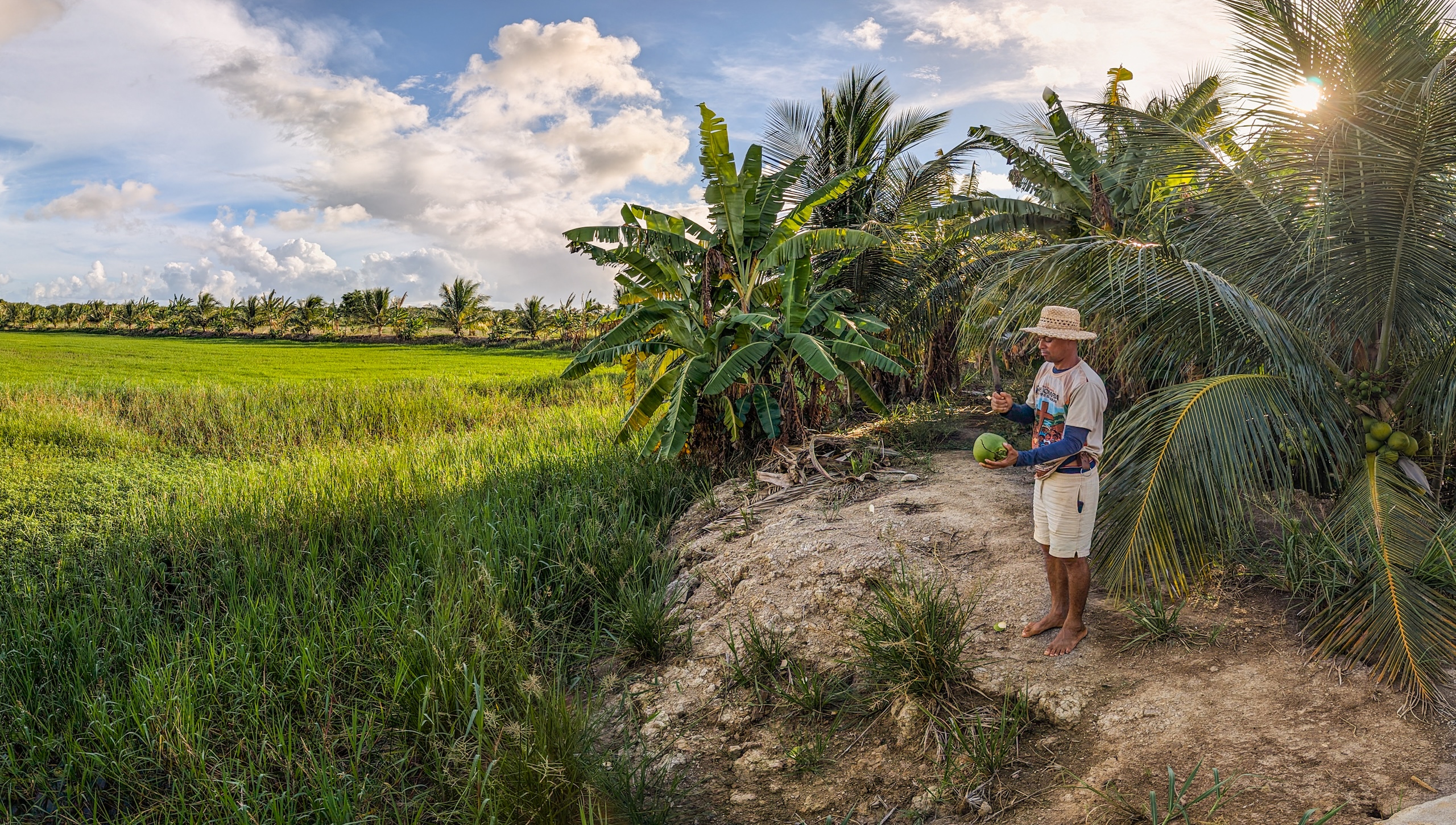
From Resina’s river dock, it’s a 30-minute boat ride along the São Francisco to the rice fields. Along the way, Rosa points out lands that have yet to be expropriated by the government, docks, areas under threat, and farms where land grabbers remain. He knows every bend of the river. When we arrive at the rice fields, he uses a machete to collect and cut open a coconut, a bunch of bananas, and the best guavas we’ve eaten in a while. Gherkins, okra, cassava, watermelon and other crops grow together in the fields by the water.
While rice farming has declined in other parts of the Lower São Francisco due to salinization, the crop has persisted in Resina, though it initially depended on chemical pesticides and fertilizers. There was a cost, though: in the irrigation channels known as levadas, shrimp, fish and crabs were dying.
“Even the bees vanished,” Rosa says. “Fireflies, butterflies, everything ended up disappearing because of the pesticides.”
The soil was becoming impoverished, and the yield barely covered the expenses. Instead of producing food, they were producing debt.
During the COVID-19 pandemic, the discussion became urgent. Relying on government-provided staple food packages felt like a return to an old form of submission, and the community wanted to produce its own food. That was when Mauro Cibulski arrived. A native of Rio Grande do Sul state, he’s a member of the Balaio de Solidariedade network working with Cáritas Arquidiocesana Nordeste 3, the Catholic charity. The proposal was simple: to plant without agrochemicals.
“We were a bit suspicious, but we tried it,” Rosa says. Earthworms, crabs and butterflies returned. “We saw the soil grow stronger,” he says. “The plants became more resistant, more beautiful, greener and stronger.”
Today, they make natural insecticides from herbs, cashew nuts and local ingredients, and fertilizer from rice straw, chicken manure and cow urine.

Resina is now the largest producer of agroecological rice in Sergipe, and the only quilombo in the state to farm this way. In 2024, the community harvested 254 metric tons of rice from about 40 hectares (100 acres). The pesticide-free crop, branded as Velho Chico rice, is sold to the National Supply Company (CONAB) and the state government, which distributes it to families facing food insecurity through the Food Acquisition Program (PAA).
“It all started with rice,” Rosa says. “Agroecological management changed our lives; it gave us awareness and income. It was the liberation of our people.”
For Cibulski, key steps are still missing, such as investment in machinery for planting, harvesting and drying, as well as technical support tailored to the community and leadership training. “This is a historical debt. The government should encourage [agroecology], especially because it protects the environment,” he says, emphasizing that none of it can be fully secured without formal land titles.
Rosa agrees. When he talks about the future, he focuses on land and youth. “My dream is for this territory to come into our hands, and for it to come with investment, because if they hand over the land and don’t give us the conditions to produce, they will call us lazy,” he says. “And I want our youth to stay here. Today, it’s very difficult to keep young people in the countryside. Our dream is for them to study, graduate and come back to work here. Because we have everything we need to be happy. We just need access to land, credit, water and rights.”

‘When we come together, we realize we are one’
A few kilometers away, in the quilombo of Carapitanga, Mislaine Lima is an example of a youth who chose to stay. She also studies, gathers mangrove seedlings, or propagules, and works to restore the mangroves.
“We call them the little mangrove pens,” she says, pointing to the shoots she replants in areas degraded by shrimp farms, squatters and others.
Lima is part of the Water Peoples Project, an initiative of the Association of Small Farmers of the State of Sergipe (APAESE) in partnership with one of the corporate social responsibility programs of Brazilian state-owned oil and gas company Petrobras. The project operates in the municipalities of Brejo Grande and Pacatuba, focusing on mangrove reforestation, environmental education, marketing support, and wastewater treatment.
While sururu mussels have almost vanished, crabs, which fishers once caught by reaching into the mud, are now so deep they require a small net trap to capture. But these nets can become a pollutant if left behind.
“We all survive off the mangrove; it is our Old Father,” Lima says. “That’s why we must have this awareness not to leave waste there. I’m studying for this. I won’t have a clear conscience if I know I left something in the mangrove.
“I’m a mix of Indigenous, cabocla [half-breed], Black, African,” adds Lima, a 16-year-old mother of two young children. When she talks about the meetings and exchanges she attends through social programs, she describes a blend of cultures. “It’s important that, when we come together, we realize we are one.”

It’s in the same spirit of care and belonging that Antônio Bonfim describes their relationship to the mangroves. For him, Nanã, the orixá (deity) of still waters, mud and origins, is present in this ecosystem. Anyone who destroys the mangrove destroys not just a biome: they offend a sacred being.
“Nature is one of the sacred pillars in African-derived religions,” Bonfim says. “There is a saying: ‘Without leaves, there is no orixá.’”
The following afternoon, during a walk through the Santa Cruz forest, Maria Izaltina Santos points out the various fruit and medicinal plants that the forest provides: jatobá, cruiri, ubaia, ingá, amescla and olho-de-boi — the latter is “good for carrying in your purse as protection,” she recommends. The ground is covered with dry leaves that are collected to fertilize backyard plants. At the end of the trail, a century-old wild fig tree with massive roots awaits us, its trunk wrapped in a white cloth ribbon and a clay pot filled with water and flowers at its base. Before approaching, one asks for permission. Before touching it, one is warned: the tree mirrors the energy of whoever touches it. “Our ancestral tree is a strong connection to our sacred,” Bonfim says. They light candles, kneel, clap their hands and pray.
The territory is home to three temples dedicated to African-derived religions. But many of the faithful — the traditional healers, root herbalists and prayer makers — “hide themselves,” Bonfim says. Most still purport to be Catholic, but the community is gradually opening up to the sacred traditions kept for generations, even when they conceal it.
“We are the ones who separate what is Catholic from what is African-derived; it doesn’t work that way in the astral realm,” Bonfim says. “An archangel needs Exu [a Yoruba deity], and Exu needs to communicate with an archangel.”

No single quilombo
Each community has its own nuance, suffering, and pace of achievement. Brejo Grande and the Brejão dos Negros village lie outside the area demarcated by INCRA. Carapitanga has suffered the most from the rapid encroachment of shrimp farming, with its mangroves being cleared meter by meter. Resina and Santa Cruz hold the leadership and some of the territory’s most visible achievements, but they remain under threat and have a long way to go before they are fully protected.
Internal diversity can be a strength or a source of division. In all the communities, residents report conflicts, disappointments, and even neighbors working against the quilombola associations, creating rival groups with opposing proposals.
“These tensions only weaken us,” says Manoel Santos, the former child sharecropper. “And they are encouraged. Because they know that the more divided we are, the easier it is to bring us down.”
To navigate this complexity and protect themselves, the community drafted a consultation protocol in 2023. The document was created by the quilombolas themselves, with support from researchers and activists from organizations like Teia dos Povos, the Federal University of Sergipe (UFS), Cáritas, and SABEH.
“We were just facilitators in the process,” says Alzení Tomáz from SABEH. “The community conducted its own cartography and told its own story.”
More than a map, the protocol is a political instrument to demand action from the state and strengthen the land-titling process. The document is categorical: “As quilombolas and guardians of this territory, we have the responsibility to observe and carefully evaluate every action that might interfere with our place. The quilombo is a place of life, today, tomorrow, and forever.”

This life has many forms and many faces. For example, it persists in Magno Santos, who is pursuing a master’s degree in quilombola education at UFS while teaching biology at a public school 100 km (60 mi) from home. He also coordinates a quilombola teacher training school program implemented a year ago in the territory. And he’s a fisherman, farmer and beekeeper. “Beekeeping manages to make the territory productive. That is what keeps people here,” he says, expressing pride in having trained six quilombola students in the activity.
It also persists in what Maria Izaltina Santos calls, almost in passing, “our things”: the crochet and straw crafts that women take to fairs; the cambuí cachaça liquor that some call whiskey de bolinha; the ubaia jams; the reforestation efforts with mangabeiras and native palms. And the traditional medicine taught by all mothers, which was almost lost. “Every plant is good for something,” Izaltina Santos says.
She recently became a citizen researcher for a FIOCRUZ research group, and was invited to teach a university class on social movements. Bonfim was also invited to teach about ancestry at UFS. The territory that was treated as invisible for decades is now in university classrooms.
Izaltina Santos speaks of faith in transformation and the life that persists, citing a famed quilombola activist leader: “As Nêgo Bispo said: when a river flows out and meets another river, it doesn’t end, it follows another. The beginning doesn’t reach the end; instead, it’s the beginning again. There will always be someone starting over. We leave, we depart, but someone continues.”
Banner image: Rice fields in the Brejão dos Negros Quilombola Territory. Image courtesy of André Cherri/V.U.E.L.A.
This story was first published here in Portuguese on July 30, 2026.
Citations:
Cordeiro Domingues, R. (2016). A vulnerabilização camponesa no contexto da transposição do Rio São Francisco: O desterro na vila produtiva rural Baixio dos Grandes (Master’s thesis, Aggeu Magalhães Research Center, Recife, Brazil). Retrieved from https://www.cpqam.fiocruz.br/bibpdf/2018domigues-rc.pdf
Cavalcante, G., Vieira, F., Campos, E., Brandini, N., & Medeiros, P. R. (2020). Temporal streamflow reduction and impact on the salt dynamics of the Sao Francisco River Estuary and adjacent coastal zone (NE/Brazil). Regional Studies in Marine Science, 38, 101363. doi:10.1016/j.rsma.2020.101363
Cite this article
Carolina de Marchi (2026). Land rights and mangroves entwine in a Brazilian quilombo’s resistance. Mongabay Conservation news. DOI: https://doi.org/10.66709/news-325902

