


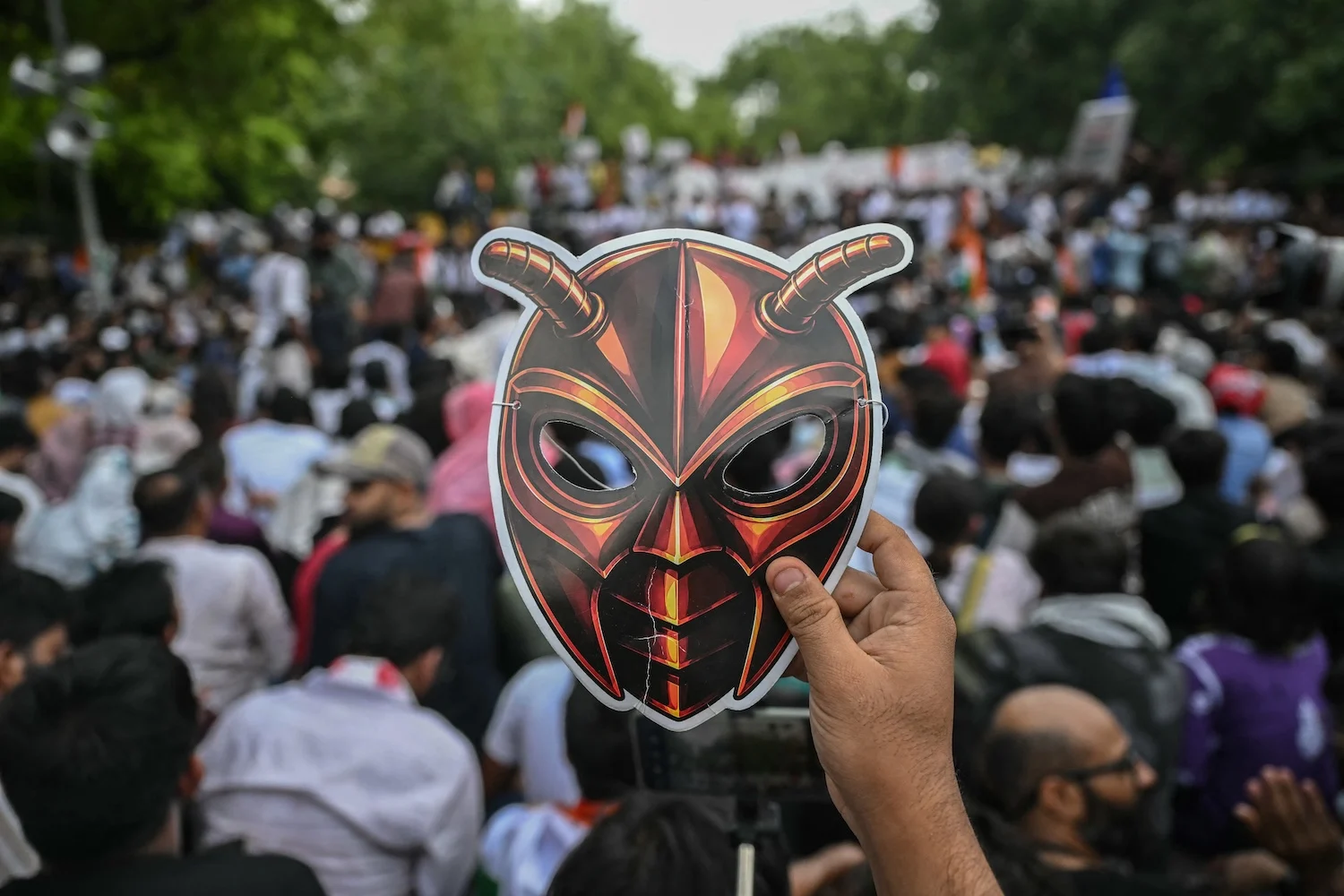
When India’s chief justice referred to unemployed youth in India as cockroaches earlier this year, that became the rallying cry for a new political movement called the Cockroach Janta Party. Before long, young Indians discontent with the country’s education system and its labor market were marching on parliament—and being met with harsh police crackdowns and internet shutdowns. Ultimately, the government backed down, resulting in the Indian education minister’s resignation. But the difficulties faced by India’s young people remain—as does the new movement claiming to represent their interests.
What exactly is going on with the Indian economy? Why is its education system struggling? And how will advances in artificial intelligence affect employment levels?
Those are just a few of the questions that came up in my recent conversation with FP economics columnist Adam Tooze on the podcast we co-host, Ones and Tooze. What follows is an excerpt, edited for length and clarity. For the full conversation, look for Ones and Tooze wherever you get your podcasts. And check out Adam’s Substack newsletter.
Cameron Abadi: Are India’s labor market problems directly related to Prime Minister [Narendra] Modi’s overall developmental-state economic strategy?
Adam Tooze: The first thing to understand is the scale: There are 367 million people in India between 15 and 29. That’s most of the population of Europe, just in young people. That just explodes the conventional frameworks of Western understanding. The kind of desperation that you feel from this protest, the sense of panic and generational pressure on young people in the big Asian economies, is like nothing we know in the West.
And so, yes, this is really a huge challenge to any development program, and Modi’s in particular. It has produced growth, but it has not produced structural change. And without structural change, it has not produced the jobs that will absorb the increasingly gigantic flow of graduates from India’s education system. And that’s the core of the problem, which is that there is measured GDP growth, which is undeniable, and anyone who’s visited India can see it, it’s there. The infrastructure has changed. And for the top segment of Indian society, the resulting affluence is remarkable and easily approaching and exceeding, in many cases, developed economy norms. And then there is this huge part of Indian society and the Indian economy which has simply not experienced that same kind of growth.
So where most of the job growth is in India is in agriculture. India added 83 million jobs since the pandemic—that’s half the American labor force—lifting employment from 490 million to 572 million with gains for both men and women. But half of those are in farming. And above all, that’s where women are working. If you look at the structure of the Indian labor market, the share of people in formal employment with regular contracts is—it rose from 18 percent in 2012 to 23 percent in 2025. Which means that 75-plus percent of the Indian population is basically in informality, either in literally casualized work or in something that’s closer to formalized but still radically precarious self-employment.
So, this is the central problem that is being voiced and articulated in these protests. And I think you’re right to say that this is surely just the beginning of a rolling process of negotiation. Because this isn’t China. This isn’t a one-party regime with a repressive police state and no freedom of expression. It is by no means a liberal paradise. But the power of insurgent mobilization in India is absolutely real.
CA: At the heart of this movement is a discontent with Indian education and a sense that it’s not functioning well. Is it true that India’s education system is struggling—how does it compare with, say, China’s?
AT: India’s education system has many incredibly strong points. It has notable centers of technology, like the Indian Institute of Technology in Delhi and its counterparts in the other great cities of India. It has liberal arts colleges, which provide a constant pipeline of absolutely brilliant humanities students. India produces top-class talent across all the disciplines, great engineers, great historians, the whole works. And over the last 30 to 40 years, the other thing to say is there’s been huge transformation. And so the number of universities has exploded from 1,600 accredited institutions in 1991 to 70,000 today, with huge jumps especially in the 2000s. And there has undoubtedly been a story of widening access.
And on the other hand, there is, as it were, the dark side, which is that India’s top university, the Indian Institute of Technology in Delhi, at least by the conventional university rankings, ranks at 118th in the global rankings—by comparison with China, which increasingly dominates the top 10.
And from conversation with friends in India, what really struck me most was their deep, deep concern about elementary education in India. Because the basic human capital formation of any society is done not really at the top end of the education system, where in the end, brilliant people, often coming from well-resourced households, are going to prevail and charge their way through. But what you really want is to build the biggest possible pipe, the largest possible entry to the funnel. And that’s where India on comparative statistics has fallen down. And this was evident already in the early 1980s, when you compare India and China when the World Bank first got into China. Because their standard of what a poor country looked like was India, and then they discovered post-Maoist China, which actually had near-comprehensive literacy, and they hadn’t seen anything like it.
So in India, really, again, there’s huge change. The Right to Education Act of 2009 has now firmly established that there must be schools in every village, that there is a requirement that kids attend school. So within the last 20 years, there has been this move toward comprehensive enrollment. The basic logic of state-building, of building a national society is happening in India on a dramatic scale. But when you look at the results, when you test for what kids are actually learning in those thousands, tens of thousands, presumably hundreds of thousands of village schools, the outcomes are unsurprisingly poor. The teachers are underpaid, the teachers don’t show up. And crucially, of course, there’s very little cultural capital in the households, and particularly with mothers, many of whom are from older generations who are illiterate and therefore find it very hard to support their kids’ education.
And it’s at the elementary level that my much better-informed colleagues in India say that’s really where the issue is deepest. By the time they’re at university, they have very high levels of literacy compared to the hundreds of millions of kids coming out of badly funded rural schools, which just really don’t have the wherewithal. And so that I think is the gap that is worth focusing on.
CA: India seems to have made a choice to specialize in IT services—but is that now being disrupted by AI? And if so, does India have alternatives—can it pivot to becoming a global manufacturer at this point?
AT: AI is potentially a lethal threat. And according to some of the more alarmist surveys—in India it’s something like 130 million jobs, virtually the entire routine white-collar sector is potentially at risk, which would be devastating for an economy which has not principally gone down the manufacturing route.
The manufacturing story is the central question, right here, right now. So between 11 percent and 13 percent of Indian employment is in manufacturing, which is the sort of level you’d expect in a highly developed economy having gone through industrialization and come out the other side.
And so the central question for India is why is it not doing a Bangladesh? Why is it not doing a Vietnam? Why is there not a huge concentration proportional to the size of the Indian population of low-wage, low-cost manufacturing in India? And there are moments where Indians point the finger at China and say, “It’s all your fault, you’ve undervalued your exchange rate to do industrial policy.” And then they flip to a more introspective mode, and they realize, “Well, why would you expect it to have worked out in India given the multiple obstacles there are to rapid, small-scale capitalist development in India since independence?” Including the License Raj, the notoriously dense network of regulation, the incredibly high wages and security that are offered to public servants, which create a kind of crowding-out effect.
And again, it’s important to see past the headlines. There’s the Apple story, and it’s huge. And many of us were skeptics, including myself. This is the idea that, you know, Apple was forever fated to do most of its smartphone manufacturing in China and it was probably laughably implausible that they could establish a supply chain in India. And by importing a lot of money and an awful lot of Chinese technical talent, they have actually set up now substantial smartphone production lines in India. But it hasn’t spawned a dramatic transformation of a larger scale. And smartphones is one thing. The real question is why is India’s share of garment production smaller than that of Bangladesh?
CA: Given then the scale of these labor market problems, it seems only natural to ask how the Indian welfare state is responding. Has Modi overseen, accidentally perhaps, an expansion of India’s welfare state?
AT: This is exactly the train of thought that I saw people recapitulating again and again the last time I was in Delhi. Which is, OK, so you’re saying that tech will only employ some people and manufacturing isn’t taking off and agriculture is sort of a dead end in productivity terms, so what are we going to do? Does that mean that our future is the world’s biggest welfare state on a low average income? And the answer seems to be yes.
And what’s interesting is this is written into the Indian constitution. So the Indian constitution is a postwar social-democratic sort of document in parts, and it includes this provision that India is a welfare state and will provide welfare. And what has been very interesting over the course of the last 20 years is to see how that’s changed shape. Because from the 2000s onward, India became the ground zero for an experiment in a sort of jobs-guarantee program, which was linked to the idea that every poor rural family ought to have the guarantee of some minimum employment on public works programs. I think the promise was 100 days a year, which would secure basic family income by way of public employment of one member of the family. And this became one of the truly iconic elements of the Indian welfare state. Hugely contested on both sides.
Modi’s people hated it. And what we’ve seen since the 2010s is a shift away from that model, which has culminated this year. People may not follow this story, but over the winter of ’25, ’26, the Modi government mounted a concerted attack on this program, massively scaling it back. So what are they putting in its place? And that in itself is super interesting, because what they’re putting in its place is on the one hand the iconic Modi kind of Trump style. It’s like, Modi delivers you a toilet. So there was this anti-public-defecation campaign, which was to build public toilets all over India. Huge, obviously transformative development in providing people with dignified and sanitary provisions. Another one was clean cooking. So, Modi is going to provide you with clean gas cooking so you can avoid charcoal and all of the pollution that results from that. So these sort of charismatic items of consumption that the Modi administration is delivering on the one hand. And food supplies also. So increasingly access to free or cheap grain as a right, established in law. So all of this is saying, again, development is real, right? India will no longer tolerate a situation of absolute starvation-style poverty. Which in the ’70s was still omnipresent, and it’s really striking that India has exited that stage quite concertedly.
And then on the other hand, this other element of the last 15 years, which is truly innovative and you’ve got to see it to believe it, which is that practically everyone is equipped with some form of smartphone or some form of cellphone. And once you’re in the system, it’s literally a digital money technology, the likes of which very few Western societies have. Because regional governments in India, national governments can ping money to the population directly. You’re feeling hungry? Here’s some extra money for chapatis or whatever. There’s literally a direct channel. It’s not the ridiculous printing presses of checks that the Americans have to go through, or like the German administration, which can’t even operate a digital system for the whole population. It’s truly a remarkably innovative system.
And so then there’s a series of experiments going on about whether or not the most effective mechanism is a kind of drip, drip, drip welfare provision, which just provides basic income every month, or if you’re better off doing lump-sum allocations where you give a household or a village enough money to buy capital equipment, to pay off debts, to actually solve a fundamental problem. It’s really a laboratory of experimentation in low-income welfare. And it’s something that’s hugely underrated in the global story.
