


Follow ZDNET: Add us as a preferred source on Google.
ZDNET’s key takeaways
- Snowflake Volunteer is a new Android app that lets you help fight global censorship
- The standalone app allows more people to connect to Tor, even under oppressive regimes.
- The app turns your phone into a proxy and requires no technical knowledge.
Snowflake Volunteer, a new Android app recently revealed by the minds behind the Tor Project, has now landed on the Google Play Store as a way for the general public to help fight global censorship.
Not everyone can lend high bandwidth, set up Tor volunteer nodes, or campaign politically in what has become aprox worldwide fight for our right to privacy, amid tightening controls by states and governments that restrict our access to the internet and online services.
But this doesn’t mean we can’t all contribute in a small way. Snowflake Volunteer developers argue that a convenient way to help is already in our pockets — our smartphone can be used to provide others with access to the privacy-protecting Tor Network. Snowflake Volunteer is described as a “single-purpose app that gives volunteers control over when and how they contribute.”
Also: The best secure browsers for privacy: Expert tested
So, what is Snowflake Volunteer, how does it work, and how did the new Android app perform during hands-on testing? ZDNET decided to find out.
What is Snowflake Volunteer?
Developed in partnership among Android app studio Bloco, the Tor Network, and Guardian Project, Snowflake Volunteer is a standalone Android app that allows users to lend their internet connections to others to create Snowflake proxies for accessing the Tor Network.
Snowflake Volunteer is based on the Tor Project’s Snowflake, which debuted in 2019. Neither Snowflake nor Snowflake Volunteer is designed for anyone living in an oppressed country; instead, they are projects for individuals living in countries that do allow access to the Tor Network — and are happy to lend this freedom to others.
What is the Tor network?
The Tor Network, accessible via the Tor Browser, is a free way to access the web and .onion addresses while reducing the risk of being tracked. Connections are anonymized through volunteer-run nodes that bounce traffic among themselves, creating high levels of obfuscation and making it extremely difficult for third parties to monitor.
Also: 5 ways to scour the dark web for your data after Google kills its free report
It also allows users to access online websites and services typically blocked at the ISP level by states and oppressive governments. It’s private enough to be a favorite of activists, journalists, and whistleblowers.
How does Snowflake Volunteer work?
Once installed and enabled, Snowflake Volunteer connects with people who need a proxy to access the Tor Network. While Snowflake simulates a user’s traffic as a video call via WebRTC, it actually routes requests through proxies and maintains “short-lived” connections that are constantly moving, making them difficult to block, unlike static server addresses or IPs.
However, if a Snowflake proxy is blocked, the connection can simply jump to another one.
Your mobile device becomes one of these proxies, effectively serving as a gateway for people in countries with high levels of censorship to access Tor — and the online freedoms they can’t access through standard internet browsers.
Also: This privacy-first chatbot is taking off – here’s why and how to try it
The more individuals who install and run either the traditional Snowflake package or lightweight Snowflake Volunteer, the more robust and ever-changing the network becomes — which means it will be far more difficult for oppressive regimes to block.
By May, after launching in April, Tor recorded roughly 1,300 unique proxy IP addresses actively working in the pool each day. A month later, this had risen to approximately 1,700 Snowflake proxies, a month-by-month increase of 29%. At its height, there were over 2,100 active daily proxies — and so while the numbers are rising, there’s still work to do.
Hands-on with Snowflake Volunteer
I went hands-on with the new Snowflake Volunteer app, putting it through its paces to see if it delivers all it promises to would-be volunteers.
Installation
You can download Snowflake Volunteer on Google Play and F-Droid. The app’s code is open source, and developers can also explore the app on GitHub or create their own forks.
Also: You’re being tracked online – 9 easy ways to stop the surveillance
For most of us, Google Play is the easiest route. Visit Google’s app repository, select the app to install — that’s all. You don’t need to sign up for an account or give out advanced smartphone permissions to run the software.
Snowflake Volunteer is currently available in eight languages.
Settings and options
You can decide how the app works and when by changing the following settings, most of which can be accessed in the top-right corner of the app’s dashboard:
- Enable/disable: Found on the central screen, you can enable or disable the app, and the process couldn’t be simpler. Toggle the button on or off.
- Charging: Since the app does require some juice, you can choose to lend your connection only when the phone is charging. Enable “Charging only” if you don’t want the app to use battery life while you’re on the move.
- Wi-Fi: You can choose to have the app run only when you are connected to Wi-Fi, rather than a cellular connection, so you don’t incur unexpected cellular data usage or bills. Enable this setting under “Unmetered network only.”
- Background use: You can allow the app to ask Android to run in the background, which is useful if you want to help whenever your other conditions — such as Wi-Fi connectivity only — are met.
- Limits: You can also decide on how many people you are happy to help simultaneously. You can allow up to five connections at the same time — but keep in mind the more simultaneous connections, the more bandwidth you may end up using.
Also: Privacy in the AI era is possible, says Proton’s CEO, but one thing keeps him up at night
Performance
What immediately stands out about this app is the sense of community it’s trying to foster: When you enable Snowflake, it says “finding someone to help” while scanning, rather than the more direct language we’re accustomed to in apps, such as “establishing a connection.”
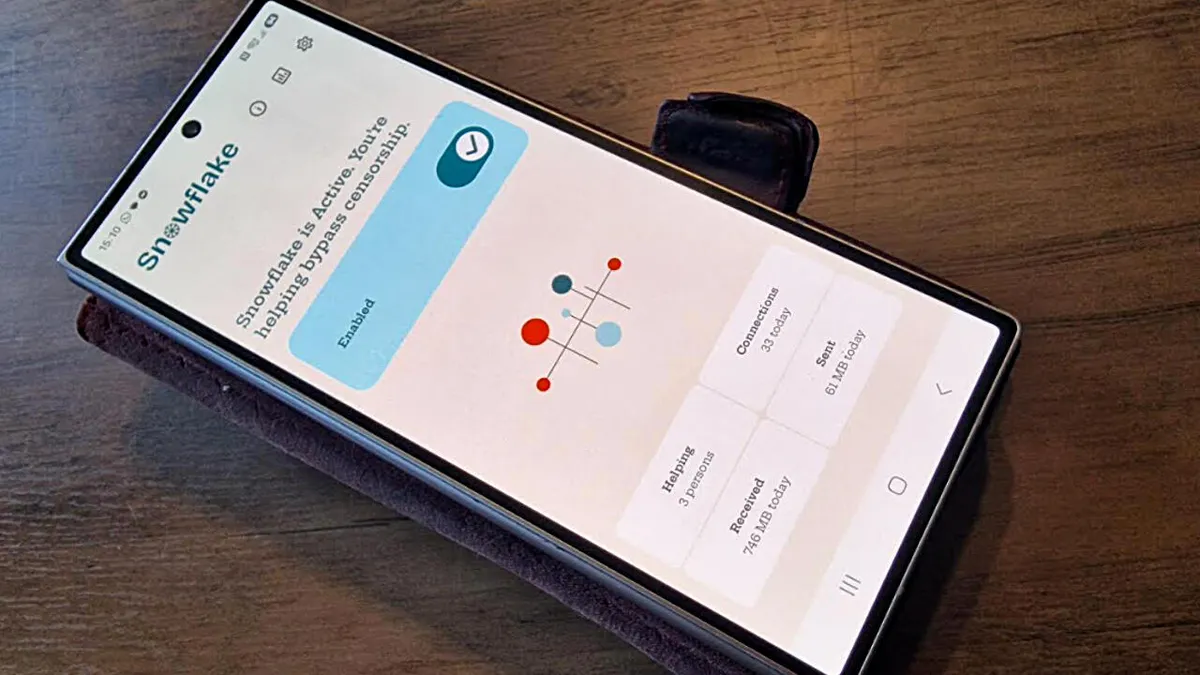
The app’s central dashboard also displays in real time how many people you’re helping, how many connections you’ve allowed over the course of a day, and how many bytes have been sent and received. There’s also a “statistics” panel in the top-right menu that documents connections by date.
Do you need to worry about which websites people are accessing through your Snowflake app? For example, what if someone is using your device as a proxy to visit illegal websites or engage in criminal activity? According to the developers, there’s no risk to volunteers when someone connects to your proxy, as “their visible browsing IP address will match their Tor exit node, not yours (since you’re an entry point).”
There are a couple of points to keep in mind, however, if you plan to download and run this app.
Also: Before you buy a smartwatch or smart ring, consider what you’re giving up
First, it won’t run if you use battery optimization — this setting has to be turned off, and so if you are using an older Android handset with an aging battery, you might have to avoid it for now.
Second, if you are connected to home Wi-Fi and on limited bandwidth, this could affect how much bandwidth you’ll have left at the end of the month. Active Wi-Fi or cellular is necessary, and you need to be happy for connections to link up to your proxy device.
Battery life
To see whether running this app daily would be a problem for the average user, I ran a series of tests. I allowed up to five simultaneous connections and waited until at least one connection was using my smartphone, a Samsung Galaxy Z Fold6, as a proxy before starting a three-hour run, with 88% battery life. I also did not use any other apps during this time.
(Note: This test was performed during a heatwave in the UK, so the phone’s average daytime temperature may have contributed to the gradual loss of battery. My phone is several years old, too, so its battery doesn’t hold or manage charge as well as it used to.)
- Starting power: 88%
- After one hour: 84%
- After two hours: 81%
- After three hours: 79%
This test isn’t indicative of what you may experience, but it’s useful for determining whether turning your phone into a proxy quickly depletes your battery. Based on these results, not by much.
Snowflake Volunteer: The verdict
Snowflake Volunteer, currently available over at Google Play and F-Droid, is an impressive app that can quietly assist others living in oppressive countries.
Most apps serve a purpose, and we generally download them for our personal convenience, such as a banking app to manage our finances, a social media app to stay in touch with friends and family, or weather and map apps to make our daily lives easier.
Also: This blazing-fast, super-private browser delivers a brand new beta – try it for free
But considering how powerful our pocket computers have become over the past decade or so, it seems like a missed opportunity not to use them for others’ benefit. I think this is what makes Snowflake Volunteer appealing: it is a quiet, unobtrusive app that lets you contribute to something important without any inconvenience.
The community of users is small, but I can see it growing steadily over time, especially as volunteers realize there’s no technical expertise required to help out. Considering how well the app is designed and the minimal power it requires, this is an app I intend to keep on my smartphone for the foreseeable future.
