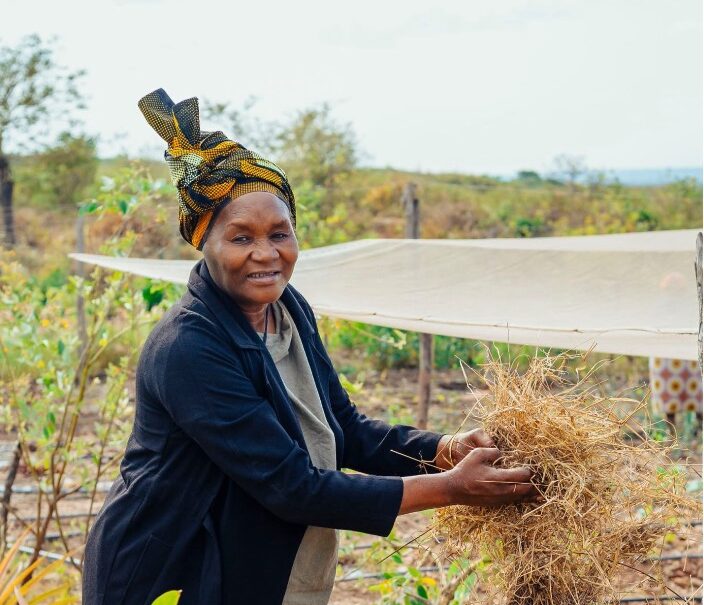
- In an interview with Mongabay, Mozambican social activist Olga Muthambe advocates agroecology as a response to the challenges confronting rural women affected by extractive industries and armed conflict.
- Muthambe is a co-founder of NGO Hikone Moçambique, a civil society organization that has been active in the African nation for over a decade. Since its inception, the organization has connected more than 5,000 women to socioeconomic training initiatives.
- According to Muthambe — who currently serves as the NGO’s executive director — agroecology enables women to produce pesticide-free food for both family consumption and trade, thereby improving food security and generating income.
In Mozambique, southeast Africa, more than 1,600 women participate in agroecological practice programs across the provinces of Maputo and Gaza (both in the south), Tete (central region) and Cabo Delgado (far north). These initiatives are led by Hikone Moçambique, a civil society association founded in 2013 that seeks to empower rural women. The organization’s work focuses primarily on Mozambican women facing social vulnerability.
The displacement of local populations, with resulting impacts on livelihoods, along with expropriation and concentration of land and resources, are some of the most common adverse effects associated with extractive industries that often amount to appropriation of nature through labor exploitation.
According to Hikone Moçambique, extractive industries also undermine food sovereignty and exacerbate inequalities, disproportionately affecting women, who lose their income-generating alternatives.
Hikone was co-founded by Mozambican social activist and current executive director Olga Muthambe. A feminist, community development practitioner, self-taught educator and mother of seven, she has over 30 years of experience with rural communities. In the 1990s, Muthambe worked with women and youth rehabilitation projects following the civil war in Mozambique (1977-1992), where she led initiatives to ensure food security.
Decades later, in 2021, in the midst of another armed conflict in Cabo Delgado, the NGO expanded its work to support women affected by violence and forced displacement, which impacted around one million people in that province alone.
Throughout its history, the organization has worked with more than 5,000 women across various activities, including training, community gatherings and seminars throughout Mozambique.
In 2025, Muthambe also visited Brazil for the 2nd Meeting of the National Women and Climate Network, organized by the Brazilian government as part of its goals to tackle the climate crisis by 2035.
Mongabay spoke with Olga Muthambe about the country’s social landscape, the challenges faced by the NGO and the role played by agroecology in the inclusion of women living in various vulnerable situations.
Mongabay: What kind of agroecology do women practice in Hikone’s projects in Mozambique?
Olga Muthambe: They practice agroecology based on the principles of sustainability, production diversity and valuing local and traditional knowledge. On small plots of land and in their backyards, they grow several food crops, vegetables, medicinal plants and fruit trees, using methods that respect nature and promote conservation of soil, water and biodiversity.
For these women, agroecology is much more than food production or a means of livelihood. To speak of agroecology is to speak of mobilization, autonomy, freedom, solidarity and sustainability. It is a form of resistance and a way to build alternatives in the face of the impacts of extractive industries, loss of land and territories, social inequalities, climate change and armed conflict. Through agroecology, women strengthen their ability for collective organization and for defending their rights and livelihoods.
How does this practice benefit those who engage in it?
Olga Muthambe: Firstly, [the practice] contributes to food and nutritional security, ensuring greater diversity of healthy, chemical-free foods. It also strengthens women’s economic autonomy by trading agricultural surpluses, reducing dependence on external supplies and increasing their ability to generate income. Agroecology promotes the preservation of natural resources, improves soil fertility, protects biodiversity and increases communities’ resilience in the face of climate change. It also strengthens female leadership, solidarity and collective organization. Agroecological spaces become places for learning, experience exchange, mutual support and social mobilization to defend the rights of women and their territories.
Overall, what problems led these women to adopt agroecological practices?
Olga Muthambe: The adoption of agroecology came as a response to the several challenges faced by rural women, especially those living in areas affected by extractive activities and armed conflict. The main problems include loss of agricultural land for extractive projects, environmental degradation, declining soil fertility, the impacts of climate change, food insecurity and limited economic opportunities for women.
[Muthambe pointed out the prolonged armed conflict in the province of Cabo Delgado, started by insurgent groups and religious fundamentalists in October 2017. The crisis gave rise to a wave of murders, kidnappings and arson attacks, causing the death of more than 6,600 Mozambicans and displacing around one million civilians, according to estimates]. With the displacement of the population, loss of production assets and difficulties in accessing means of livelihood, women identified agriculture [as a strategy]. Hikone sensitized women’s collectives to adopt agroecology as an alternative to overcome the dynamics of extractive activities and armed conflict. They would produce collectively in small areas so they could have pesticide-free and healthy food on their plates, recover their autonomy, strengthen local food production, protect natural resources and rebuild their lives and communities.
And what is the connection between the victims of extractive industries, cases of armed terrorism and agroecology?
Olga Muthambe: When terrorism emerged in Cabo Delgado, families stayed in sheltering centers. That is where we found these women, amidst total despair and trauma. We felt that remaining there, in that situation, was not the best option. So, we focused on community therapy as our working tool, and that is how we helped the women “awake” from emotional trauma and avoid physical dependency on external aid. They woke up, gained self-esteem and began seeking alternative income sources. That is how they turned to agriculture.
We supported their choice but ruled out using pesticides due to their harmful effects. As an alternative to ending pests, we seek to establish agriculture using the traditional knowledge taught by our ancestors. Women gained awareness by choosing agroecology to avoid consuming foods with chemicals.
[to raise awareness about not using pesticides]. In the case of women victims of terrorism in Cabo Delgado, we explained that it was difficult to buy fertilizer and stressed the health benefits of agroecology. Women who had been compensated and resettled, such as those affected by extractive industries, had become dependent on what they were given.
Once they ran out of compensation money, they were left with only their resettlement homes and began demanding [more] land to farm. We challenged and encouraged them to practice agroecology in their yards. It was an alternative far removed from their usual way of thinking as they were used to farming in their machambas [small plots of land for subsistence agriculture, often owned by the State and communally used by members of the same family].
How is agroecological knowledge conveyed to these women?
Olga Muthambe: Agroecological knowledge is conveyed through popular education and collective learning processes. Women learn from one another through experience exchanges, field schools, hands-on training at production sites, community demonstrations, visits to learn from other collectives, and knowledge and experience exchanges with Brazil.
Older women’s traditional knowledge and wisdom are also valued; they share what they learned and know about preparation of compost and natural insecticides, conservation of local seeds, growing techniques, food preservation and sustainable management of natural resources. The methodology focuses on “learning by doing” and combines traditional knowledge with new agroecological practices adapted to local realities. This process strengthens women’s confidence, solidarity and leadership within their communities.
To what extent does Hikone feel it is achieving its goals as an organization?
Olga Muthambe: The most visible results have been observed in the field of agroecology. Women produce food for both family consumption and trade, improving food security and generating income. Agroecology collectives have an active communication network via WhatsApp groups, where they share experiences, challenges, solutions and achievements related to farming, thereby strengthening collective learning. Significant changes are also evident among women displaced by armed conflict. Many of them, who used to rely solely on humanitarian aid are now committed to restoring their livelihoods by seeking support to cultivate the land, produce healthy food and rebuild their traditional economies. Results in adult literacy have also been significant. Many women have learned how to read and write and gained autonomy. They are now able to sign their own documents, including identity cards and passports. They can travel independently.
What is the vision for the future?
Olga Muthambe: In the long term, Hikone aims to consolidate increasingly strong women’s agroecology collectives organized as cooperatives, with greater production capacity and access to stable, decent income. We also seek to strengthen collectives of women who are informal traders by promoting their organization into cooperatives, fostering collective work, facilitating market access and increased their earnings. Another strategic objective is to expand women’s leadership in defending their rights, protecting their territories, adapting to climate change and building communities that are more just, resilient and peaceful.
Banner image: Olga Muthambe, Mozambican social activist and Executive Director of the NGO Hikone Moçambique. Image courtesy of Olga Muthambe.
This article was first published here in Portuguese on July 28, 2026.
FEEDBACK: Use this form to send a message to the author of this post. If you want to post a public comment, you can do that at the bottom of the page.