



Chicago environmental justice advocates say a new effort in the city to regulate data centers is an important step toward addressing public health and affordability concerns as national pressure on the industry grows.
Mayor Brandon Johnson signed an executive order on Tuesday directing a new task force to work on tighter regulations aimed at restricting data centers’ air and noise pollution, tempering water and energy usage and preventing utility bill spikes.
Katia Balba, a policy organizer with the community group Alliance of the Southeast, said the executive order is a good start, but she wants to see a full moratorium on data center development and more concrete details on how the city will address pollution, potential power outages and utility costs.
“We’re excited where this is going—it seems like we’re being heard and listened to,” Balba said. “We just need to continue with the momentum.”
A moratorium would be up to the City Council. Johnson said he’s urging the council to pass a temporary halt on new and expanded data centers until the city can put more comprehensive rules in place.
“Until City Council passes such an ordinance I’m using my executive authority to leverage every lawful tool to strengthen protections for clean air, clean water, affordable energy and the health and well-being of Chicago residents,” Johnson said in a statement on social media. “Chicago will not allow unchecked data center development to strain our water supply, drive up energy costs, or compromise the health of our communities.”
Chicago has 39 data centers, according to city officials, and that number is expected to grow. Although the city isn’t a hub for the “hyperscale” complexes that need more space, its central location, water access and reliable energy make it attractive to smaller operations focused on cloud computing and artificial intelligence.
“The Data Center Coalition and its members strive to be good actors where we operate, which is why we are hopeful this directive from the Mayor will help separate those who are responsible water and energy stewards from those who are not,” wrote Brad Tietz, director of state government affairs at the Data Center Coalition, an industry group, in an emailed statement. “We strongly encourage Chicago leaders to work with the industry and all stakeholders to establish reasonable regulatory frameworks that meet local needs of the area without deterring the industry and the benefits it can bring.”
Residents have voiced concerns that data center development will increase their energy bills and that air pollution from the complexes’ diesel-powered backup generators could pile on to existing environmental hazards in overburdened communities.
“Anything that compromises our air, water and land is never good,” said Cheryl Johnson, executive director of People for Community Recovery and a long-time environmental justice advocate. “We need to have strong regulations and guidance.”
Johnson’s executive order follows recommendations published last month by a “sustainable data centers” working group that was established by city ordinance in 2024. The order creates a task force to work on regulations and calls on the city’s chief sustainability officer, Angela Tovar, to publish rules specific to data centers for air pollution permitting and noise control.
It also tasks the city’s planning and development commissioner with considering environmental impacts, water and energy consumption and air emissions when considering new data center proposals.
Tovar said the task force will work with city departments over the next few months to develop stricter environmental and zoning rules and with the City Council to pass a moratorium, tighten pollution standards and evaluate the environmental impacts of new or expanding data centers.
“Our current policies do not reflect the realities of modern data centers, which are more resource-intensive than those of the past,” Tovar wrote in an emailed response to Inside Climate News. “By taking this step, we can more rapidly implement protections to preserve Chicagoans’ health and quality of life and Chicago’s natural resources.”
Johnson claimed the executive order establishes the “strictest, most robust regulatory safeguards covering data centers of any city in the country.”
Nationally, opposition to data centers is growing. A recent survey from the University of Pennsylvania found that 61 percent of U.S. adults oppose new data center construction in their area. In July, New York became the first state to enact a temporary moratorium on hyperscale data centers, citing environmental and affordability concerns. Several counties in Maryland have also passed temporary pauses on the industry, and Monterey Park, a city in southern California, voted to ban data centers entirely in June.
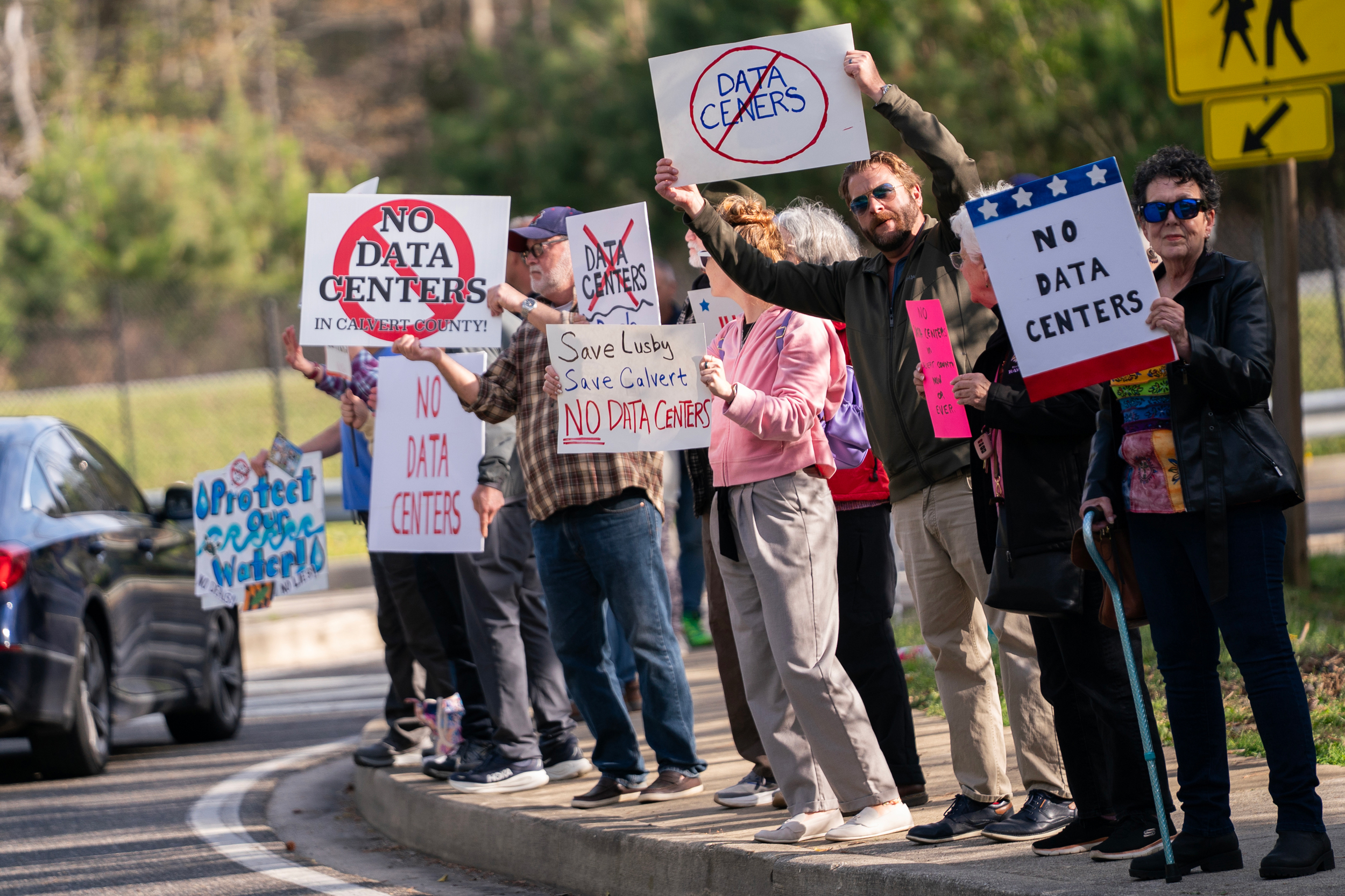
Earlier this year, Illinois environmental groups pushed for a bill to rein in data centers’ environmental, climate and affordability impacts statewide. The bill failed to pass the General Assembly in the spring, but lawmakers said negotiations are continuing through the summer and it could resurface in the fall.
The bill garnered pushback from industry groups. Tietz from the Data Center Coalition said that Illinois is already an unfriendly place for data center development but that the industry is interested in community engagement, water efficiency and clean energy sourcing.
The mayor’s announcement came as the greater Chicago area was hit with heavy rain, tornadoes and power outages. Climate change is bringing more intense rain and storms to the region, straining the power grid and adding to concerns about surging energy demand from data centers.
This story is funded by readers like you.
Our nonprofit newsroom provides award-winning climate coverage free of charge and advertising. We rely on donations from readers like you to keep going. Please donate now to support our work.
Rising utility bills are a central concern for communities opposing data centers across the country, and in Illinois, data centers are already reportedly causing serious electric-bill spikes.
Oscar Sanchez, executive director of the Southeast Environmental Task Force, noted that the climate crisis increases the urgency of addressing the strain data centers put on the electrical grid.
“Data centers are very much extractive of our electrical grid systems, and when it comes to already-faulty systems, when it comes to these heavy storms, they’re just going to cause more influxes of power outages,” Sanchez said. “That’s something that we’re very concerned about.”
Anthony Moser, president of Neighbors for Environmental Justice, a grassroots environmental justice group based on the Southwest Side, said he sees the health and environmental concerns related to data centers as part of a long history of industrial hazards in the city.
Moser authored a 2023 report that argued the city has not effectively held businesses accountable to environmental laws, and said he wants to see a plan for what will happen if data centers fail to meet the city’s new standards.
“The ongoing problem that the city has is that there’s no larger strategy for dealing with businesses that are systematically out of compliance,” he said.
He was glad to see the city taking air pollution seriously in the executive order, but also wants to see officials work to rein in other polluting industries.
“If we think of this as a novel issue that is only now coming up, then I think it would be easy to overlook how long this has been going on,” Moser said. “It’s great to take air pollution seriously, but I think that it will require extending that kind of attitude beyond just saying ‘we don’t want to have more data centers’ and thinking about, what are the actions the city can take to meaningfully reduce air pollution?”
About This Story
Perhaps you noticed: This story, like all the news we publish, is free to read. That’s because Inside Climate News is a 501c3 nonprofit organization. We do not charge a subscription fee, lock our news behind a paywall, or clutter our website with ads. We make our news on climate and the environment freely available to you and anyone who wants it.
That’s not all. We also share our news for free with scores of other media organizations around the country. Many of them can’t afford to do environmental journalism of their own. We’ve built bureaus from coast to coast to report local stories, collaborate with local newsrooms and co-publish articles so that this vital work is shared as widely as possible.
Two of us launched ICN in 2007. Six years later we earned a Pulitzer Prize for National Reporting, and now we run the oldest and largest dedicated climate newsroom in the nation. We tell the story in all its complexity. We hold polluters accountable. We expose environmental injustice. We debunk misinformation. We scrutinize solutions and inspire action.
Donations from readers like you fund every aspect of what we do. If you don’t already, will you support our ongoing work, our reporting on the biggest crisis facing our planet, and help us reach even more readers in more places?
Please take a moment to make a tax-deductible donation. Every one of them makes a difference.
Thank you,

Reporter, Health and Justice
Keerti Gopal covers intersections between climate change, public health and environmental justice at Inside Climate News. Previously, she covered climate activism and movement repression. She is a National Geographic Explorer and has received fellowships from Fulbright, the Solutions Journalism Network, The Lever, and the National Press Foundation.
