

Close Menu
NCIJ Network NCIJ Network
    What's Hot

    Bitcoin Flashes Bottom Signals As “Digital Gold” Narrative Returns

    August 12, 2026

    A vest tested on the Artemis I mission blocked some radiation exposure

    August 12, 2026

    As DRC confronts largest Ebola outbreak, health agencies revise strategy

    August 12, 2026
    Facebook X (Twitter) Instagram
    Trending
    • Bitcoin Flashes Bottom Signals As “Digital Gold” Narrative Returns
    • A vest tested on the Artemis I mission blocked some radiation exposure
    • As DRC confronts largest Ebola outbreak, health agencies revise strategy
    • $13.2 billion gas project moves forward with ADNOC’s $8.2B EPC awards to Wison and Maire’s Tecnimont
    • The Guardian view on early prisoner release: don’t lose sight of systemic reform | Editorial
    • Did Trump admin pay German energy company RWE $1.2B to stop building offshore wind farms?
    • Live Updates: First Total Eclipse in Decades Turns Day to Night in Europe
    • Eurovision bars countries at war or in ‘sensitive geopolitical situations’ from hosting – POLITICO
    • About
      • Our Team
      • Editorial Policy
      • Editorial Independence
      • International Support
    • Trust & Standards
      • AI Usage Policy
      • Conflict of Interest Policy
      • Corrections Policy
      • Ethics Policy
      • Fact-Checking Policy
      • Source Protection
    • Get Involved
      • Guide for Sources
      • Support Independent Journalism
    • Legal
      • Cookie Policy
      • Privacy Policy
      • Terms of Use
    Facebook X (Twitter) Instagram
    NCIJ Network NCIJ Network
    Wednesday, August 12
    • Home
    • World
    • Ai
    • Business
    • Politics
    • Health
    • Crypto
    • Science
    • Technology
    • Cybersecurity
    • Defense & Security
    • Economy
    • Energy
    • Europe
    • More
      • Fact Check
      • Investigations
      • Opinion & Analysis
      • Environment
    NCIJ Network NCIJ Network
    Home»Science

    Scientists turn Starlink into a giant scanner for Earth’s upper atmosphere

    NCIJ NETWNCIJ NETWORKBy NCIJ NETWNCIJ NETWORKAugust 12, 2026 Science No Comments3 Mins Read
    Share
    Facebook Twitter LinkedIn Pinterest Email

    The region surrounding Earth is getting more crowded as thousands of satellites and pieces of space debris move through low Earth orbit. Farther above, at altitudes of several hundred kilometers, traces of Earth’s upper atmosphere can still exert enough drag to slow satellites. Accurately measuring atmospheric density at these heights is therefore important for forecasting satellite motion and reducing the risk of collisions.

    More than 99 percent of the upper atmosphere consists of electrically neutral gas known as the thermosphere. The term thermospheric density refers to the density of this neutral atmosphere between about 100 and 1000 kilometers above Earth’s surface. By comparison, the ionized gas of the ionosphere accounts for less than 1 percent of the atmosphere. Because ionized gas affects the way radio waves travel, the ionosphere is relatively straightforward to observe. Measuring conditions in the thermosphere is much more difficult.

    A New Way to Observe the Thermosphere

    Better measurements of thermospheric density could advance research into the upper atmosphere while also providing valuable information for space engineering. Motivated by both needs, researchers at Kyoto University developed a new technique for visualizing this difficult-to-observe region.

    “This is a multidisciplinary study between space science and space engineering,” says corresponding author Mamoru Yamamoto. “Reading papers from both research fields, we realized that deeper dialogue between researchers from both fields is necessary.”

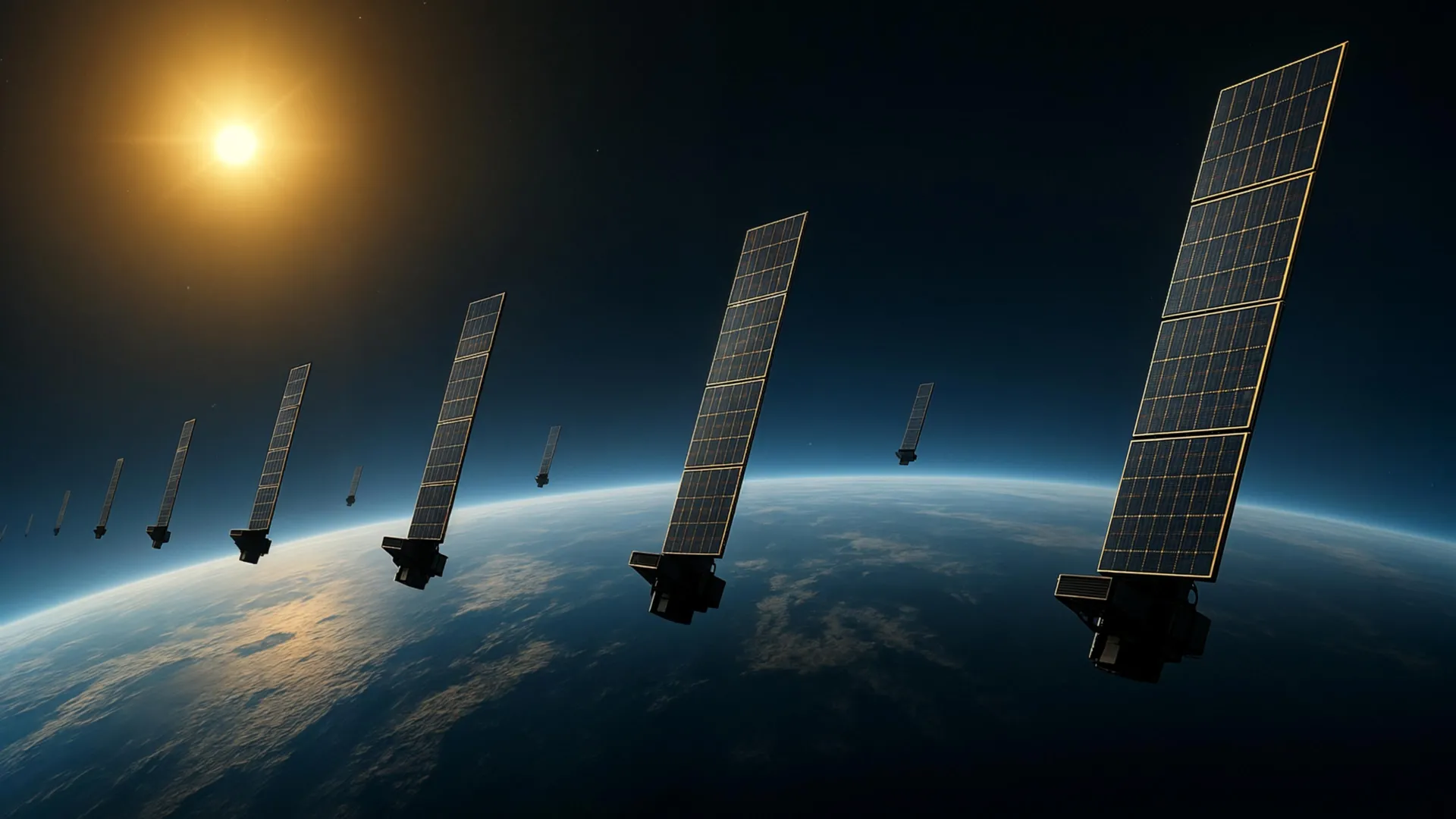
    The researchers used publicly available orbital information from Starlink satellites and applied tomography, a technique commonly associated with medical imaging, to Earth’s upper atmosphere. By examining atmospheric drag through the gradual decay of satellite orbits, the team estimated thermospheric density around approximately 1,200 satellites flying at an altitude of 482 kilometers.

    Building a Two-Dimensional Atmospheric Map

    Using those measurements, the researchers produced a two-dimensional latitude-longitude snapshot of thermospheric density at an altitude of roughly 500 kilometers. According to the team, this represents the first tomographic analysis of its kind.

    The resulting density patterns also showed strong consistency with observations from the European Space Agency’s SWARM satellites, which measure changes in atmospheric density along their orbital paths.

    The work expands on an earlier study by the same team. In that research, scientists estimated how thermospheric density changed over time and altitude using general orbital information called Two-Line Element, or TLE, data from Starlink satellites. The new analysis adds another dimension by examining how density varies horizontally across latitude and longitude, revealing more of the thermosphere’s geographic structure.

    Making Crowded Orbits Safer

    The findings could have practical benefits as the number of objects orbiting Earth continues to grow. More accurate information about atmospheric density can improve predictions of satellite motion, helping reduce the chance of collisions between satellites and between satellites and space debris.

    The technique could also eventually support near-real-time measurements of atmospheric density around satellites. Such monitoring could improve space weather forecasting and contribute to safer, more dependable satellite operations in the future.

    Atmosphere Earths giant Scanner Scientists Starlink Turn Upper
    NCIJ NETWNCIJ NETWORK
    • Website

    Keep Reading

    A vest tested on the Artemis I mission blocked some radiation exposure

    NASA Astronaut Mike Fincke Leaves NASA, Career Includes 4 Spaceflights

    Ozempic may have revealed the brain’s hidden “craving center”

    Too many choices complicate female frogs’ sex lives

    Stops Along the Path of Totality

    Another OpenAI Exec Quits in Leadership Shake-Up as AI Giant Eyes IPO

    Add A Comment
    Leave A Reply Cancel Reply

    Editors Picks

    Bitcoin Flashes Bottom Signals As “Digital Gold” Narrative Returns

    August 12, 2026

    A vest tested on the Artemis I mission blocked some radiation exposure

    August 12, 2026

    As DRC confronts largest Ebola outbreak, health agencies revise strategy

    August 12, 2026

    $13.2 billion gas project moves forward with ADNOC’s $8.2B EPC awards to Wison and Maire’s Tecnimont

    August 12, 2026
    Latest Posts

    Record-breaking wildfires burned nearly 100,000 hectares in France, interior minister says – POLITICO

    July 25, 2026

    Former top US food safety official says Trump’s handling of cyclospora is ‘catastrophic’ | Trump administration

    July 25, 2026

    Did Trump collapse while trying to get into vehicle?

    July 25, 2026

    Subscribe to News

    Get the latest sports news from NewsSite about world, sports and politics.

    NCIJ Network is an independent digital news platform delivering trusted investigative journalism, European and global news, in-depth analysis, and fact-based reporting with accuracy, transparency, and integrity.

    Facebook X (Twitter) Instagram Pinterest YouTube

    Bitcoin Flashes Bottom Signals As “Digital Gold” Narrative Returns

    August 12, 2026

    A vest tested on the Artemis I mission blocked some radiation exposure

    August 12, 2026

    As DRC confronts largest Ebola outbreak, health agencies revise strategy

    August 12, 2026

    Subscribe to Updates

    Get the latest creative news from FooBar about art, design and business.

    Type above and press Enter to search. Press Esc to cancel.