


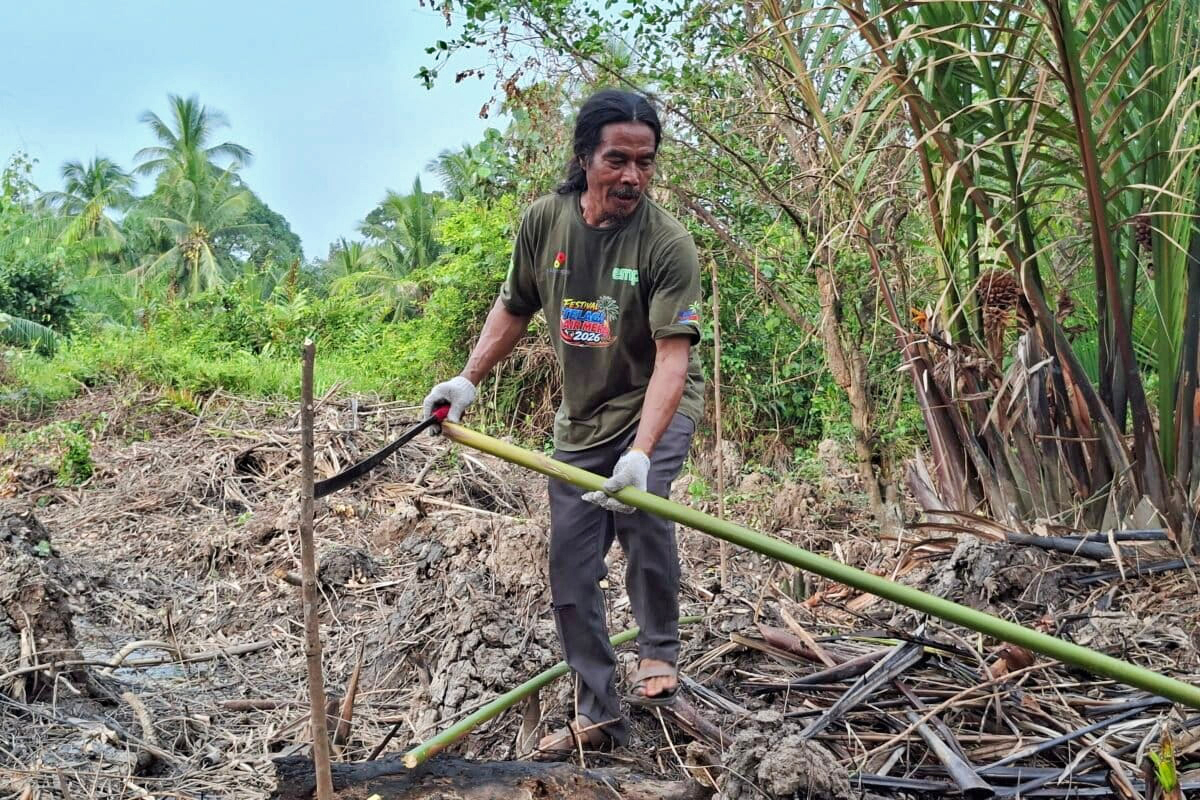
- A palm oil grower in an Indonesian village on Sumatra island, around 100 miles west of Singapore, has spent 15 years studying the role of mangroves in coastal ecosystems and pushing local action to restore coastal forests.
- Research shows this area of Sumatra’s northern coastline, which is separated from the Strait of Malacca by a narrow channel and the island of Bengkalis, is experiencing coastal abrasion of more than 6 meters per year, due primarily to mangrove loss.
- Indonesia pledged to restore around 600,000 hectares in five years by 2024, which researchers say was likely the world’s most ambitious reforestation initiative on record. However, only a small share of the planned planted area was successfully seeded.
SUNGAI APIT, Indonesia — Harisyah was still knee-deep in peat as the light faded over the mouth of Indonesia’s Siak River. The 53-year-old palm oil and pineapple grower had been cutting back weeds since morning, clearing the riverbank on the north coast of Sumatra island before driving wooden stakes into the peat at 1.5-meter (5-feet) intervals.
“We’re going to use this location as a nursery for the new seedlings,” Harisyah told Mongabay Indonesia. “This new generation will grow up close to mangroves, and they can learn more about them through playing and activities.”
Harisyah and others who live in Tanjung Kuras, a coastal village in Siak district, say the weather has become increasingly erratic in recent years. Researchers, meanwhile, have documented a rapidly retreating coastline as the area’s peat soils continue to subside.
Residents also contend with frequent tidal flooding, which many blame on the loss of the mangrove forests that once fortified the shoreline. Last Ramadan, the Islamic holy month observed by millions in the world’s largest Muslim-majority nation, strong winds lifted off the dome from the village mosque.
“It’s because there’s no mangrove forest as a buffer to block the wind,” Harisyah said. “It’s been turned into an oil palm plantation — so the wind from the sea blows straight onto land.”
World’s largest mangroves
Indonesia’s more than 17,000 islands contain the world’s largest mangrove forest estate, covering about 3.3 million hectares (8.2 million acres) along coastlines and river deltas.
But decades of clearing for charcoal production and shrimp and fish farming have degraded nearly half those forests.
People in Harisyah’s village of Tanjung Kuras attribute the mangrove loss to charcoal production in Bengkalis, an island district located on the other side of the Siak River.
Along much of the northern coast of Riau province, housebuilders here also often use a lattice of mangrove timber to stabilize soft peat soils beneath foundations.
Riau is home to the largest peatland in Indonesia, which accounts for more carbon-heavy tropical peat than any other country.
Mangroves can store around four times more carbon in their dense root network and soil than terrestrial forests, solidifying the importance of the trees in restricting climate change.
In 2020, then-Indonesian President Joko Widodo pledged to restore 600,000 hectares (nearly 1.5 million acres) of mangroves by 2024. The program ultimately fell well short of its national target.
Harisyah’s work reflects a recent shift in Indonesia’s mangrove restoration drive. National targets helped mobilize funding and political attention, but sustainable recovery depends on local leaders persuading communities to protect forests long after planting ends.
Harisyah’s hands-on activism with mangrove conservation began in 2011 during an aquaculture training course in the nearby Meranti Islands, where he learned how mangroves naturally filter brackish water before it enters fish and shrimp ponds.
“That’s where I started to learn little by little about the mangroves,” Harisyah said.

Rise to local office
After the month-long course, Harisyah spent years visiting mangrove groups across Siak district, learning how to raise seedlings, restore coastal forests and organize community volunteers.
Then in 2018, seven years after he first began to study mangroves, Harisyah won election as head of Tanjung Kuras village.
As village head, Harisyah directed funding toward mangrove restoration and trained volunteers to map local mangrove forests. Tanjung Kuras also received around 10,000 seedlings from the Indragiri Rokan River Basin Management Center (BPDAS), a local environmental agency.
However, Harisyah was not elected for a second term, and after leaving office, encountered renewed difficulty driving community support for mangrove conservation without his government authority.
After a frustrating few years, Harisyah reconnected with nonprofits working in Riau province in 2024. He soon partnered with nonprofit Pantau Gambut on a community-based mangrove rehabilitation program alongside the Global Environment Centre and Aramco Asia Singapore. Tanjung Kuras is one of four project sites, with the other three located in neighboring Bengkalis.
“That passion was sparked again,” Harisyah said.
Restoration continues
Restoration work is now focused on the Beting Selayang area of Tanjung Kuras, where around 25 hectares (62 acres) of mangroves have largely disappeared.
“We appreciate God’s creation with all the beauty of nature, and the immense potential of Tanjung Kuras village,” Harisyah said.
Harisyah hopes reforesting the coastline will help reduce subsidence affecting countless villages in Siak district and the island of Bengkalis, a short ferry or fishing boat ride from Tanjung Keras.
Years of logging for charcoal and repeated oil spills have damaged the coastline. One spill alone destroyed nearly half of a nursery containing 5,000 seedlings, while populations of mud crabs and shellfish — once an important source of food and income — have declined.
However, as the environmental work has progressed, fishers have begun to report signs of recovery in near-shore stocks, with anecdotal sightings of more fish and turtles.

Village leaders are now seeking to compound these gains through new regulations with new mangrove protections and action to tackle river pollution, Tanjung Kuras village head Badaruddin explained.
“This isn’t only about planting,” said Mulyadi, director of Pantau Gambut, a foundation that specializes in peatland conservation and research. “There’s also a series of capacity-building and economic alternatives, such as nipah palm sugar production.”
District officials also see the tree-planting as part of a broader effort to restore the region’s coastline.
“This mangrove planting is for the future — for our children and grandchildren,” said Hendri Yadi, an official from the local Sungai Apit subdistrict government.
Research published by the University of Riau in the December 2025 edition of the Asian Journal of Aquatic Sciences found that coastal abrasion in neighboring Mengkapan village averaged 6.43 meters (21 feet) per year.
One of the restoration sites Harisyah has prepared lies less than 500 meters (1,640 feet) from an elementary school. During king tides, the Siak River floods nearby homes for several days.
“At the mouth of the Siak River, there’s a beach that’s perfect for playing,” Harisyah added.
Harisyah’s preparation work culminated on July 6, 2026, when dozens of schoolchildren joined local residents and representatives from partner organizations at the site to plant mangroves.
“If these kids already in their phase of growing up learn about mangroves, hopefully, they’ll start caring for the natural environment in their village in the future,” Mulyadi said.
The seedlings planted along the Siak River remain fragile, and their survival will depend on the kind of patient long-term commitment that Harisyah has brought to these riverbanks.
“We keep going,” Harisyah said. “Even if you’re by yourself, keep going.”
Banner image: Harisyah measures the distance between mangrove planting holes. Image by Suryadi/Mongabay Indonesia.
This story was reported by Mongabay’s Indonesia team and first published here on our Indonesian site on July 26, 2026.
As Sumatra loses mangroves to oil palms, local fishers also suffer
A one-time illegal logger grows back a forest for his people in Sumatra
Citation:
Asfar, A., Suandy, I., Yusri, Y., Mandar, A., … Mustofa, M. (2025). Collaboration on development planning policy: Mitigation of abrasion prevention in Siak Regency (Case Study of Mengkapan Village). Asian Journal of Aquatic Sciences, 8(3), 469–477. doi:10.31258/ajoas.8.3.469-477
