


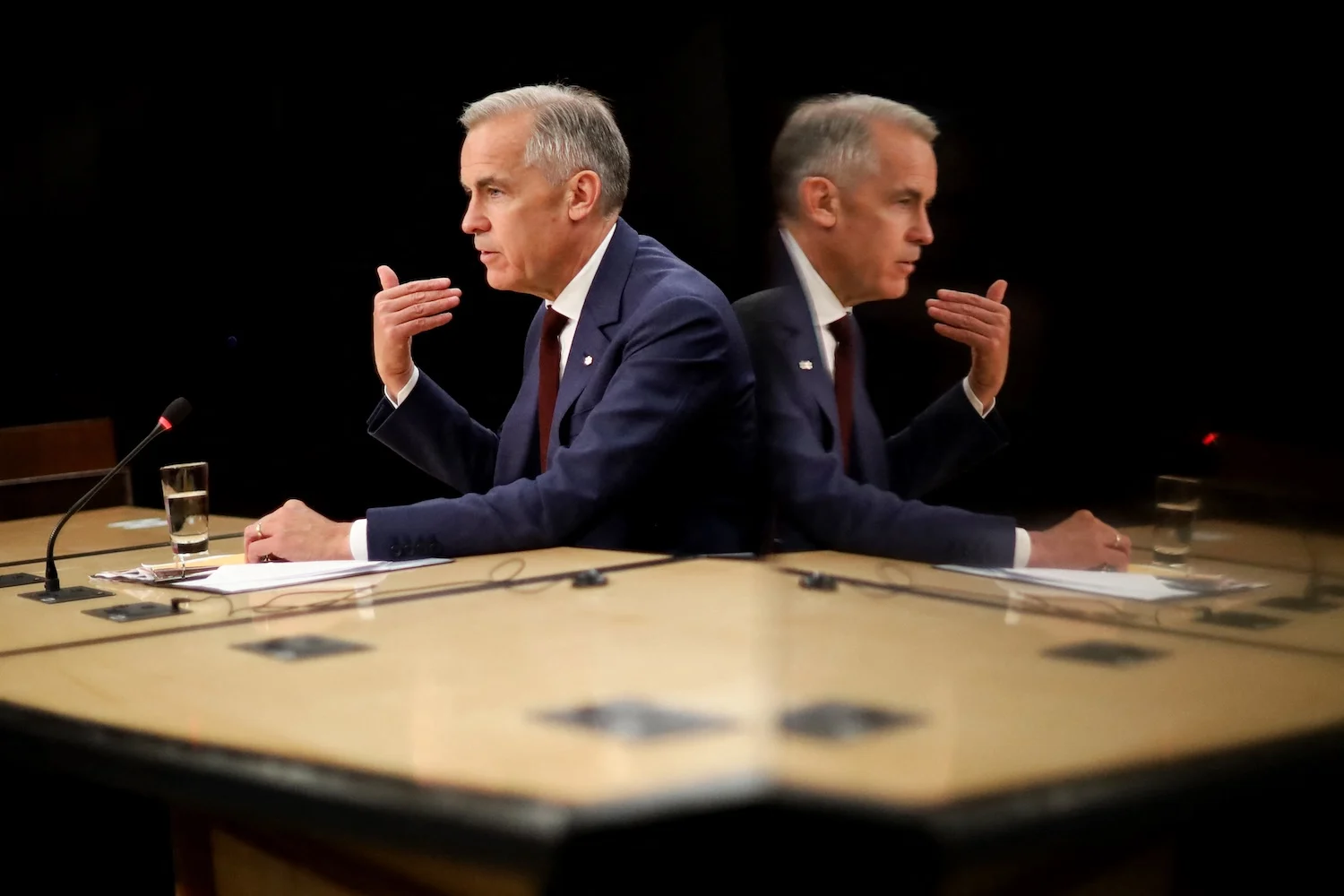
In his landmark speech at the World Economic Forum in January, Canadian Prime Minister Mark Carney called on “middle powers” to jointly invigorate the international system. Such nations, he ventured, “have the capacity to build a new order that encompasses our values, such as respect for human rights, sustainable development, solidarity, sovereignty, and territorial integrity of the various states.” Champions of international order cheered his vision of a unified bloc able to offset great-power competition and counter the bellicose, norm-wrecking U.S. President Donald Trump.
In the ensuing eight months, Carney’s vision for middle powers—countries with notable economic and military strengths that are smaller than the world’s hegemons—has gone unrealized. Due to a confluence of factors, including divergent priorities and limited leverage, these countries have confronted hard truths about their ability to call the shots.
While Carney was right that the U.S. turnabout made cooperation among middle powers more necessary, it has also forced each of them to concentrate, above all, on their own exposure to political upheaval and economic shocks. Efforts to create a new order have been sidelined by the imperative of surviving the old one’s demise.
Trump’s undersecretary of defense for policy, Elbridge Colby, brought this issue back into the spotlight last month on X, when he dismissed the “hubbub about a collective ‘middle powers’ strategy.” He claimed that Washington sees no sign that allies are diversifying away from technological or military reliance on the United States, adding that middle powers lack the coherence to align. While Colby is in denial about the scale of global hedging taking place, he is not wrong that middle powers lack the common ground for sustained collective action.
Broad visions of a new system birthed by middle powers are, at least for now, farfetched. But even as they navigate an unstable world, these countries can still lay the groundwork for the international system to survive long enough to be reinvented. Middle powers and those who vest hopes in them should take a hard look at how the current imperatives of national self-preservation can contribute to, rather than detract from, the prospect of an orderly global future.
That Carney has not made good on his conception of a new world order is unsurprising. At various points, Trump has threatened tariffs of up to 100 percent on Canadian goods. Faced with a suddenly hostile neighbor that accounted for 76 percent of his nation’s merchandise exports, 96 percent of its crude oil exports, and virtually all of its natural gas exports, Carney was in no position to go big on international architecture. Instead, it became a national emergency to lessen Washington’s leverage over Canadian jobs, revenues, energy, and security—never mind rallying the national spirit against a turncoat neighbor threatening to render Canada as the 51st U.S. state.
Carney has tried to do this by concentrating Canada’s resources on strategic autonomy: rearmament, strengthening domestic industry, and cultivating international partnerships in search of new avenues for minerals, energy, defense, and trade. Canada’s recent moves to deepen relations with China, Qatar, and Saudi Arabia are motivated by the drive to diversify dependence, not by shared values. The closest thing to order that Ottawa has forged is a handful of new arrangements focused on specific sectors, including a tech partnership with Australia and India and a nine-nation Defense, Security, and Resilience Bank to finance national armaments.
Carney’s inward turn forms part of a broader pattern of U.S. allies retreating into self-preservation. Although Carney said in his speech that “a world of fortresses will be poorer, more fragile, and less sustainable,” governments that once relied on the United States as a guarantor of security and prosperity—including Canada, Germany, Japan, Korea, and Poland—have hardened their defenses, secured new markets, and reduced dependencies on other states. These moves have consumed money, political attention, and diplomatic energy that Carney might have hoped would go into reimagining the global system.
Even when middle powers have attempted to shore up the international order at various points, they have bumped up against fractured interests. For instance, the European Union’s plan last year to channel roughly $160 billion in frozen Russian assets to Ukraine faltered because most of the money sat in Belgium, leaving Brussels disproportionately exposed to Russian retaliation.
Another example came after the United States intervened in Venezuela in January, capturing President Nicolás Maduro. Brazil convened an emergency meeting of the Community of Latin American and Caribbean States to form a regional consensus on how to approach the operation. Yet the 33-member organization became paralyzed when some governments condemned Washington’s ouster of Maduro while others welcomed it. Middle powers often recognize their common predicament, but national exposure, domestic politics, and conflicting threat assessments prevent them from converting that recognition into collective power.
Even when middle powers manage to convene imaginative coalitions, they often lack the leverage to alter the conduct of states that control the battlefields and chokepoints. In April, the United Kingdom and France brought together 51 countries to plan for a defensive maritime mission in the Strait of Hormuz. Yet while the coalition could prepare to secure the waterway in the event of its reopening, it could not compel Iran or the United States to end the conflict that had closed it in the first place. A U.K.- and French-led coalition has likewise assembled 30-plus countries behind post-ceasefire security guarantees for Ukraine but cannot produce the truce itself.
Still, there are concrete steps that internationalist nations can take to staunch the erosion of global norms and set the stage for a stronger future.
First, middle powers should pool capabilities across defense, energy, and advanced manufacturing. Currently, they are scrambling to reduce security dependency on Washington through a patchwork of national programs that are often disjointed, duplicative, and wasteful.
Europe’s air defenses illustrate the continuing cost of atomized rearmament. Since Russia’s 2022 invasion of Ukraine, the continent has increased defense spending and cooperation through joint purchases and initiatives such as the European Sky Shield. Yet major acquisitions still reflect national requirements and industrial preferences. Governments continue to buy different systems for similar missions, creating separate command arrangements, maintenance chains, and training programs. The European Defence Agency has warned that national preferences produce shorter production runs, higher costs, slower delivery, and overall weaker defense.
Kurt Campbell and Rush Doshi’s concept of “allied scale”—which proposes that the United States must approach military, technology, and industrial competition with China by partnering closely with allies—offers a useful touchpoint. In areas where the United States is retreating, coordinated strategies among middle powers are even more imperative. Pooled orders, common command systems, shared inventories, and agreed divisions of production could support quicker and more cost-effective rearmament.
Countries will only enter such arrangements if access remains dependable in a crisis, so they will require stronger commitments than commercial supply contracts, including treaty-backed delivery obligations. Measures such as prohibiting unilateral export suspensions and ensuring shared reserves across jurisdictions will also be important. None of this has to be at odds with domestic industrial interests. Governments can distribute employment and technical capacity across participating countries. Canada’s recent decision to turn to the German-Norwegian Type 212CD submarine for its new fleet offers a model for this: All three countries will share training, maintenance, parts, and technology, and Canadian industry will be involved in production.
Pooling would carry not just material benefits but also political ones. Participating countries could make transparency, lawful procurement, labor rights, data protection, and accountable governance conditions of membership and access to these arrangements. The resulting networks would fortify shared norms through daily economic and security practice. They would also deepen relationships among rights-respecting countries and potentially build the confidence required for more ambitious collective action later.
Second, middle powers should approach coalition-building as a way to further broaden international cooperation. Small, flexible, and temporary coalitions are increasingly defining the global system. But a world organized through shifting clubs—what Carney and others call “variable geometry”—can easily tip into one where norms have limited force and countries outside the most powerful coalitions lose both voice and protection.
Yet variable geometry can reinforce—or at least prevent the further erosion of—global order if designed carefully. New informal coalitions could do this by anchoring their actions in international law, publishing their standards and decisions, establishing objective membership criteria, and remaining open to states willing to meet them. They should also report to relevant global bodies and cooperate with established institutions for technical expertise and coordination.
The interim appeals mechanism created after the United States blocked appointments to the World Trade Organization’s (WTO) Appellate Body in 2019 illustrates the approach. Led by Canada and the European Union, the improvised arrangement uses an existing provision of WTO law to offer appellate review for trade disputes among participating countries. It remains open to every WTO member and presents itself as a bridge to restoration of the full dispute-settlement system. Ultimately, it works around institutional blockage while preserving the WTO’s procedures and authority.
Other coalitions should reinforce the same discipline. Partnerships on critical minerals should commit to uphold international labor, environmental, and human rights standards rather than creating closed purchasing clubs. Maritime coalitions should ground their mandates in the U.N. Convention on the Law of the Sea. Groups supporting Ukraine should continue to root their work in the U.N. Charter and preserve transparent rules governing weapons and civilian protection. These measures can help prevent cooperation from accelerating the splintering of international relations into rival blocs.
Finally, middle powers must protect the existing international machinery. It would be virtually impossible to replicate the global field networks, accumulated expertise, and convening authority of the United Nations and its related institutions for humanitarian relief, refugees, disease surveillance, food security, peacekeeping, and technical standard-setting. Even Trump has continued to rely on parts of this apparatus while attacking and abandoning others, exposing a gap between political hostility toward multilateralism and practical dependence on its capabilities.
Yet several traditional defenders of international order are retreating from the system in its time of need. Countries including Finland, Germany, the Netherlands, Sweden, and the U.K. are cutting aid and support for U.N. development programs in order to finance military buildups. Although their security concerns are real, these governments should not lose sight of the powerful stake they have in keeping the multilateral system afloat.
Likewise, middle powers should aim to make existing institutions more relevant, authoritative, and useful. When the U.N. Security Council is blocked, they should use the U.N. General Assembly to affirm legal principles, create fact-finding commissions, and condemn countries that defy norms. They should collectively protect courts, investigators, and officials from sanctions and intimidation while treating the selection of the next secretary-general and the current U.N. reform process as major diplomatic priorities.
These three approaches—pooling efforts to achieve allied scale, grounding ad hoc coalitions in the global system, and reinforcing the buckling rules-based system itself—could gradually create the conditions for broader renewal. Although these measures would fall well short of Carney’s proposed new order, they could strengthen multilateral relationships, preserve the foundations of a global system, and give middle powers important tools to work with when a wider opening for reinvention arrives.
