


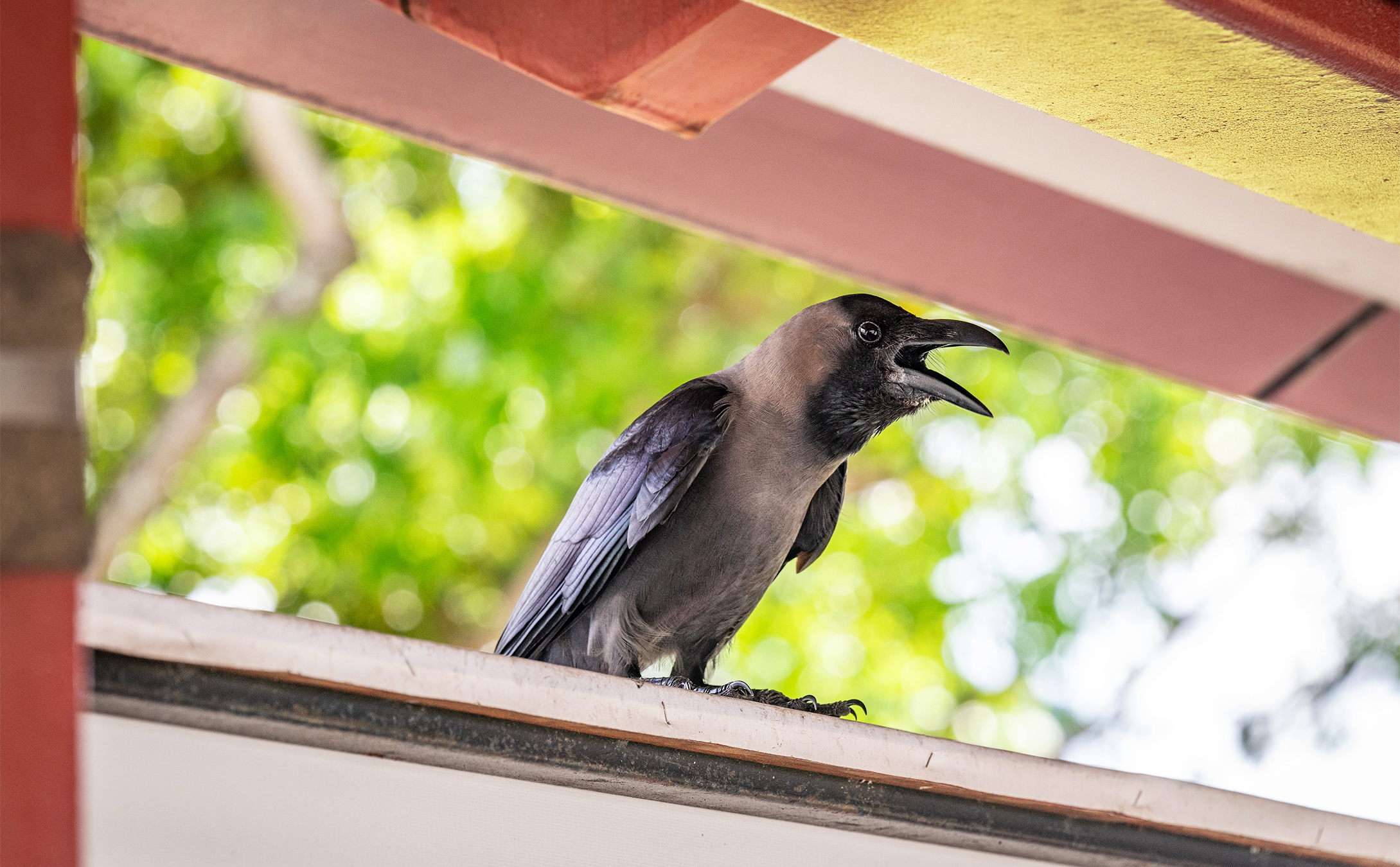
- A campaign to shoot crows has resumed in Singapore in response to a surge in public complaints about attacks, with authorities saying “pest” birds pose a public health risk and outcompete native species.
- Ecologists argue Singapore’s crow problem is human-made, with poor waste management and illegal feeding fueling a population boom.
- They criticize culling as ineffective over the long term and say it risks normalizing lethal wildlife control while undermining Singapore’s “City in Nature” vision.
- Nature groups say ongoing and planned forest clearance for public housing could lead to further increases in urban bird populations, as more favorable habitats are created, leading to “endless culling” to control bird populations.
SINGAPORE — On a Friday afternoon in July, a pest control officer patrols the grounds of Sungei Tengah Lodge, Singapore’s largest dormitory for migrant construction workers, picking up birds in various stages of distress. Some are twitching, others are wobbling, as if drunk.
The officer tosses the birds, which he had poisoned with baited scraps a few hours earlier, into a garbage bag. Most of them are still alive. The bagged birds will later be gassed using carbon dioxide, a culling method for “pest” birds the authorities say is “humane” — a claim contested by animal welfare groups.
Though culling may immediately trim the local population, ecologists question the long-term effectiveness of efforts to reduce urban birds, arguing that Singapore’s rapid urbanization creates favorable conditions for them to thrive, as forests are lost to high-rise buildings.
Birds considered pests in the tropical metropolis are the common pigeon (Columba livia), Javan myna (Acridotheres javanicus) and house crows (Corvus splendens), which are not protected under the Wildlife Act and routinely culled in response to complaints from the public.
Known as “nuisance” birds, they’re framed as invasive species that are noisy and a threat to public health and local biodiversity by competing with and, in the case of crows, preying on native birds.
Crows, in particular, have found themselves in the crosshairs of late. The government resumed a program to shoot crows in March after a six-year hiatus, as complaints about attacks on people have surged.
Crow-related feedback to the authorities has tripled in five years, to more than 15,000 complaints in 2025 — a number that now even dwarfs complaints about long-tailed macaques (Macaca fascicularis) entering condos and pilfering food.
Reports of crow encounters have been particularly high during nesting season, when adult birds have reportedly swooped on pedestrians and cyclists that get too close to their nests.
House crows are believed to have established themselves in Singapore during the British colonial era, after spreading south from Peninsular Malaysia, where they were introduced in the 19th century to control insect pests ravaging coffee plantations. More recently, their population has exploded, increasing roughly 20-fold over the past decade, according to a 2024 survey by Singapore’s National Parks Board (NParks).
When announcing the resumption of crow shooting in March, National Development Minister Chee Hong Tat said other measures, such as trapping the birds, pruning trees, and removing nests — nest clearances increased from 600 in 2021 to nearly 9,000 in 2025 — had proven insufficient.
Being highly intelligent, adaptable birds, crows have learned to recognize and avoid traps, a 2024 study found.
The government announced in July that 500 crows had been shot since shooting had resumed — a small number, perhaps, considering their population is now estimated at more than 160,000, but crows are learning to avoid hit squads too, conservationists suggest.
How Choon Beng, NParks’ wildlife management director, told Mongabay that shooting would, in combination with other measures, lead to a “gradual and sustained reduction” in crow numbers.
‘Endless culling’
But some say the authorities are fighting a losing battle.
Culling is a reactive measure “to show the public that something is being done” and “treats the symptoms, not the cause,” said Alfred Liu, assistant director of conservation at the nonprofit Nature Society Singapore.
John Marzluff, a professor of wildlife science at the University of Washington in the U.S., agreed. In the U.S., hundreds of thousands of ravens, a close relative of the crow, have been culled over the last decade. Although there has been some observed reduction in nest predation of native birds in areas where culling has taken place, the population is still growing at an exponential rate as urbanization rumbles on, Marzluff said. His 2021 paper argues that the hyperabundance of these birds in big cities is driven entirely by human development.
Though culling in Singapore led to a decline in the crow population until shooting stopped in 2020 — when stray bullets from a hired shooter hit a housing block — some ecologists suggest that culling may even lead to an increase in bird populations over time, a phenomenon known as the “vacuum effect.”
Removing birds from an area creates vacant territory and frees up food and nesting sites, attracting birds from surrounding areas — in Singapore’s case, neighboring Johor, a state in Malaysia — to move in. Reduced competition for resources can also improve the breeding success of surviving birds, a 1995 study of pigeons culled in Canada found.


Singapore’s dense urban landscape is a utopia for adaptable bird species. Pigeons and mynas love to nest on air-conditioning ledges and under sheltered walkways in public housing estates, while crows prefer to call the tall yellow flame trees (Peltophorum pterocarpum) that line the city’s streets their home.
Food is plentiful. Though measures have been taken to curb the availability of human food, such as anti-bird netting around outdoor eateries, and cleaners deployed to clear food waste from dining tables faster, Singapore’s ubiquitous hawker centers present pigeons, crows and mynas with a free buffet.
A mandatory tray return scheme launched in 2021 to ease the workload for table cleaners has been correlated with an increase in Singapore’s crow population since. The tray return stations are usually positioned at the edge of hawker centers, giving birds easy access to leftover chicken rice and roti prata, said Liu of Nature Society Singapore.
Feeding birds is also a stubbornly popular pastime among residents. Cases of people caught for bird feeding increased from 150 in 2021 to 380 in 2025. In May, the government doubled the severity of punishments for bird feeders, with repeat offenders facing fines of up to S$20,000 ($15,500) and 12 months in jail.
But the loneliness of the big city can make giving up feeding birds hard; half of the people caught for bird feeding are seniors aged 65 and older.
Ecologists say another major factor is often overlooked: as Singapore’s forests are replaced by housing estates, urban-adapted birds gain even more opportunities to exploit human environments.

A global review of more than 400 studies found that most crow species grow more abundant as cities expand, largely because urban areas provide abundant food, nesting sites, and few predators. A Singapore-specific study from 2003 backs up these findings.
“As long as we keep providing unlimited food and increasing numbers of nest sites, the population will grow. This is not rocket science — it is plain biology,” Marzluff told Mongabay.
And Singapore is creating more spaces for urban birds to live in. In early July, the government announced that large swatches of Maju Forest and Gillman Barracks are to be cleared to build public housing. Both forests are close to residential areas and home to the critically endangered straw-headed bulbul (Pycnonotus zeylanicus).
It was the latest in a series of environmental impact assessments (EIAs) that the Urban Redevelopment Authority has published for public review in close succession that affect Singapore’s unprotected forests, which cover roughly 16% of the island.
Singapore has lost most of its forests — more than 99% of its primary forests are gone, with most uprooted during colonial times. Besides the nature reserves, what’s left is a fragmented patchwork of secondary forests, which have regenerated over abandoned villages and plantations over the last 50-100 years.
Under Singapore’s urban redevelopment master plan, the city could lose more than 7,300 hectares (18,000 acres) of secondary forest over the coming decade or so — mostly to public housing, a 2022 study projected. This area covers more than 10% of Singapore’s land area, and more than its nature reserves and parks combined.
Clearing forests for public housing is necessary because of the country’s land constraints and the need to provide affordable homes, the government argues. However, rapid deforestation has prompted many to question Singapore’s famous “City in Nature” positioning and the loss of natural heritage. Petitions opposing the development of the Maju and Gillman forests drew some 60,000 signatures ahead of the EIA public feedback deadline of Aug. 6.

But amid the outcry, few are making the connection between increased urbanization and the urban bird population explosion that will likely follow, said Liyin Tan, founder of community group Urban Birds Institute, which advocates for coexistence with wild birds.
“There is an unspoken painful contradiction: Urbanization plays a key role in driving the population expansion of urban-adapted birds,” she said.
“Yet, we tend to vilify them as ‘invasive pests’ when we are the ones creating the urban environments these adaptable birds thrive in. If we do not learn to coexist with them, we should brace ourselves for endless culling.”
NParks did not comment directly on urbanization driving bird population growth, but said other factors, such as their adaptability and wide-ranging diet, have enabled them to thrive in Singapore.
Singapore’s Housing & Development Board, the government body responsible for building public housing, said it has started trialing netting to cover air-conditioner ledges to stop pigeons from building nests on housing blocks.
Cull culture in the ‘City in Nature’
The culling of other wild animals, including of a saltwater crocodile (Crocodylus porosus) in May spotted cruising off Sentosa Cove, a rich enclave, has raised questions about why lethal removal seems to be the default institutional response to problem wildlife in the “City in Nature.”
Section 42 of Singapore’s Animals and Birds Act makes it a criminal offense to ill-treat animals, including causing them unnecessary pain or suffering. But culling is framed by the authorities as a measure of last resort. Wild animals are typically culled to prevent property damage, curb disease transmission, or reduce public nuisance.
Wild pigs (Sus scrofa), whose population is just recovering from African swine fever, are routinely trapped and euthanized because of the damage they cause to young saplings in nature reserves and the threat they pose to the public when rearing young.
Wild chickens have been culled to manage bird flu risks and prevent interbreeding with the endangered native red junglefowl (Gallus gallus). Long-tailed macaques (Macaca fascicularis) deemed overly aggressive are also put down, and a task force was set up in July to control noisy cicadas (Asianopleura fulvigera). Nature groups question how many koi ponds will have to be raided by smooth-coated otters (Lutrogale perspicillata) before they, too, find themselves to be a target.

While Singapore is said to be a biophobic country that regularly complains about nuisance wildlife, a 2015 survey by animal welfare group ACRES found low public support for culling. Tan of the Urban Birds Institute pointed to studies that show culling could lead to further public alienation from nature and an objectification of animals that encourages cruelty.
She suggested that Singapore’s “City in Nature” vision needs to evolve. “It is too anthropogenic. To advance it, we need to start seeing ourselves as a multi-species city. We need to learn to live with our wild neighbors.”
Banner image: Crows, in particular, have found themselves in the crosshairs of late in Singapore. Image by Takeshi Aida via Flickr (CC BY-SA 4.0).
Study: Singapore biodiversity loss is bad — but not as bad as previous estimate
Citations:
Yong, C. K. L, Soh, M. C. K., Astri, N. S., Lim, K. N., & Er, K.B.H., (2024) Trapping efficacy of invasive crows is affected by environmental factors and deployment history. Wildlife Society Bulletin, 48(3). doi:10.1002/wsb.1535
Marzluff, J. M., Loretto, M.-C., Ho, C. K., Coleman, G. W., & Restani, M. (2022) Thinking like a raven: Restoring integrity, stability, and beauty to western ecosystems. Human-Wildlife Interactions, 15(3), 22. doi:10.26077/2525-d6f5
Sol, D., & Senar, J. C. (1995). Urban pigeon populations: Stability, home range, and the effect of removing individuals. Canadian Journal of Zoology, 73(6), 1154-1160. doi:10.1139/z95-137
Lim, K. N., Soh, M. C. K., Leong, D. Y. W., Loo, A. H. B., Lee, B. P. Y.-H., & Er, K. B. H. (2023) Proximity to anthropogenic food sources determine roosting and nesting prevalence of feral pigeons (Columba livia) in a tropical city. Ecological Solutions and Evidence, 4(2). doi:10.1002/2688-8319.12234
Soh, C. K. M., Sodhi, N. S., Seoh, R. K. H., & Brook, B. W. (2024) Nest site selection of the house crow (Corvus splendens), an urban invasive bird species in Singapore and implications for its management. Landscape and Urban Planning, 59(4), 217-226. doi:10.1016/s0169-2046(02)00047-6
Benmazouz, I., Jokimäki, J., Lengyel, S., Juhász, L., Kaisanlahti-Jokimäki, M.-L., Kardos, G., … Kövér, L., (2021). Corvids in urban environments: A systematic global literature review. Animals, 11(11), 3226. doi:10.3390/ani11113226
Lim, H. C., Sodhi, N. S., Brook, B. W., & Soh, M. C. K., (2003) Undesirable aliens: factors determining the distribution of three invasive bird species in Singapore. Journal of Tropical Ecology, 19(6), 685-695. doi:10.1017/s0266467403006084
Wu, Y. (2023). Study towards integrating secondary forests into future land use development in Singapore for biodiversity objectives. Sustainability, 15(4), 2916. doi:10.3390/su15042916
Garlick, S. Matthews, J., & Carter, J. (2011). Countering brutality to wildlife, relationism and ethics: Conservation, welfare and the ‘ecoversity’. Animals, 1(1), 161-175. doi:10.3390/ani1010161
Cite this article
Robin Hicks (2026). As Singapore culls ‘nuisance’ birds, rapid urbanization continues to fuel an avian boom. Mongabay Conservation news. DOI: https://doi.org/10.66709/news-325857

