


- Throughout Brazil, the contact between domestic cats and wild felines has been exposing threatened, biologically vulnerable feral species to diseases, which can reduce their populations.
- According to experts, habitat fragmentation is a common denominator of this crisis, from the Amazon to the Pampa, where felines are forced to leave the boundaries of their native areas and approach sites modified by human action.
- From the imposing jaguar to one of the smallest and rarest, the pampas cat, no Brazilian feline escapes the risks of contracting fungi, bacteria, parasites, and known viral diseases, such as feline leukemia and others.
- Studies and veterinarians warn that mass vaccination of domestic animals and the preservation of natural areas are key pieces to address this problem.
Every day, millions of Brazilians recall how rich the country’s feline biodiversity is when they reach into their wallets: Since entering circulation in 2010, the ‘50 real’ notes have carried a printed drawing of a jaguar (Panthera onca), the largest feline in the Americas. In Brazil, one can even trace the animal that inspired the design of the popular banknotes: It is the jaguar called “Gabi,” a 2002-born female that lived in the old Rio de Janeiro Zoo (today Rio’s BioParque). The “model” Gabi died in 2022, but she remains alive in the imagination of Brazilian consumers in every day-to-day cash transaction.
Despite the tribute, alongside species such as the puma (Puma concolor), the ocelot (Leopardus pardalis), and the jaguarundí (Herpailurus yagouaroundi) or gato-mourisco, as it is known in Brazil, the jaguar faces a common crisis among Brazilian species: Its existence is threatened by problems ranging from illegal wildlife trafficking to the accelerated degradation of its habitats across different biomes. Also, there is a silent emergency that places these wild felines in a threatening environmental context: Diseases that affect domestic animals.
“There is a risk for all feline species. Especially for our native species and for those that are endangered,” said Flavia Tirelli, a doctor in zoology and coordinator of the Geoffroy’s Cat Working Group, an international network fighting for the conservation of Leopardus geoffroyi and other wild felines. According to the specialist, who also acts as a researcher at the Laboratory of Evolution, Systematics, and Ecology of Birds and Mammals of the Federal University of Rio Grande do Sul (UFRGS), in southern Brazil, the spread of common diseases among domestic cats (Felis catus) — such as feline immunodeficiency virus (FIV), feline leukemia virus (FeLV), and panleukopenia, caused by the feline parvovirus (FPV), among others — can significantly affect the feline fauna throughout Brazil.
“Species threatened with extinction have smaller and more isolated populations within our anthropic matrix [as natural environments modified by human action are called] and can also be near domestic animals that carry these viruses,” Tirelli said. It is estimated that Brazil ranks third globally in the number of pets, with about 30 million domestic cats. At the same time, the number of felines living on the street or without a defined owner also exceeds millions: Data from the World Health Organization (WHO) suggest there are 10 million cats in these uncertain and vulnerable conditions.
This scenario, experts say, favors the appearance of feral animals, hinders birth control, and accelerates the spread of diseases. Also, as Mongabay has previously reported, there are risks of hybridization between wild species and domestic animals, which, besides threatening wild populations by compromising their genetic profile, opens the way for animals more prone to sickness.
Tirelli explained that the potential impact of “domestic” diseases is not limited to a single species: It can expose different, biologically sensitive felines to dangerous pathogens. These pathogens, in turn, can manifest as viral infections — but also bacterial, fungal, or parasitic ones; many of these diseases can be fatal. The environmental hazard posed by common diseases carried by domestic animals adds many challenges to the conservation of extremely threatened species, such as Leopardus munoai, one of the species of the pampa cat. This mysterious feline ranks among wild cats at the highest risk of extinction in Brazil, according to the expert.
This small and rare animal, endemic to the Pampa biome (in the southern part of South America, including southern Brazil, Argentina, and Uruguay), is already under harassment from humans — for being a predator of domestic birds — the reduction of its habitat, and the risk of being run over on roads. As it lives under the threat of different forms of contagion, this feline is exposed to additional health factors that can drastically reduce its already sparse population.

Habitat fragmentation facilitates the spread of diseases
According to data from Brazil’s Institute for the Conservation of Neotropical Carnivores (‘Pró-Carnívoros’), a Brazilian civil initiative created in 1996 and officially recognized, Brazil has 10 species of the Felidae family in its territory. Although they inhabit different areas and have diverse forms and behaviors, something unites their stories: The struggle for survival. From the Amazon rainforest’s humid woods to the plains of the Cerrado savannah, their habitats are being pressured by biome fragmentation. Whether large or small, when continuous natural areas are reduced to “islands” of vegetation, disconnected spaces are created.
The crisis combines urban expansion, the conversion of natural areas into agricultural zones, and the construction of infrastructure, such as roads and highways that cross extensive areas of forest. Among its multiple consequences for biodiversity is the spread of diseases.
“Habitat fragmentation and urban expansion have greatly facilitated the transmission of pathogens between domestic and wild species,” Tirelli said. “The more this fragmentation increases, with more ‘little pieces’ of natural areas within a modified anthropogenic matrix — whether urban, rural, or countryside — humans bring with them domestic animals that can transmit diseases to the wild [animals] ones.”
In addition to the best-known viruses, such as those causing feline leukemia (FeLV) and panleukopenia (FPV), a 2024 Brazilian study dedicated to a bibliographic review of diseases in wild felines of Brazil also highlighted the risk of exposure to the canine distemper virus (CDV), adenoviruses, and the rabies virus.

In the case of CDV, better known as distemper, additional risks arise: It represents “a global risk for dogs, and although it does not significantly affect cats, it has been shown that other felines are susceptible to this disease.” The research also highlights that the transmission of this disease to wild species “can occur through contact with dogs” and that its symptoms “can be aggressive and lead to the animal’s death.”
Regarding rabies, which is extremely lethal, the dangers can be broader. The study states that “wild feline species are not considered reservoirs for rabies, but they can act as vectors and transmit the virus to humans and other species.” The matter becomes critical as the scientific study mentions other studies that report the presence of antibodies against the rabies virus in jaguars, indicating exposure to the disease in the Pantanal and in the Emas National Park, an important conservation unit for the great American feline in the state of Goiás, in central-western Brazil. Considered a UNESCO World Heritage site, the park protects 132,000 hectares (326,000 acres) of the Cerrado and houses a rich biodiversity.
In all cases, the study concludes that there is “a clear relationship between human actions and the exposure of wild animals to viral agents, as the destruction of their natural habitats forces them to approach areas inhabited by humans and domestic animals.” Among the prevention measures, the study mentions “the vaccination of dogs and cats and the protection of natural areas to preserve the health of wild feline populations.”
In addition, as highlighted by Tirelli and other experts, avoiding the fragmentation of wild habitats is a “priority measure” to prevent exposure of different species to urban risks. This is extremely important, they explain, since strategies for monitoring pathogens within fragmented forest environments can be “very complex,” Tirelli observes, given that “each virus and each variant can modify the effectiveness of transmission,” which imposes additional challenges on scientific efforts in the field.

Science seeks answers regarding felines and parasites
Marcelo Alievi is a doctor in veterinary medicine and coordinator of the Center for Conservation and Rehabilitation of Wild Animals (Preservas), a project of the Federal University of Rio Grande do Sul (UFRGS) based in Porto Alegre, the state capital. Alievi shared a story of two margay specimens (Leopardus wiedii). One arrived in 2025 under the care of Preservas in serious condition. The other had already been transferred lifeless. “We received [in 2025] a weakened margay, which eventually died,” he told Mongabay Latam.
According to Alievi, this small feline — classified as vulnerable to extinction by Brazil’s Chico Mendes Institute for Biodiversity Conservation (ICMBio) — is just one of many wild species suffering from the reduction of its natural habitat and at risk of coming into contact with domestic animals and their diseases.
“It is common for these animals to live in a small space, where the food supply is not so abundant. For this reason, they seek resources and other ways to survive — and it is not rare to see them in peri-urban regions [transition zones between rural and urban areas]. And contact [with domestic cats] can occur that way,” Alievi told Mongabay.

However, something caught the specialist’s attention after the necropsy of the felines: The presence of parasites. Speaking to Mongabay, professor João Fábio Soares, doctor in parasitic diseases and coordinator of the Protozoology Laboratory of UFRGS, stated that the conclusions — although still preliminary — pointed to a parasite specific to wild felines.
“The parasite, however, presented an atypical condition in the wild feline: It was found in an organ in an unusual way, where it is not usually located. And that caused a more serious lesion,” Soares said. Interestingly, in one of the margays, the presence of the domestic cat virus or feline AIDS [feline immunodeficiency virus] was also confirmed. According to the expert, that could have reduced its immunity and facilitated the emergence of the [parasitic] disease in that form.
Although further research remains to reach conclusions on the specific case of the margays analyzed by UFRGS, the protozoology specialist highlighted another case of scientific relevance.
“We had a case of Lagochilascaris, another parasite — this one associated with domestic cats — that infected a southern tiger cat (Leopardus guttulus), in the mountainous region of Rio Grande do Sul. In this case, it also presented in a very atypical way, infecting the animal’s ear canal and, through it, reached the base of the brain. The animal suffered a serious neurological disease,” Soares said.
The expert explained that the case is related to the atypical living conditions the animal was subjected to, as it was near urban areas, which increases the possibility of contact with domestic cats. “A veterinarian from the region, specialized in domestic felines, mentioned that cases of this parasite in cats are common. This reflects that proximity [between domestic and wild species]. Following these findings, we organized a vaccination and deworming campaign for domestic carnivores to mitigate these transmissions,” Soares added.
Bacteria and fungi live nearby
In a 2021 study — involving different institutes and conducted by researchers from Brazil, including Tirelli — there are warnings about the advancement of other types of infections, equally harmful to the lives of felines and others. Particularly, it mentions feline sporotrichosis, a serious fungal infection, often caused by the fungus Sporothrix brasiliensis, discovered in Brazil. The disease, already a cause for concern among specialists, is highly contagious and causes deep lesions that are difficult to heal in animals. Without proper treatment, it can spread through the lymphatic system and internal organs, leading to the death of the animal.
“Unlike other species, cats develop lesions with a very high fungal load and can also harbor the agent in their claws and oral cavity, making transmission extremely efficient,” said Gabriela Kharsa Bastos, a veterinarian specializing in feline medicine from the São Paulo State University (Unesp) Botucatu. According to Bastos, semi-domestic cats or those with access to the street “play a fundamental role in maintaining the epidemiological chain.”
Bastos explained that the introduction of the fungus into native feline populations occurs in many ways: “In addition to direct transmission through bites and scratches, infected cats can contaminate the environment by sharpening their claws on tree trunks, fences, and other natural substrates, as well as depositing secretions and organic material containing the fungus.”
According to the Brazilian Ministry of Health, the country has recorded an increase in sporotrichosis cases in recent years: In cats, the number of cases jumped from 1,412 in 2022 to 3,290 in 2023 — a 233% increase. Bastos warns, however, of substantial differences in how wild species populations are affected.

“While domestic cats are present in large numbers, wild species have a lower population density and often already face threats such as habitat loss and roadkill. Therefore, even a few cases [of infection] can have significant importance in terms of conservation,” she told Mongabay.
According to Bastos, controlling sporotrichosis requires an integrated approach between animal health, human health and environmental conservation. Furthermore, she indicated that rapid diagnosis and immediate treatment of infected cats are necessary, as well as education on the zoonotic and environmental risks of the disease, expanding access to treatment and sterilization campaigns, and active epidemiological surveillance, especially in regions near natural areas.
The 2021 research also focuses on a group of emerging bacteria of the genus Bartonella. According to the study, felines represent an important reservoir for various species of the bacteria, with domestic cats being the main reservoir for Bartonella henselae, the causative agent of cat-scratch disease (CSD).
Publications accessible on the website of the State of São Paulo Regional Council of Veterinary Medicine (CRMV-SP) say that it rarely causes harm to the carrier cat, but even when it’s benign, the disease can evolve into a serious condition “mainly in immunodeficient individuals [infected humans], in whom it can cause a fatal infection.”
The study also underscores the importance of understanding the patterns of emergence and spread of pathogens in felines as “a fundamental issue for wildlife conservation.” The research also highlights that free-ranging carnivores are especially important in this context “as they occupy the top of the food chain and act as bioaccumulators and biomagnifiers of pathogens.”

So far, one thing is certain: All experts consulted agree on the need to pay attention to the problem, especially to prevent irreversible levels in wildcat population losses. This, they underscore, happens across Brazil — where different biomes remain harassed by human actions and urban advancement.
“The more fragmented the animals’ habitat is, and the closer we are to them, the more susceptible they will be to contamination by common and frequent diseases in domestic animals,” Alievi concluded.
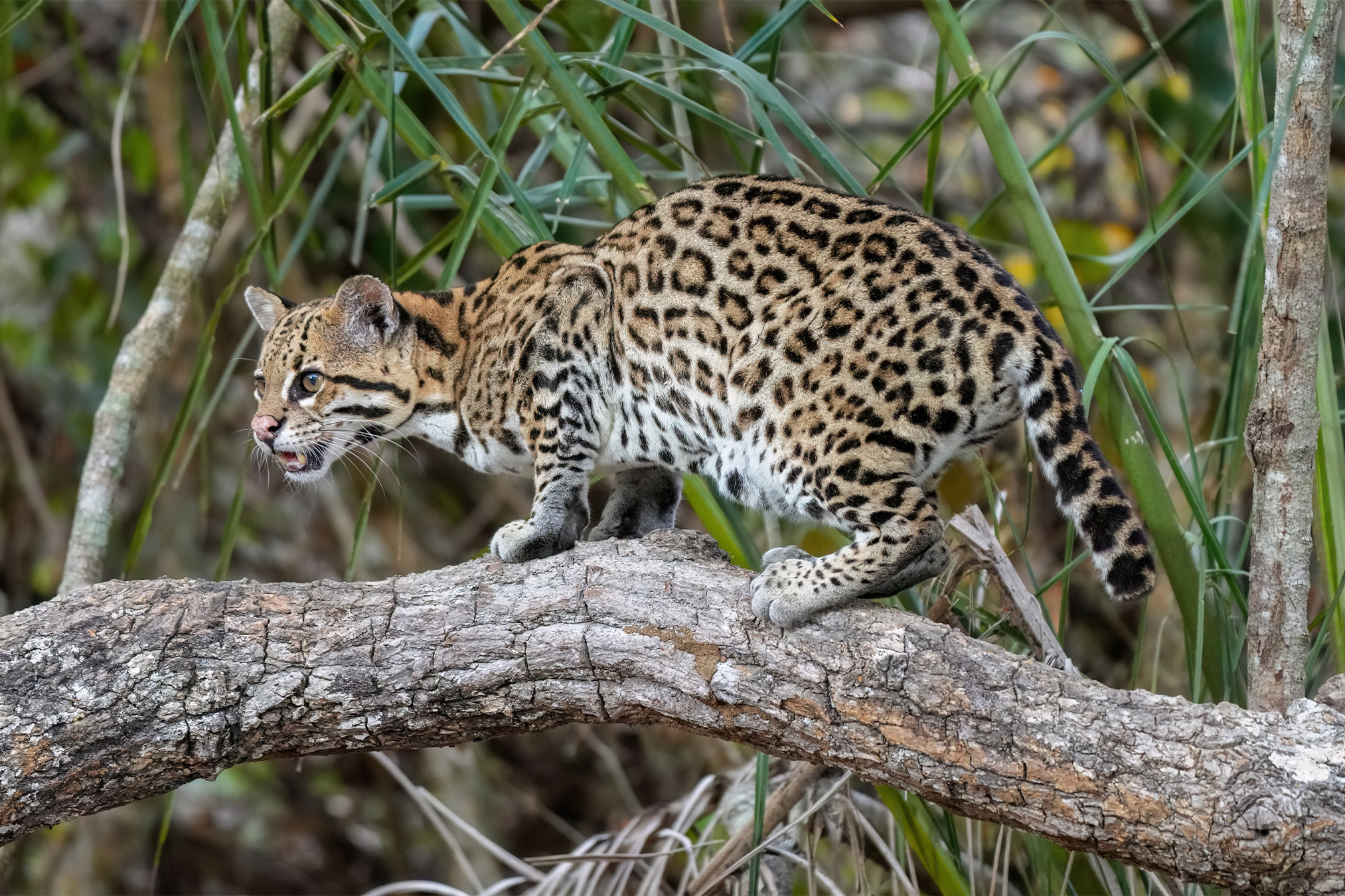
Banner image: An ocelot (Leopardus pardalis) photographed in the Encontro das Águas State Park, Mato Grosso, Brazil. Image by Giles Laurent on Wikimedia Commons (CC BY-SA 4.0).
This report is a journalistic alliance between Mongabay Brasil and Mongabay Latam. The story was first published in Spanish and Portuguese in July.
Researchers eye jaguar conservation wins under Brazil Indigenous stewardship project
Endangered Andean cat is imperiled by climate change and its solutions
Citations:
Gomes, A. K. V., Silva Filho, D. S. P., Silva, T. R., … Rodrigues, W. S. D. (2024) Doenças virais em felinos selvagens nativos do Brasil. Health Sciences, 28(139). doi:10.69849/revistaft/ar10202410211208
Souza, U. A., Webster, A., Dall’Agnol, B., Morel, A. P., Peters, F. B., Favarini, M. O., … Reck, J. (2021). Molecular and Serological Survey of the Cat-Scratch Disease Agent (Bartonella henselae) in Free-Ranging Leopardus geoffroyi and Leopardus wiedii (Carnivora: Felidae) From Pampa Biome, Brazil: Souza UA et al. Microbial ecology, 81(2), 483–492. doi: 10.1007/s00248-020-01601-x
Cite this article
Lucas Berti (2026). Brazil’s wild cats face multiple diseases due to habitat fragmentation. Mongabay Conservation news. DOI: https://doi.org/10.66709/news-325826

