


Unlock the Editor’s Digest for free
Roula Khalaf, Editor of the FT, selects her favourite stories in this weekly newsletter.
Sweden’s prime minister has called Spain’s amnesty for irregular immigrants a “very bad idea”, warning that it could push Europe back to a 2015-style migration crisis and call into question the continent’s free-movement zone.
Ulf Kristersson, the Swedish centre-right leader running for re-election next month, told the FT that Spain’s amnesty for more than 1mn people had caused a “pretty big outcry” at the last meeting of EU leaders as it ran counter to what other countries were trying to achieve.
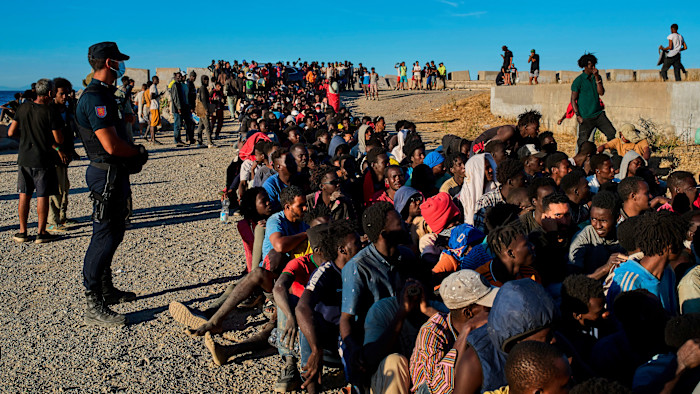
Leaders from Italy, Germany and Denmark among others have been sharply critical of Spain after tens of thousands of people entered the Spanish exclave of Ceuta last month, even though the vast majority returned to Morocco within hours.
Kristersson said: “It symbolises that we still have to be very, very careful not to act in a way that could even come close to what happened in 2015. I think Spain got the message . . . but it shows the vulnerability.”
Sweden accepted more immigrants relative to its population than almost any other European country in 2015, but then struggled with deep integration challenges and spiralling gang crime.
Kristersson is campaigning for re-election on a platform of having slashed asylum seeker numbers as well as the level of deadly shootings in Sweden. But his rightwing bloc, which includes the nationalist Sweden Democrats, lags behind the left in polls, led by the Social Democrats.
The Swedish prime minister said he had told Spanish counterpart Pedro Sánchez of his dislike of the recent amnesty of irregular migrants that led to 1.2mn applying, more than double the amount Madrid expected.
“Having [the amnesty] also creates a possibility for you to use European territory. That is specifically damaging for us because we know from experience that many people coming to Europe prefer to go north. Exactly that happened in 2015,” Kristersson said.
Sánchez argues immigration is vital to the long-term economic health of Spain’s ageing population. The amnesty offers immigrants without legal status a one-year, renewable residence permit if they have lived in Spain for five months and have a clean criminal record.
The Spanish amnesty would confer rights to live and work in Spain but not the rest of the EU. Migrants, however — many of whom are Latin American — would be able to move freely inside Europe’s Schengen Area for borderless travel.
Kristersson warned that Schengen depended on members acting “in a united way to be able to protect our external borders and to have as aligned policies as possible”.
He added that there was “no doubt” that having increased migration flows due to one country’s decision would affect the “solidarity” of the Schengen system.
Sweden itself has sharply tightened its rules on migrants, deportations and permanent residence, leading to a 40-year low in the number of asylum seekers last year.
“It is not the time to get relaxed on this . . . there is a huge majority in Sweden saying they cannot go back to an uncontrolled situation,” Kristersson said. “Doing things that could jeopardise a stable situation would be a very bad idea.”
September’s elections represent a watershed moment in Sweden, where Kristersson and his centre-right allies have said for the first time they would include the Sweden Democrats in government. The party’s roots are in the neo-Nazi movement, and its leader last year apologised for those links and its history of antisemitism.
The opposition Social Democrats have said they are willing to work with any party in parliament except the Sweden Democrats. The most recent poll in July gave the centre-left Social Democrats 32 per cent, ahead of 20 per cent for the Sweden Democrats and 17 per cent for Kristersson’s Moderates.
The prime minister defended the inclusion of the Sweden Democrats, saying the rightwing bloc had a clear coalition proposal unlike the Social Democrats, who have not said which parties they will govern with.
“I don’t see the drama in it,” said Kristersson, pointing to neighbouring Norway and Finland recently having coalition governments with anti-immigration nationalist parties.
All eight parties in the outgoing Swedish parliament back support for Ukraine and increased defence spending. But the prime minister questioned whether a new government led by the Social Democrats would have the same impact in Nato as his administration, which led Sweden into the alliance. Stockholm has since played a forceful role in regional defence plans and touted its defence industrial capabilities.
Kristersson said Russia would be the “defining threat” for Europe and that “security will be a fundamental part of everything we do in the coming years”.
He added: “If the left parties win, two out of four [of them] will be against Swedish Nato membership and against the new security policy orientation we have. How on earth would they even be able to make any new decisions on Nato participation from the Swedish side?”
The Social Democrats say they are strong backers of Sweden’s Nato membership, the country’s defence industry and support for Ukraine.
