

Close Menu
NCIJ Network NCIJ Network
    What's Hot

    Hormuz Nerves Cost Bitcoin $65,000 Mark Despite Solid Institutional Flows

    August 10, 2026

    New GLP-1 pill delivers up to 12% weight loss in 36 weeks

    August 10, 2026

    Sudan’s army chief holds unannounced talks on national dialogue | Sudan war News

    August 10, 2026
    Facebook X (Twitter) Instagram
    Trending
    • Hormuz Nerves Cost Bitcoin $65,000 Mark Despite Solid Institutional Flows
    • New GLP-1 pill delivers up to 12% weight loss in 36 weeks
    • Sudan’s army chief holds unannounced talks on national dialogue | Sudan war News
    • Europe’s scorching summer is erasing its economic growth, says report – POLITICO
    • What could Andy Burnham do to block early release of PC Andrew Harper’s killers? | UK criminal justice
    • From ticket booking fees to shrinkflation, six other ways Burnham could cut cost of living | UK cost of living crisis
    • Hong Kong’s plan to clear rural villages for a new gateway to China
    • Why managers are ransomware’s top targets now – and 6 ways to stay safe
    • About
      • Our Team
      • Editorial Policy
      • Editorial Independence
      • International Support
    • Trust & Standards
      • AI Usage Policy
      • Conflict of Interest Policy
      • Corrections Policy
      • Ethics Policy
      • Fact-Checking Policy
      • Source Protection
    • Get Involved
      • Guide for Sources
      • Support Independent Journalism
    • Legal
      • Cookie Policy
      • Privacy Policy
      • Terms of Use
    Facebook X (Twitter) Instagram
    NCIJ Network NCIJ Network
    Monday, August 10
    • Home
    • World
    • Ai
    • Business
    • Politics
    • Health
    • Crypto
    • Science
    • Technology
    • Cybersecurity
    • Defense & Security
    • Economy
    • Energy
    • Europe
    • More
      • Fact Check
      • Investigations
      • Opinion & Analysis
      • Environment
    NCIJ Network NCIJ Network
    Home»Science

    Lion Nebula Roars to Life With NASA’s Webb

    NCIJ NETWNCIJ NETWORKBy NCIJ NETWNCIJ NETWORKAugust 10, 2026 Science No Comments4 Mins Read
    Share
    Facebook Twitter LinkedIn Pinterest Email

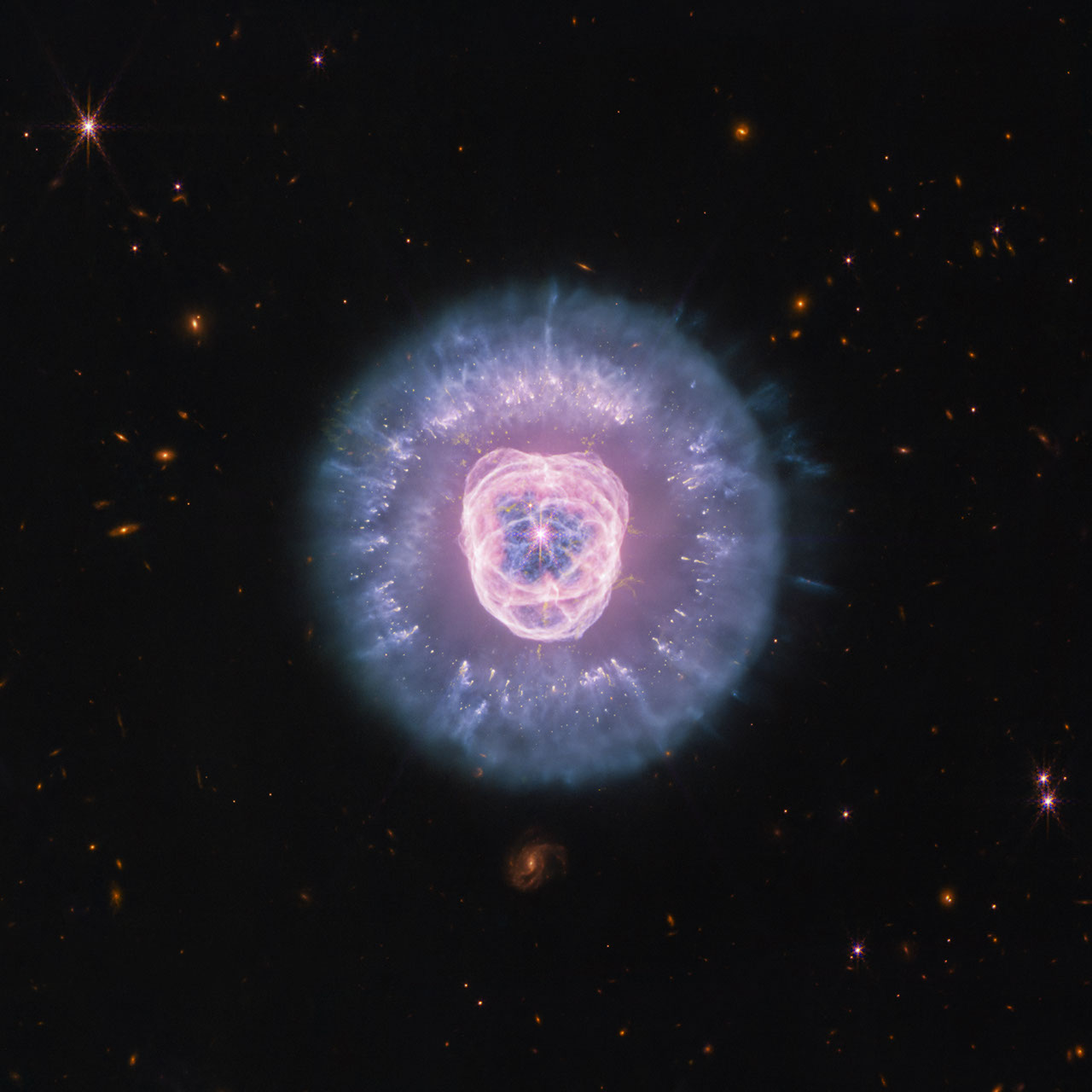
    Observing across the starry “plains” of space, NASA’s James Webb Space Telescope has taken new images of NGC 2392, nicknamed the Lion Nebula. NASA’s Hubble Space Telescope previously viewed this planetary nebula in 2000, imaging the lion face-shaped target in visible light and revealing features such as the “mane” of hazy, comet-shaped objects. Now Webb has captured a clearer, more detailed view of the Lion Nebula due to its high-resolution imaging.

    NASA’s James Webb Space Telescope imaged the planetary nebula NGC 2392, the Lion Nebula, using the observatory’s NIRCam and MIRI instruments. The central star’s remains are responsible for the nebula’s structure, including a lion face-shaped bubble of ionized gas and dust “mane.”

    Image: NASA, ESA, CSA, STScI; Image Processing: Alyssa Pagan (STScI)

    At first glance the nebula’s overall structure in Webb’s infrared images, with both the NIRCam (Near Infrared Camera) and MIRI (Mid Infrared Instrument) instruments, may look quite similar to Hubble’s earlier visible-light view. However, Webb’s infrared vision highlights features like compact clumps of dust and a haze of ionized gas. It’s taken several thousand years for this collection of gas and dust to reach its current shape, and the nebula’s components continue to be altered.

    The source of these constant changes and the reason for the Lion Nebula’s distinct appearance is located at the center: the remains of a dying star. Though it looks like the button nose of the lion, its energy and radiation are powering the intricate structures seen here.
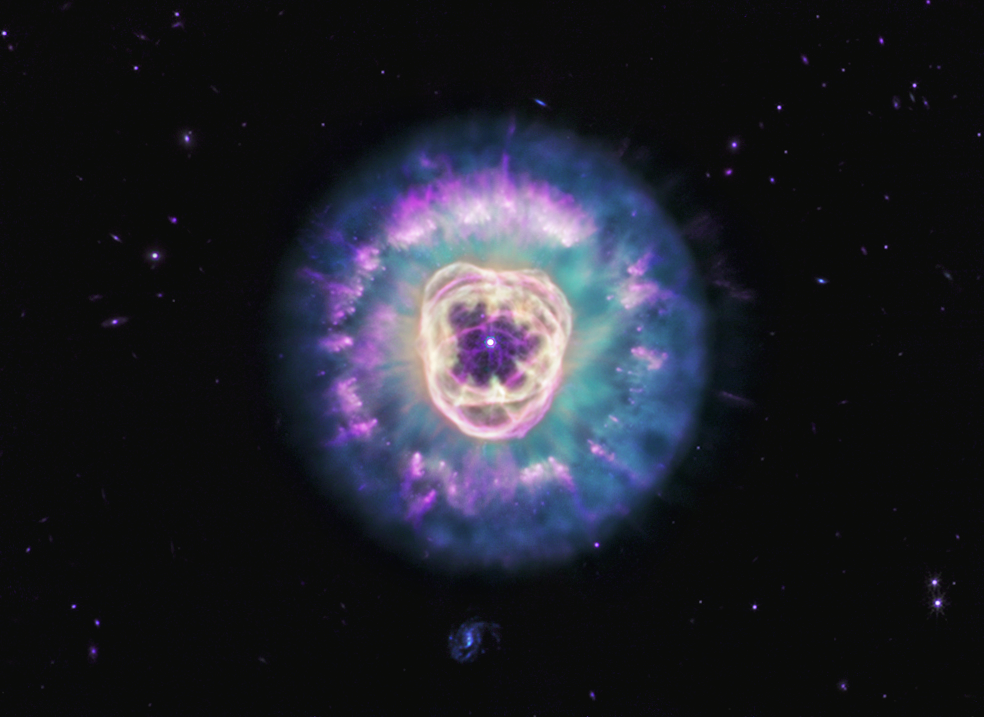
    Planetary nebula NGC 2392, also called the Lion Nebula, against the black background of space. The nebula is in the center, circular in shape, and looks like a male lion’s head. In the very center is a small, bluish-white circle with eight-point diffraction spikes, a white dwarf star. Surrounding the star are light purple-red cavernous bubbles and shell-like rings. The bubbles and shells collectively form an oval with two small, wide arcs near the top, reminiscent of a lion’s face and its ears. What appears to be extended outward from the lion’s face is a thick ring of cyan material. The width of the ring is consistent throughout and resembles a mane. The area closest to the lion’s face looks cloudy, while the edges of the mane look like there are purple clumps of dust with comet-like tails and strands. In the background are distant galaxies and stars. Some galaxies appear as small purple points of light and others with visible blue spiral structures. A couple of the stars have diffraction spikes.

    NASA’s James Webb Space Telescope’s mid-infrared image of planetary nebula NGC 2392, nicknamed the Lion Nebula, highlights the varying dust structures. Some dust is being destroyed by the dying central star’s radiation, while some dust filaments manage to survive.

    Image: NASA, ESA, CSA, STScI; Image Processing: Alyssa Pagan (STScI)

    Massive stars undergo supernova explosions at the end of their lives, but these kinds of events are few and far in between. Most of the universe’s stars have lower masses, like the one belonging to NGC 2392. When a lower-mass star can no longer sustain itself with nuclear reactions in its core, the star becomes unstable and pulsates, losing its mass by shedding its outer layers, which then turn into shells of gas and dust called a planetary nebula. (Stars at this life stage are responsible for producing much of the universe’s observable dust.) The star’s radiation drives the ejected material away, leaving behind the very hot stellar core, also known as a white dwarf.

    In the Lion Nebula’s case, the death of the oxygen-rich central star has left behind a white dwarf that is “cooking” everything from the inside and producing a bubble of ionized gas as it does. The gas bubble, which forms the lion’s face, is expanding over time and destroying dust that is in its path. Understanding why the swept-up gas has a complex structure of rings and shells, a common feature in planetary nebulae, is an ongoing endeavor.

    The mane of the lion is the interior of a dust shell that is being illuminated by the white dwarf at the center. The tufts of hair, which look like cometary tails of material, are compact clumps of dust that have survived the stellar core’s radiation and protect the material that lies behind them.

    Webb’s imagery “freezes” this planetary nebula in time, though the star’s death, and its tumultuous effects, go on. NGC 2392 will continue to undergo changes as its gas and dust migrate away from the stellar core. Astronomers estimate the lion will eventually disperse in approximately 10,000 years — a relatively short period in astronomical terms.

    The James Webb Space Telescope is the world’s premier space science observatory. Webb is solving mysteries in our solar system, looking beyond to distant worlds around other stars, and probing the mysterious structures and origins of our universe and our place in it. Webb is an international program led by NASA with its partners, ESA (European Space Agency) and CSA (Canadian Space Agency).

    To learn more about Webb, visit:

    https://science.nasa.gov/webb

    The following sections contain links to download this article’s images and videos in all available resolutions followed by related information links, media contacts, and if available, research paper and Spanish translation links.

    life lion NASAs Nebula Roars Webb
    NCIJ NETWNCIJ NETWORK
    • Website

    Keep Reading

    New GLP-1 pill delivers up to 12% weight loss in 36 weeks

    Launch Into a New School Year With NASA

    Science backs calls for limiting screens in schools

    Typhoon Dolphin: China evacuates more than 1 million people as massive storm arrives

    The dodo bird had a secret sensory world scientists are only now discovering

    Stress can scramble your brain’s internal GPS, MRI study finds

    Add A Comment
    Leave A Reply Cancel Reply

    Editors Picks

    Hormuz Nerves Cost Bitcoin $65,000 Mark Despite Solid Institutional Flows

    August 10, 2026

    New GLP-1 pill delivers up to 12% weight loss in 36 weeks

    August 10, 2026

    Sudan’s army chief holds unannounced talks on national dialogue | Sudan war News

    August 10, 2026

    Europe’s scorching summer is erasing its economic growth, says report – POLITICO

    August 10, 2026
    Latest Posts

    Harbour Energy’s US arm advances repair plan after riser leak at Gulf of America oil & gas asset

    July 24, 2026

    Beavers restored a volcano-scarred river. Now it’s at risk again

    July 24, 2026

    China’s Tianwen-1 captures interstellar comet 3I/ATLAS near Mars

    July 24, 2026

    Subscribe to News

    Get the latest sports news from NewsSite about world, sports and politics.

    NCIJ Network is an independent digital news platform delivering trusted investigative journalism, European and global news, in-depth analysis, and fact-based reporting with accuracy, transparency, and integrity.

    Facebook X (Twitter) Instagram Pinterest YouTube

    Hormuz Nerves Cost Bitcoin $65,000 Mark Despite Solid Institutional Flows

    August 10, 2026

    New GLP-1 pill delivers up to 12% weight loss in 36 weeks

    August 10, 2026

    Sudan’s army chief holds unannounced talks on national dialogue | Sudan war News

    August 10, 2026

    Subscribe to Updates

    Get the latest creative news from FooBar about art, design and business.

    Type above and press Enter to search. Press Esc to cancel.