


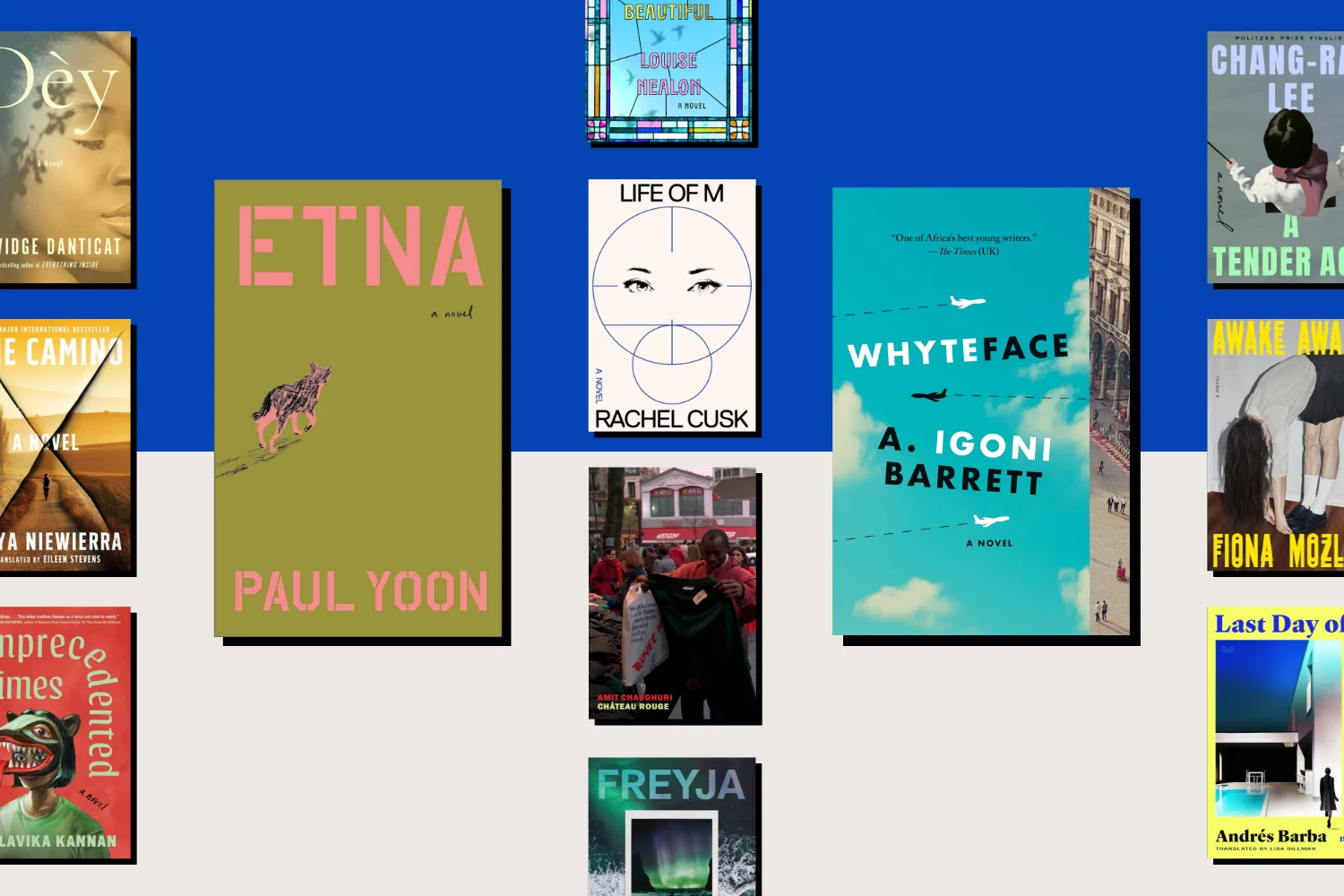
This month, we’re reading two deeply divergent takes on displacement and the pull of home, from an unnamed country in the wake of a devastating war to modern Nigeria.
Etna: A Novel
Paul Yoon (Scribner, 208 pp., $28, August 2026)
This month, we’re reading two deeply divergent takes on displacement and the pull of home, from an unnamed country in the wake of a devastating war to modern Nigeria.
Etna: A Novel
Paul Yoon (Scribner, 208 pp., $28, August 2026)
As many a moviegoer leaving Christopher Nolan’s Odyssey can attest, the most powerful scene in Homer’s epic is arguably a quiet one—when Odysseus returns home to Ithaca to find that his dog, Argos, has waited for him for 20 years. Upon seeing Odysseus, who cannot greet him lest he give up his disguise, Argos dies. (It’s also potentially the first moment of sentimentality in the Western tradition.) Dogs, Homer knew, unearth layers of emotion and pathos that even tales of war and human suffering cannot always access.
In Etna, Paul Yoon has tried his hand at what Nolan has called “the ultimate dog story,” reimagining the Odyssey from a canine perspective. The result is as moving and wrenching as one might expect. The novel is narrated by an ex-military dog named Etna, who was trained by Americans fighting in an unnamed Asian country as a bomb-detection and attack canine. Although the side he fought for has technically won, the country is in ruins after four years of war. As Etna sets out to attempt to find his way back to the coast he was taken from as a pup—the only reference point he has for home—he confronts what is left of this land: rubble, starvation, desolation. Few buildings still stand. Medical aid never arrives from the West. As one of the two surviving U.S. soldiers in Etna’s unit says early on, “Yeah, we sort of made a mess of things here, didn’t we?”
Etna features the spare yet emotionally rich prose of Yoon’s earlier work, along with his preoccupations with trauma and displacement. (Reading this book, I was reminded often of “Valley of the Moon,” a gorgeous story of his in the New Yorker a few years ago.) This lack of embellishment makes Etna’s recollections of the war all the more haunting. At one point, he recalls seeing his military handler die in an explosion: “the spaces appearing between parts of his body where there shouldn’t have been spaces.”
It almost feels like a paradox for a writer of such economy to have penned a wartime epic. And yet, in just 208 pages, Yoon’s novel manages to touch seemingly infinite dimensions of life amid and in the wake of great conflict, from the near-futility of rebuilding to the miracle of feeling the grass beneath your feet (or paws) again to the absurdity of corralling others—human or otherwise—to fight for a cause that is alien to them. Etna is also a reminder that, nearly 3,000 years later, a well-trodden genre has not yet been exhausted, if only one knows which perspectives to take.—Chloe Hadavas
Whyteface: A Novel
A. Igoni Barrett (Graywolf Press, 264 pp., $17, August 2026)

As Whyteface begins, Frank Whyte is facing a struggle that most travelers know all too well: He is stuck in traffic on the way to the airport, worried about missing his plane. In his hometown of Lagos, Nigeria, “traffic could make you late to your own funeral,” writes novelist A. Igoni Barrett, who lives in the city. Frank bemoans that he did not “set off for the airport at least twelve hours before his flight.”
But after Frank’s freak-out on a packed Lagosian highway, Whyteface stops being a widely relatable travelogue. That’s because of Frank’s unique identity. Born as Furo Wariboko, a Black Nigerian man, Frank woke up one morning as an adult to discover that he had become Caucasian overnight—except for his butt, which remained Black. “His transformation hadn’t made him white, but rather a piebald creature, the in-betweener, forever yoked to his inborn blackness despite the singed branding of whiteness,” Barrett writes.
After his metamorphosis, Frank changed his name; moved from Lagos to Abuja, Nigeria’s “capitalistic capital”; and built up enough wealth to finally make his maiden voyage to Europe. Readers accompany Frank on a tri-country jaunt to Amsterdam, Oslo, and Milan—a satirical yet unsettling journey through the Schengen area. (Barrett first introduced Frank to readers with his 2016 novel Blackass, but Whyteface can be read on its own.)
Used to being the “token white face” in Nigeria, Europe is—at first—a relief for Frank. He “promenaded unnoticed among the sightseeing masses, a new experience for him.” But when he opens his mouth—“a black voice in a white face”—Frank confuses many locals. Meanwhile, fellow Nigerians whom Frank encounters are baffled to meet an “oyibo” carrying a green passport who is fluent in pidgin, asking him, “where are you really from?”
Barrett juxtaposes Frank’s relatively privileged journey to Schiphol Airport (hefty Schengen visa fees and airfare still required) with the plight of African migrants who cross the Mediterranean by boat or languish in Libyan prisons in the hopes of gaining refuge in Europe.
Because Frank is white, many Europeans do not couch their racial prejudices around him. His Airbnb host in Amsterdam calls African children whom he sees on TV “future migrants.” In Milan, Frank identifies with the “lamentation” of Black Italian soccer phenom Mario Balotelli. When Frank observes a racist attack in Oslo, he feels “as if he were witnessing an outrage against his former face … his black family.”
Fed up with Europeans complaining about African migrants, Frank notes that Americans’ and Europeans’ “inalienable rights to travel anywhere and settle everywhere had been earned over violent centuries of undocumented migration.”
Frank was once a “whining citizen” who complained endlessly about Nigeria. But by the end of his trip, he is “no longer at ease with bashing the country he called home.” He traveled to Europe in search of savoir vivre; instead, he got an inside look at the continent’s animus. In the face of frustration abroad, he starts feeling comfortable in his apparently contradictory racial and national identities—and allows others to call him by his old name again.
“Furo was learning that his becoming was the journey and that his being—not his whyteface or blackass, but rather shared humanity, shorn of tribe and gender—was always and forever the destination,” Barrett writes. “A Nigerian is still a man o, whether he’s a black or white.”—Allison Meakem
August Releases, in Brief
Edwidge Danticat, the great literary voice of the Haitian diaspora, returns with her first novel in over a decade, Dèy. Dutch crime queen Anya Niewierra’s breakthrough thriller, The Camino, is translated into English by Eileen Stevens. With Unprecedented Times, Malavika Kannan has written what one critic has called the “first Great American Gen Z Novel.” Family secrets loom over Louise Nealon’s portrait of Irish domestic life, Everything That Is Beautiful. Rachel Cusk, patron saint of contemporary autofiction, interrogates the cost of global stardom in Life of M.
Indian author-composer Amit Chaudhuri looks beyond the sheen of the City of Light in his novel-in-fragments, Château Rouge. A cold case is reopened in Margrét Ann Thors’ debut novel, Freyja, a thriller steeped in Icelandic folklore. With A Tender Age, Korean American novelist Chang-rae Lee offers up a new addition to the canon of Western bildungsromans. The psychological weight of geopolitics crashes down on an unreliable narrator in Awake Awake by Fiona Mozley. And Andrés Barba’s contemporary ghost story, Last Day of a Prior Life, is translated from the Spanish by Lisa Dillman.—CH
