


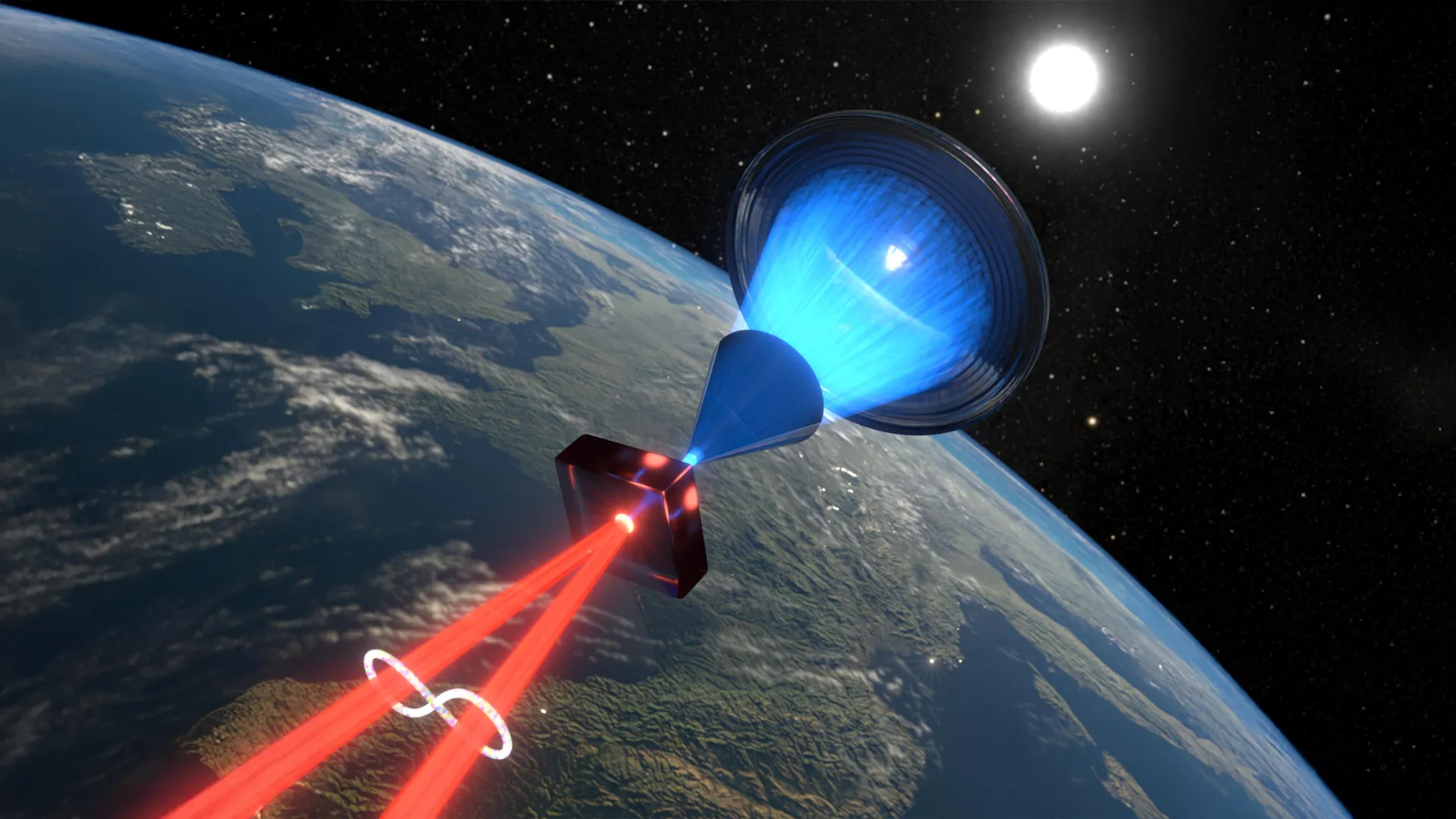
Many of today’s quantum technologies depend on powerful lasers that consume significant amounts of energy. As these systems grow larger and more widespread, their electricity requirements could become an increasing concern. Researchers have now demonstrated a striking alternative: sunlight itself can be used to generate quantum entanglement between photons.
“Quantum entanglement is crucial for applications such as secure communication, ultra-precise sensing and high-performance computation,” said Cheng Li, a recent graduate of the University of Ottawa in Canada. “Our work shows that abundant natural light sources can be used for quantum entanglement, opening the possibility of more energy-efficient and accessible quantum technologies.”
The findings, published in Optica, Optica Publishing Group’s journal for high-impact research, show that sunlight can produce entanglement comparable to laser-based techniques when differences in the bandwidth of the incoming light are taken into account. The achievement brought together theoretical work from Robert Boyd’s group at the University of Ottawa and a new solar concentrator created by Hanieh Fattahi’s team at the Max Planck Institute for the Science of Light (MPL) in Germany.
“This technology could one day enable satellites to create secure encryption keys using the sunlight already abundant in space, reducing the need for onboard lasers and much of the supporting hardware,” said Li, first author of the paper. “Sunlight-driven entanglement generation could also provide the crucial ingredient needed to scale up quantum computing without adding to the energy burden.”
Challenging Assumptions About Quantum Light
Scientists have traditionally believed that producing the strong correlations needed for photon entanglement requires coherent light. In coherent light, the waves remain synchronized so that their peaks and valleys follow a predictable pattern. Lasers are commonly used for this purpose because they generate highly coherent light concentrated at a single color.
Earlier research from Boyd’s team began to challenge that assumption. The researchers predicted theoretically, and then demonstrated experimentally, that incoherent light could also generate quantum entanglement. In those experiments, they used an LED, an incoherent light source, to produce polarization-entangled photons.
Those results established an important principle. Light can be disordered in one characteristic, such as the directions in which it travels, while still creating photons that are entangled through another characteristic, such as polarization.
The new work pushes that concept further by replacing the LED with sunlight. Sunlight presents a much greater challenge because it spreads in many directions and contains a wide spectrum of colors.
Creating Entangled Photons With Sunlight
To generate the entangled photons, the researchers relied on spontaneous parametric down-conversion (SPDC). In this established optical process, a pump beam enters a nonlinear crystal, where individual photons can split into pairs that may become quantum entangled.
Rather than using the conventional laser pump, the team supplied the system with sunlight. The sunlight was strongly polarized while remaining highly incoherent across both space and time. Its overall light field oscillated in the same direction, even though it contained photons of different colors traveling along many different paths.
“We designed our experimental setup so that differences introduced by the different colors and propagation directions didn’t influence the photons’ polarization,” said Li. “As our theory predicts, if the entanglement lives only in polarization, then it should only depend on the pump’s orderliness in its oscillation direction and not on its direction or color. This allowed us to produce high-quality polarization entanglement from highly spatially and temporally incoherent sunlight.”
Getting enough sunlight onto the extremely small nonlinear crystal created another major obstacle. The crystal measures only about a millimeter in size, making ordinary methods of collecting sunlight impractical.
Fattahi’s team at MPL addressed the problem by designing an all-glass solar concentrator. The cone-shaped system collects sunlight with a Fresnel lens approximately the size of a household window and channels that light into an optical fiber about as wide as a human hair. The concentrated sunlight can then be directed onto the tiny nonlinear crystal responsible for producing the entangled photons.
Sunlight Produces Strong Quantum Entanglement
The researchers tested both their theoretical predictions and the new concentrator during an outdoor experiment at MPL. They used quantum state tomography to analyze the resulting quantum state and found that the entanglement produced with sunlight was about 94% similar to a perfectly entangled state.
The team also found that the photons displayed correlations that violate Bell’s inequality. That result is especially important because such correlations cannot be explained by classical physics and instead provide evidence that genuine quantum entanglement was produced.
With the proof-of-principle experiment successfully completed, the researchers are now working toward a system that could eventually be used outside the laboratory. Their efforts are focused on increasing brightness and further improving the quality of the entanglement.
The experiment relied on SPDC, but the researchers say the underlying approach could also work with other nonlinear optical techniques, including four-wave mixing. Expanding the concept to additional methods could create new possibilities across quantum photonics.
From Skepticism to a Working Experiment
The result also overcame significant doubts within the scientific community about whether sunlight could realistically drive the process.
“Since the inception of this project, our idea has met with repeated doubt and pushback,” said Li. “Some world-renowned researchers in the field even questioned whether it would be possible to detect any photons — not to mention entangled photons — from sunlight-driven nonlinear optical processes. However, we trusted our calculations, continued improving the experimental setup, and eventually showed that it was possible.”
