


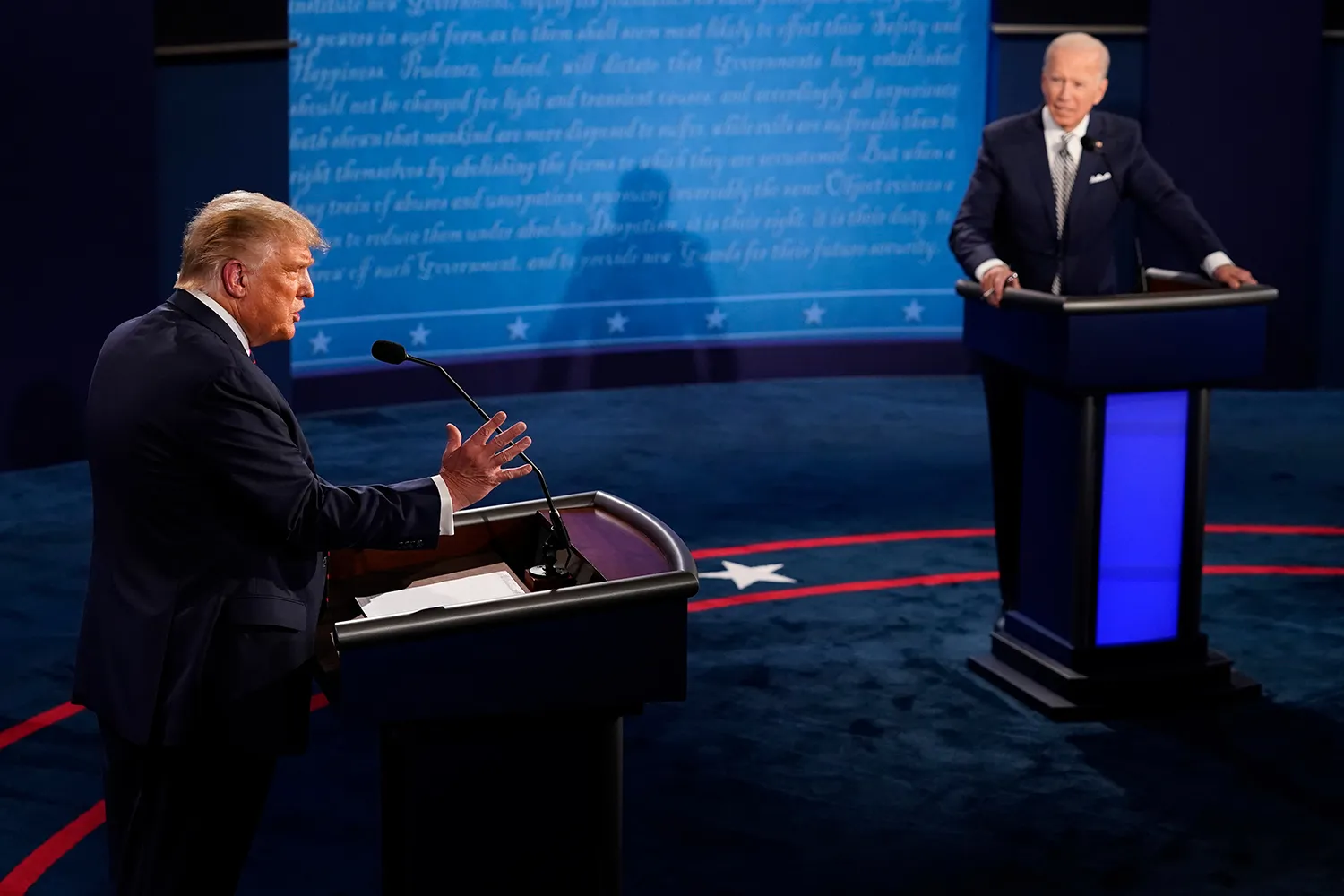
Thomas Wright’s short, effective new book diagnoses how Donald Trump and Joe Biden’s foreign policies signal a transformed world order, albeit in different ways. Wright, who served on Biden’s National Security Council from 2022 to 2025, combines a scholar’s insight and a practitioner’s experience to shed light on a changing world. However, the book is limited by a lack of meaningful discussion about both Israel-Palestine, and the future of the Democratic Party’s foreign policy.
Wright focuses on a few major themes, the most important of which is the idea that the post-Cold War world is over. Barack Obama, he argues, was the last true “restorationist” president who tried to preserve a grand strategy based on alliances, free trade, and military supremacy. Obama was also the last president to try to integrate Russia and China into a cooperative, liberal international order—and this effort failed. Now the United States faces two major revisionist autocratic rivals that seek to weaken its global influence and assert control over their zones of the world.
Thomas Wright’s short, effective new book diagnoses how Donald Trump and Joe Biden’s foreign policies signal a transformed world order, albeit in different ways. Wright, who served on Biden’s National Security Council from 2022 to 2025, combines a scholar’s insight and a practitioner’s experience to shed light on a changing world. However, the book is limited by a lack of meaningful discussion about both Israel-Palestine, and the future of the Democratic Party’s foreign policy.
Inflection Point: Biden, Trump, and the Future World Order, Thomas Wright, Penguin, 176 pp., April 2026
Wright focuses on a few major themes, the most important of which is the idea that the post-Cold War world is over. Barack Obama, he argues, was the last true “restorationist” president who tried to preserve a grand strategy based on alliances, free trade, and military supremacy. Obama was also the last president to try to integrate Russia and China into a cooperative, liberal international order—and this effort failed. Now the United States faces two major revisionist autocratic rivals that seek to weaken its global influence and assert control over their zones of the world.
These changes, Wright argues, were well under way in Trump’s first term, if not earlier, but Trump exacerbated them with an incoherent hybrid strategy. He blasted his predecessors for overextending U.S. power and letting allies free-ride, but under the influence of his more conventional Republican policy advisors, he did not radically revise the global U.S. role.

Senior White House policy advisor Stephen Miller, left, and chief strategist Steve Bannon, center, sit with other members of the Trump administration at a news conference at the White House in Washington on Feb. 13, 2017.Mark Wilson/Getty Images
In this light, Biden’s presidency and Trump’s return to office constitute definitive inflection points from the post-Cold War world. Where some have criticized Biden as a restorationist, Wright contends that he made a series of corrections in response to an increasingly multipolar world and to the vulnerabilities exposed by the COVID-19 pandemic. He broke with the post-Cold War free trade consensus by imposing strict export controls on critical technologies like advanced microchips, expanding U.S. industrial capacity, and making the United States less vulnerable to supply-chain disruptions.
Biden also completed Trump’s withdrawal from Afghanistan, signaling an end to multiple decades of U.S. nation-building overseas. He bolstered ties to traditional U.S. allies after the first Trump term’s disruptions but did so by rallying coalitions to support partners doing the heavy lifting, as in the collective backing of Ukraine after Russia’s 2022 invasion. He also embraced strategic competition with China and Russia, in contrast to Obama’s efforts to build relationships and ease tensions with those countries. In sum, Biden’s foreign policy maintained the longstanding Democratic commitment to multilateralism and institutions while stepping back from the post-Cold War U.S. role as Atlas of the world order. He also tipped economic policy toward protectionism and re-shoring of key defense industries while acknowledging the reality of competition with revisionist powers.
Trump’s second term, Wright concludes, signifies a permanent break from the post-Cold War world and a new orientation for U.S. power. Trump, Vice President JD Vance, and other MAGA conservatives wanted to ensure that Trump’s will would not be impeded by conventional Republican advisors or bureaucratic inertia. This led to the appointment of a bizarre mix of lackeys and ideologues in his second-term cabinet, as well as a campaign to hollow out foreign policy agencies like the State Department.
In practice, this consolidation of MAGA influence over Republican foreign policy has meant aggressive and erratic U.S. behavior, including two separate military campaigns against Iran, threats against allies like Canada and Denmark, and the kidnapping of Venezuelan President Nicolás Maduro. Trump has also gone harder on economic protectionism in his second term by imposing steep and arbitrary tariffs on dozens of nations. The core ethos of MAGA’s foreign policy, Wright notes, is that it is foolish for the United States to provide any public good, such as freedom of the seas or support for defense alliances like NATO, that it does not benefit from immediately and tangibly. Enlightened self-interest remains a critical part of Democratic foreign policy thinking, but it is dead and buried in Trump’s Republican Party.
The Trump administration has also aligned itself firmly with far-right parties around the world, especially in Europe, while alienating longstanding allies. The post-Cold War order is over, Wright concludes, because both Biden and Trump moved away from the idea of the United States as the linchpin of world order, although Trump’s actions have been more extreme in this regard.

A man holds up a placard with the words ‘God Bless Donald Trump’ as people take part in a far-right protest called Unite the Kingdom in London on May 16.Carl Court/Getty Images
A second major theme of Wright’s book is the growing divergence of Republican and Democratic foreign policies. The Cold War featured a strong consensus on containing communism, and the post-Cold War era featured a new consensus on U.S. leadership (if not hegemony), free trade, military interventionism, and support for key alliance systems.
However, Wright argues, hyper-polarization in the United States has affected foreign policy by pushing Republicans and Democrats ever further apart, despite some overlap on issues like protectionism. U.S. foreign policy will therefore lurch wildly when administrations change hands. Now that Trump has instilled America First as the bedrock of Republican foreign policy, this will be a permanent dynamic.
Wright concludes that this oscillation of U.S. foreign policy will make addressing every global problem harder, from preserving treaty agreements to reassuring partners and allies like Taiwan, Ukraine, and NATO. The world, especially U.S. allies, will have to adapt to this reality. This means that regional coalitions will have to take more responsibility for key challenges, even if that means pushing back on Trump’s bullying. Wright quotes Canadian Prime Minister Mark Carney’s insight on this new condition: “We are in the midst of a rupture, not a transition,” and so “the middle powers must act together, because if we’re not at the table, we’re on the menu.”
While Inflection Point is an insightful assessment of U.S. foreign policy in the 2020s, it has less to say on what comes next. Indeed, it is at once minor but telling that Wright declines to offer a name for the new global context we now inhabit.
A larger problem is that Wright has little to say about Israel and Gaza. He is focused on great power competition and grand issues of trade, arms races, and alliances. Nonetheless, world order can be reshaped by smaller actors as well. The United States has now been deeply involved in a series of Middle Eastern wars stemming from the Oct. 7 terrorist attack on Israel. Biden failed to put any meaningful constraints on the Israeli reaction, which led not only to catastrophe in Gaza but a steady escalation of conflict in the region. Biden showed that he was stuck in a much older mentality that viewed Israel as the underdog bastion of democracy in a hostile part of the world, rather than what it has actually become: a reckless, militaristic state controlled by the far-right.
Inflection Points feels incomplete without a look at this tragic issue. Biden’s ongoing accommodation of Israel was more of a feature than a bug of Democratic foreign policy over the last several decades, as presidents such as Obama and Bill Clinton lamented Israel’s behavior but rarely responded with meaningful consequences. Now, Trump has launched an ill-considered, unprovoked attack on the Iranian regime and doubled down on the alliance with Israel. As a result, it is especially important for Democrats to think through alternatives to both Biden and Trump’s approaches to the Middle East, which have been far too similar in their failings.

The bridge linking Bandar Abbas and Kehuristan, rendered unusable in a U.S. strike, is seen in Iran’s Hormozgan province on July 19. Amir Hossein Khorgooei/Anadolu via Getty Images
A fundamental revision of the U.S.-Israeli relationship is in order, on both strategic and ethical grounds. If Democratic foreign policy experts cannot think of a new path forward in the Middle East beyond opposing Trump’s actions, then the party will be rudderless going forward. As Wright notes, Democrats are deeply divided over the Israel-Palestine issue, with the trend line moving toward the rejection of the U.S.-Israeli partnership. But he does not offer his own answer to this critical question. This reflects a larger abdication among Democratic Party elites, as exemplified by the Democratic National Committee’s failure to even mention Israel or Gaza in its autopsy of the 2024 election.
Democrats remain deeply uncertain about what role the United States should play in the world. Wright shows that the slate does not need to be wiped clean, as Biden took effective multilateral action on Ukraine, alliances, the defense industrial base, and other issues. But he was lacking in a broader vision that could counter Trump’s America First appeal. The party still desperately needs a persuasive strategy for addressing a more multipolar international system, allies whose trust in the United States has been permanently damaged, and the global reaction against liberal democracy.
In the course of a short, concise volume, Wright has conclusively demonstrated that, for all their differences, Biden and Trump moved the United States away from the key assumptions and policies of the post-Cold War system, which now appears as a roughly 25- to 30-year interim between eras of strategic competition. The message of this book is that there’s no going back. Unfortunately, it does not tell us where to go from here.
