


Welcome back to World Brief, where we’re looking at military commitments for Pakistan, Saudi Arabia, and Turkey; a mass shooting in Thailand; and Colombia’s new right-wing president.
Mutual Defense
Pakistan, Saudi Arabia, and Turkey inked a joint defense pact on Friday, concluding nearly a year of negotiations aimed at countering aggressive military posturing in the Middle East. Dubbed the Mecca Joint Defense Agreement, the alliance will act as a NATO-style mutual defense pact that consolidates the power and influence of three regional heavyweights.
Welcome back to World Brief, where we’re looking at military commitments for Pakistan, Saudi Arabia, and Turkey; a mass shooting in Thailand; and Colombia’s new right-wing president.
Pakistan, Saudi Arabia, and Turkey inked a joint defense pact on Friday, concluding nearly a year of negotiations aimed at countering aggressive military posturing in the Middle East. Dubbed the Mecca Joint Defense Agreement, the alliance will act as a NATO-style mutual defense pact that consolidates the power and influence of three regional heavyweights.
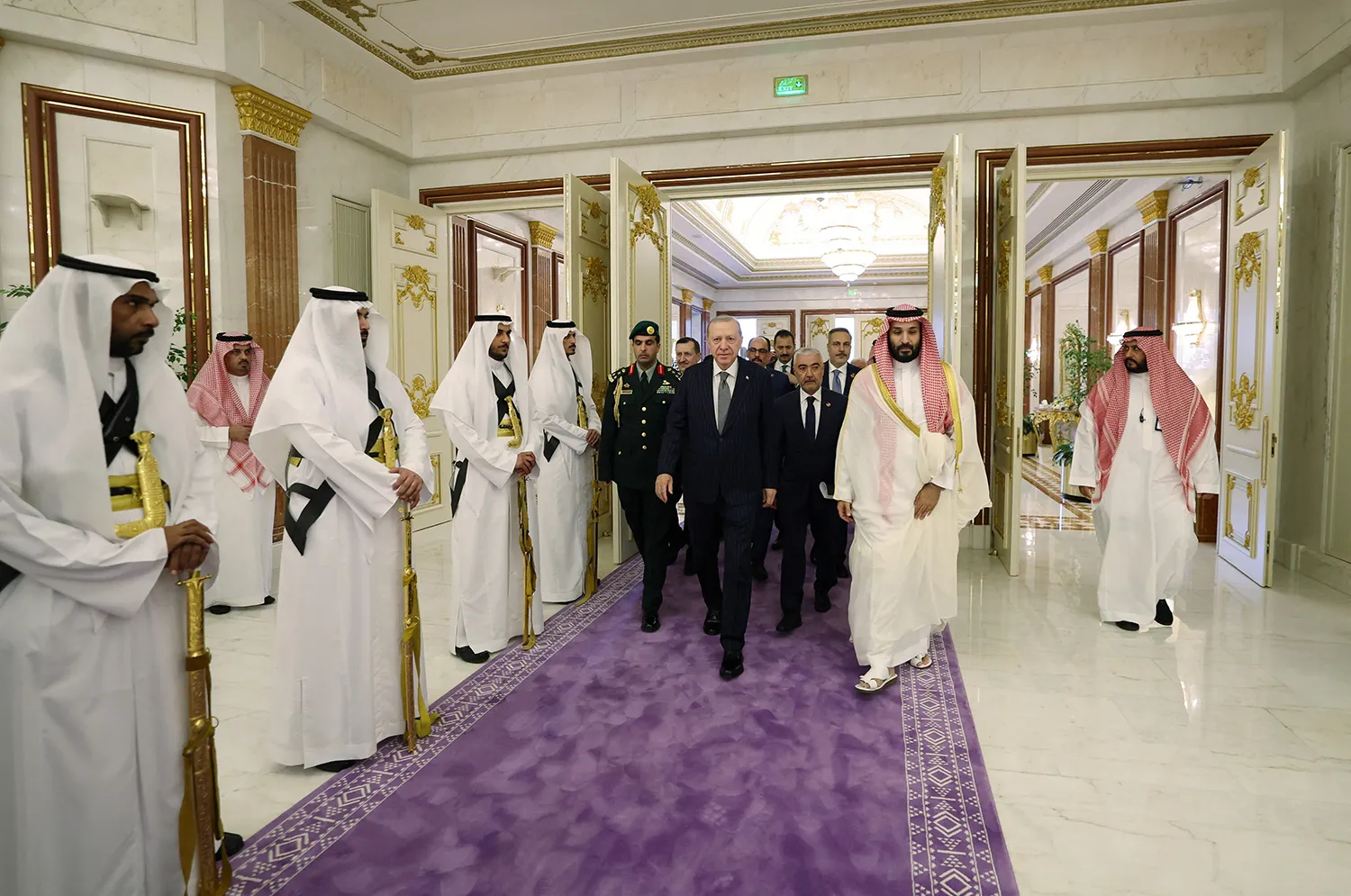
According to a trilateral statement, “the agreement is intended to strengthen collective deterrence against any act of aggression, and stipulates that any armed attack against any one of the three states shall be regarded as an attack against them all.” Although Egypt participated in early talks, Cairo was not mentioned as a participant in Friday’s deal. Pakistani Prime Minister Shehbaz Sharif, Saudi Crown Prince Mohammed bin Salman, and Turkish President Recep Tayyip Erdogan all attended the signing in Mecca, Saudi Arabia—Islam’s holiest city.
Military cooperation among the three Sunni Muslim-majority nations is nothing new. For decades, Pakistan has provided Saudi forces with training and technical aid, Islamabad and Ankara have previously exchanged warships and training aircraft, and Riyadh has repeatedly purchased Turkish drones. Last month, Pakistan and Turkey also backed a Saudi-proposed maritime defense coalition that would help protect regional shipping routes and prevent global supply chains from being held hostage during war.
But just how far the joint defense pact will go remains unclear. The three nations do not have a history of eagerly providing military support; last September, Pakistan signed a mutual defense deal with Saudi Arabia. However, Islamabad has not responded militarily to Iran’s recent attacks on the kingdom, and it has downplayed suggestions that its nuclear capabilities might be extended to allies.
Pakistan is the only nuclear-armed Muslim nation in the world, but it is not the only one bringing something to the table. Turkey has NATO’s second-largest military and is known for its extensive (and profitable) defense industry. Meanwhile, Saudi Arabia is one of the world’s top oil exporters and recently signed a pact with the United States to begin development of a civilian nuclear program.
All three regional powers are expected to leverage these assets to counter worsening security in the Middle East. Erdogan stressed on Friday that the pact is not aimed at one particular country, and Riyadh expressed similarly placatory sentiments. Friday’s agreement “does not represent an effort to establish a military axis or a sectarian bloc. Nor is it linked to any nuclear ambitions or arms race, rather it is focused on building sustainable capabilities,” Rayed Krimly, Saudi deputy minister for public diplomacy, posted on X.
But experts suspect that the deal is likely a direct response to Iranian and Israeli military maneuvers.
Until now, Turkey and Pakistan have avoided getting directly involved in the Iran war despite both sharing land borders with Iran. Saudi Arabia also initially sought non-involvement; however, long-standing tensions with the Iran-backed Houthis in neighboring Yemen drew the kingdom into active conflict, and in late July, Saudi and U.S. forces launched joint strikes on Iran-backed militias in Iraq.
In public, Iranian officials appear unimpressed. “The Saudis should know that a paper agreement with Turkey and Pakistan will not bring them security, just as years of one-sided milking by the Americans did not bring them security,” Ebrahim Rezaei, an Iranian politician, wrote on X. “Change your policies so that you do not have to #BegForSecurity from others.”
Turkey and Israel, meanwhile, have increasingly found themselves in each other’s rhetorical crosshairs. In July, Turkish Foreign Minister Hakan Fidan described Israel as a “burden that humanity can no longer bear”—remarks that Israeli officials interpreted as a call for genocide. Israeli Prime Minister Benjamin Netanyahu and other prominent political figures in the country have painted Turkey as the new Iran and warned of an “emerging radical Sunni axis.” This new defense pact is likely to further inflame such fears.
Israel has yet to respond to Friday’s signing.
Deadly school shooting. A mass shooting at a high school in Thailand on Friday killed at least six people and injured more than 20 others, with nine in critical condition. The youngest victim was 12 years old. Earlier that morning, the suspected shooter, age 14, also killed his grandparents in their home. Local officials confirmed that the perpetrator killed himself before authorities could apprehend him and that the situation is “now under control.”
Thailand has one of the highest gun ownership rates in Asia, second only to Pakistan. In 2017, more than 10.3 million firearms were owned by civilians (or around 15 guns per every 100 people). The country also has the second-highest rate of gun homicides in Southeast Asia after the Philippines. Thailand’s deadliest mass shooting occurred in 2022, when 36 people—including 24 children—were killed at a childcare center.
“When I became prime minister, one of my to-do things was to issue a new law regarding weapons, and it is still in the process,” Thai Prime Minister Anutin Charnvirakul told reporters on Friday, adding that “the new law will only allow government officials on duty to carry guns.” Thai government officials and law enforcement are allowed to buy as many firearms as they want at a discounted rate, and few regulations are in place to prevent individuals from then selling those weapons on the black market.
Colombia’s new leader. Conservative outsider Abelardo de la Espriella was sworn in as Colombia’s new president on Friday. Rather than hold the ceremony in Bogotá, though, de la Espriella chose to be inaugurated in the southwestern city of Cali, symbolizing his hard-line approach to crime. Cali has become known for its high homicide rate, rampant gang violence, and drug-trafficking networks.
One of the key pledges of de la Espriella’s campaign was to tackle violent crime. He criticized outgoing President Gustavo Petro’s policy of negotiating with armed groups, and he dismissed the efficacy of a previous peace agreement with the now-defunct Revolutionary Armed Forces of Colombia (FARC). Dissident rebel groups have emerged in the vacuum left by FARC, particularly the National Liberation Army, which has seized on FARC’s absence to fight for greater territorial control.
Among de la Espriella’s other ambitions, the right-wing businessman and lawyer aims to revive the country’s oil and gas sector, build mega-prisons, eliminate wealth taxes, and roll back many benefits established under the previous administration. He is the latest in a slew of far-right leaders to clinch electoral victories across Latin America, several of whom attended de la Espriella’s inauguration.
Ebola infections. The number of confirmed Ebola cases in the Democratic Republic of the Congo surpassed 4,000 for the first, according to government data, with deaths exceeding 1,850 individuals. Experts believe that the epidemic, which has been recorded in five Congolese provinces, is the second-largest and fastest-spreading Ebola outbreak on record. A Science report published last month estimated that the virus broke out at least four months before it was officially detected.
Ebola is “spreading at an alarming and unprecedented rate,” Doctors Without Borders said in a statement this week. And the response “is still not reaching communities quickly enough to break transmission chains.” On Wednesday, World Health Organization chief Tedros Adhanom Ghebreyesus urged local authorities to prioritize support for health care responders.
The largest Ebola outbreak occurred between 2014 and 2016, when more than 28,000 cases and around 11,000 deaths were detected across West Africa. Health officials believe that the current outbreak is being exacerbated by poor infrastructure in rural communities, mining-related movement, and rebel conflict.
Several capybaras strolled into a legislative building in Cuiabá, Brazil, last week, surprising lawmakers preparing for a scheduled vote. The adorable rodents, known for their sociability and chill demeanor, are native to South America, with many living in the wildlife park located next to the Cuiabá facility. “They show up here quite often, so we’ve gotten used to seeing them,” staffer Nayara Bueno said. Unlike their human counterparts, they’re usually not visiting lawmakers to file a complaint.
