


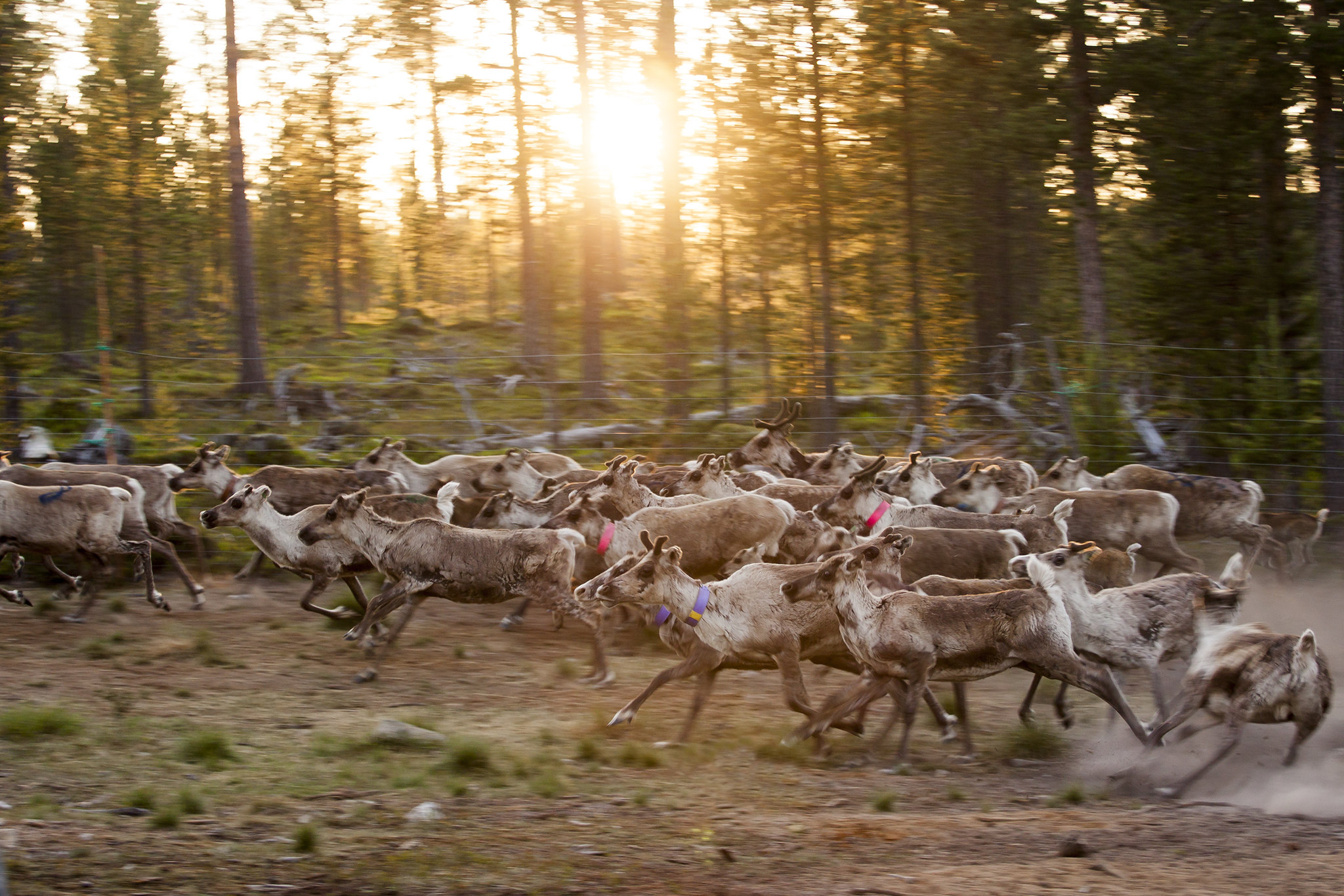
- The richness of an area’s biodiversity is not only related to protection of particular species or fragments of wilderness, but also often relates to how human beings inhabit the land across long stretches of time, a new analysis argues.
- For instance, the home territories of Scandinavia’s Indigenous Sámi peoples reveal that their sacred natural sites frequently contain greater biodiversity, more intact vegetation, and better-preserved ecosystems than surrounding landscapes.
- “Sámi land use suggests that cultural traditions, local knowledge, and enduring relationships with the landscape can help sustain environments where both humans and other living beings continue to share the same living lands,” the author writes.
- This article is an analysis. The views expressed are those of the author, not necessarily of Mongabay.
Modern conservation is often traced to the establishment of Yellowstone National Park in the U.S. in 1872. In Sweden, a similar milestone came with the founding of Sarek National Park in 1909, partly intended to protect the endangered brown bear of the far north. Yet, long before states established national parks and environmental agencies, people across the world protected landscapes through religion, customary law, and Indigenous stewardship.
In Japan, Shinto shrine forests have been preserved for centuries. In India, villagers continue to maintain sacred groves. Ethiopia’s churches and monasteries are often encircled by protected forests, while parts of rural Italy still contain sacred landscapes rooted in traditions older than Christianity itself. Some are associated with Francis of Assisi, the patron saint of animals and ecology; others may descend from sites once dedicated to Jupiter.
A growing body of research suggests that such places have often functioned — intentionally or otherwise — as informal systems of conservation.
In 2021, the researcher Piero Zannini and his colleagues published a systematic review of sacred natural sites and biodiversity conservation. Examining studies from around the world, they found that sacred natural sites frequently contained greater biodiversity, more intact vegetation, and better-preserved ecosystems than surrounding landscapes. Sacred places, they argued, often operate as effective forms of conservation grounded not in state bureaucracy or scientific management, but in cosmology, ritual, and local tradition.
Something similar once existed across Sápmi, the traditional homeland of the Sámi people stretching across northern Norway, Sweden, Finland, and Russia’s Kola Peninsula.
For centuries, Sápmi was shaped by Sámi religion and by sacred places woven into the landscape itself. The older Sámi worldview held that mountains, lakes, rivers, forests, and unusual stones possessed spiritual presence. Nature was animated, inhabited by powers and beings that demanded respect. Sacred stones and sacrificial sites formed an important part of this cosmology. Mountain Sámi communities maintained sacred places in the highlands, while fishing and forest Sámi communities often situated them near rivers, lakes, and woodland.
These places were regarded as dwellings of divine beings or local spirits — entities believed to influence hunting fortune, weather, animal migrations, and human well-being.
Such beliefs also shaped how landscapes were treated in practice.
Sacred areas could be relatively large and were sometimes marked by fences, stone formations, or natural boundaries such as streams. In some cases, low stone walls were built around sacrificial sites, with logs placed above them to protect offerings. People approached these places quietly. Loud speech, hunting, or careless disturbance near sacred ground could be considered deeply inappropriate. In effect, certain parts of the landscape became protected from intensive use.
These sites were also carefully maintained. Birch leaves decorated them during summer, spruce branches during winter. Accumulations of branches and brushwood of this kind resemble what are today called “benjes hedges” — dense ecological structures that provide shelter and corridors for insects, birds, and small mammals. Seeds spread through such environments, encouraging varied vegetation and, in turn, attracting further species. Whether intentionally or not, such practices may at times have strengthened local biodiversity.

Certain trees and forests also held sacred significance. Birch trees, in particular, could become associated with spiritual powers and were therefore protected from cutting. During the Christian missions of the 17th and 18th centuries, many Sámi sacred sites were destroyed as older religious traditions were suppressed. Sacred trees were sometimes marked for felling. Over time, many disappeared from the landscape altogether.
Knowledge of some sacred places has later been deliberately concealed from outsiders in order to protect them from disturbance and vandalism.
It is difficult to determine precisely what ecological effects these sacred sites once had. No scientific studies of biodiversity around older Sámi sacred landscapes were carried out before many of them changed or were destroyed. Yet, it is plausible that reduced human disturbance around such places allowed flora and fauna to develop relatively undisturbed. International research on sacred natural sites suggests that such connections are far from impossible.
How Sámi culture preserves biodiversity
The relationship between Sámi land use and biodiversity, however, extends far beyond what was considered sacred.
More significant from a broader ecological perspective may be the ways the entire Sámi cultural landscape was shaped through reindeer herding, seasonal migration, fishing, hunting, and generations of local ecological knowledge.
Research by the forest historian Lars Östlund and his colleagues has shown that older Sámi land use left long ecological traces in northern forests. Studies of abandoned Sámi settlements have found altered vegetation, soil chemistry, and microbial activity more than a century after the sites were deserted. Even low-intensity land use, it seems, can shape ecosystems over very long periods of time.

Yet, perhaps more important than what Sámi communities did, Östlund argues, was what they did not do.
In conversation, he notes that their low-intensity forest use created “a certain variation in the landscape with different kinds of gradients” involving nutrients, reindeer grazing, deciduous trees, and dead wood. This likely contributed to increased biodiversity. But more significant, perhaps, was that Sámi land use — unlike charcoal production, tar burning, potash extraction, and early industrial logging — did not remove what he calls “the most valuable structures in the forest” such as “large and old trees.”
Documented Sámi cultural pines offer a striking example of this relationship between ecology and cultural history. Some of these trees, occasionally four or five centuries old, still bear scars from bark harvesting and other forms of human use. Yet, they are also important ecological habitats. Rare lichens and fungi thrive on old bark and resin-rich exposed wood. Insects shelter within deadwood structures. Birds and squirrels’ nest in cavities formed over centuries. These trees are simultaneously cultural documents and living ecosystems.
Older forests in areas long used by Sámi communities also differ from both untouched old-growth forests and modern industrial plantations. The landscape often forms a mosaic of varying tree species, ages, densities, and clearings shaped by recurring human use rather than large-scale extraction. Birch is sometimes more common than in surrounding forests. Such structural variation creates habitats for many species absent from the homogeneous, even-aged stands characteristic of industrial forestry.
Reindeer themselves form part of this ecological dynamic. Through grazing, they influence vegetation patterns and may prevent certain species from becoming overly dominant. They disperse seeds and return nutrients to the soil. Reindeer husbandry, thus, becomes part of a broader interaction between animals, humans, and landscape.
Oral traditions also preserve examples of practical resource stewardship. Stories about the Sámi woman Inga Enarsdotter (1782–1866), for instance, describe how she used fishing nets with wide mesh in order to avoid catching immature fish and thereby reduce the risk of depleting fish stocks. Such stories should perhaps not be romanticized, but they suggest how long-term dependence on local ecosystems could encourage restrained forms of resource use.

Recent scholarship increasingly challenges the old idea that the forests of Sápmi were pristine wilderness untouched by human presence. By combining ecological surveys with archival material, place names, and Sámi cultural traces, researchers have shown that these northern forests are better understood as historical cultural landscapes shaped through long interaction between people and environment.
In Sámi hands, Sápmi emerges not as untouched nature but as a landscape where ecological diversity and human presence long coexisted.
Similar patterns have been observed elsewhere in the world. Areas marked by strong Indigenous continuity frequently coincide with high biodiversity. Across many regions, Indigenous peoples have played a central role in preserving ecologically valuable landscapes.
In Sápmi, this means that biodiversity is tied not only to isolated sacred sites, but to larger cultural landscapes and systems of stewardship. Sámi resistance to mines, hydropower expansion, industrial forestry, wind farms, and roads has also contributed to the preservation of large connected environments with significant ecological value.
The landscape is, therefore, simultaneously ecological, cultural, historical, and political.
Questions of biodiversity are, ultimately, not only about protecting isolated species or fragments of wilderness, they are also about how human beings inhabit land across long stretches of time. Sámi land use suggests that cultural traditions, local knowledge, and enduring relationships with the landscape can help sustain environments where both humans and other living beings continue to share the same living lands.
Emil Siekkinen is an environmental writer and advocate focused on ecological justice, biodiversity, and the intersection of law and nature.
See related coverage:
Plans to dispose of mining waste in Norway’s Arctic Ocean worries Sámi fishers, herders
Do Indigenous peoples really conserve 80% of the world’s biodiversity?
Finland’s debate over Indigenous identity and rights turns ugly
Citations:
Zannini, P., Frascaroli, F., Nascimbene, J., Persico, A., Halley, J. M., Stara, K., … Chiarucci, A. (2021). Sacred natural sites and biodiversity conservation: A systematic review. Biodiversity and Conservation, 30(13), 3747-3762. doi:10.1007/s10531-021-02296-3
Östlund, L., Zackrisson, O., …Hörnberg, G. (2002). Trees on the border between nature and culture: Culturally modified trees in boreal Sweden. Environmental History, 7(1), 48-68. doi:10.2307/3985452
Bergman, I., …Östlund, L. (2022). A sacred tree in the boreal forest: A narrative about a Sami shaman, her tree, and the forest landscape. Human Ecology, 50(6), 1023-1033. doi:10.1007/s10745-022-00365-x
Cite this article
Emil Siekkinen (2026). Sacred places & living lands: How Indigenous Sámi peoples steward biodiversity (analysis). Mongabay Conservation news. DOI: https://doi.org/10.66709/news-325594

