


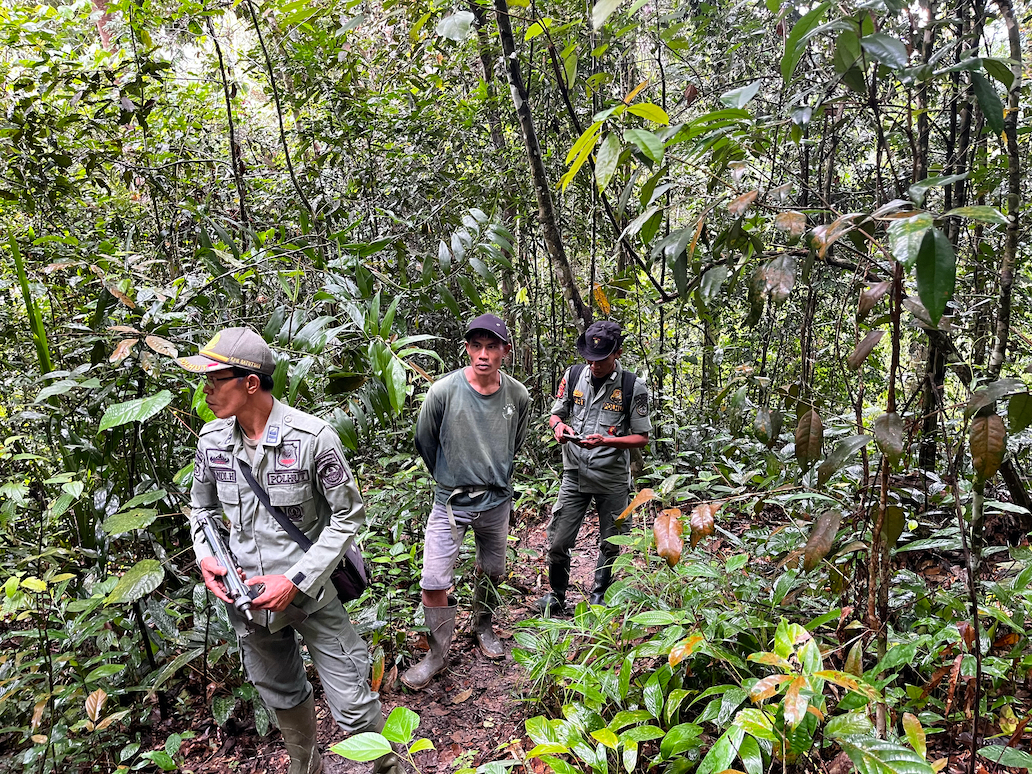
- In southern Sumatra, a small team of forest rangers is racing to protect Batutegi forest, an important watershed and refuge for endangered wildlife such as tigers and slow lorises.
- Batutegi faces persistent pressures from forest encroachment and the need to balance conservation with local livelihoods.
- Experts say protecting Batutegi will require sustained collaboration with local communities, alongside long-term conservation and forest management efforts.
TANGGAMUS, Indonesia — For more than a decade and a half, forest ranger Wandi Harmoko has walked the ridges and valleys of Batutegi, a landscape in southern Sumatra. He is one of only a handful of officers tasked with patrolling almost 60,000-hectares (148,300 acres) of forest that is not only ecologically significant but also economically vital to Lampung province.
The forest Wandi protects today has been shaped by decades of disturbance. Since the turn of the century, waves of encroachment cleared large areas of forest to accelerate conversion to coffee plantations. Nevertheless, the forests here still harbors endangered wildlife, including Sumatran tigers (Panthera tigris sumatrae), siamang (Symphalangus syndactylus), pangolins (Manis javanica), Sumatran slow lorises (Nycticebus coucang) and sun bears (Helarctos malayanus).
The survival and recovery of what remains in Batutegi depend on a fragile collaboration between a limited number of rangers, technology-driven monitoring systems, and social forestry farmers whose livelihoods are tied to the landscape.
“What affects me most are the moments when we still encounter forest encroachment,” Wandi told Mongabay after joining his team for a day patrol inside Batutegi’s core zone. “It creates an inner conflict, because sometimes we have to arrest people and see them go to prison, even though we understand their situation.”
The Batutegi landscape, including a reservoir with the same name, stretches across 81,741 hectares (202,000 acres) jointly overseen by two forest management units (KPH), namely KPH Batutegi and KPH Way Waya. Of this area, about 15,067 hectares (37,231 acres) are designated as core protection forest, while the remaining is allocated for utilization, largely under social forestry schemes, where farmers who follow rules designed to protect the forest ecosystem can legally cultivate coffee and other crops.
Threats persist against the forest and its wildlife
It is across this vast mosaic that Wandi and seven others have patrolled (often with just one or two colleagues) to monitor forest conditions, respond to reports, and negotiate with communities whose livelihoods depend on the same land the rangers are tasked to protect.
“Some still take the risk, continuing to cut down trees and log the forest,” Wandi said.
Deforestation, in turn, opens up the forest for other types of exploitation. Rangers here have found snares along patrol trails; some clearly intended for wild boar but others constructed in ways that suggest larger, more valuable targets, like the Sumatran tiger. They have also arrested hunters who travel from outside the area. According to Wandi, the presence of outsiders, coupled with the more-intricate snares, indicate some backing by financiers intentionally targeting high-value wildlife products.

Batutegi’s protection forest falls directly under provincial authority, a shift away from centralized management that occurred after Indonesia established the KPH system in 2009.
Wandi has been present for most of this transition. In 2010, he transferred from municipal policing, trading a desk job for a life of constant movement. When the Batutegi management unit was formally established in 2011–2012, he was among the first officers stationed there and has remained ever since.
According to local conservation staff, the provincial government has continued to maintain Batutegi’s status as a protection forest because of its strategic importance: The forested watershed feeds the Batutegi reservoir and two downstream dams supply irrigation water to half a dozen districts. Lampung is among Indonesia’s major rice-producing provinces, and safeguarding these forests is seen as essential to maintaining agricultural productivity far beyond the forest’s borders.
This institutional backing has helped shield Batutegi from large-scale threats such as oil palm expansion, mining or mass tourism development. But subtle and persistent pressures remain.
Deforestation for coffee plantations is an ever-present threat. Even the social forestry program designed to curb deforestation inadvertently caused waves of land clearing in 2013 and 2017, as farmers rushed to re-open abandoned farming plots in the forest in order to secure their involvement in the program.
One contentious challenge forest rangers are still working to resolve is the unclear border between the strictly protected core forest and the surrounding utilization blocks. Without clear demarcation, law enforcement becomes difficult. Forest rangers like Wandi are often accused of acting arbitrarily, while rangers in turn say villagers use the lack of clear markers as an excuse for encroaching.
“We always carry an official assignment letter when we’re in the field as a precaution, because people sometimes question our presence,” Wandi said. “Even though we are forest rangers, our duty is here, we still get questioned like that.”

Today, forest protection in Batutegi relies on a blend of direct and remote monitoring. Rangers still trek for days through the forest, but they are also supported by satellite-based tools such as Google Earth Engine, drone mapping and Global Forest Watch, which help detect illegal activities and guide patrol routes. On the ground, officers use the SMART Mobile application to record georeferenced data in real time, allowing illegal logging, snares, or encroachment to be mapped and analyzed more systematically than in the past.
In 2024 alone, patrol teams recorded 66 incidents of human activity across Batutegi, including eight cases of forest encroachment, evidence of timber processing, and several active and inactive snares. The data, Wandi says, helps them respond more precisely. For instance, patrols can deploy where threats are most likely rather than walking blindly through thousands of hectares.
To address unclear markers of forest borders, conservation managers and community farmer groups in Batutegi have begun installing boundary signboards across the landscape. In 2020, the NGO Yayasan IAR Indonesia (YIARI) — which began working in 2006 in Batutegi to release primates rescued from illegal wildlife markets — created a more holistic approach to conserving wildlife habitats and improving the productivity and sustainability of social forestry groups.
Wandi said he hopes involving local farmers in this process will foster a sense of shared responsibility, so that villagers cannot later claim ignorance when encroaching on protected areas.

Protecting the Batutegi forest
Protecting the remaining forested wildlife habitats in Lampung, specifically in Batutegi, requires long-term investment in community engagement rather than quick fixes, said Sugeng Dwi Hastono, a veterinarian and wildlife conservationist who serves as the Lampung regional representative for the HarimauKita Forum (FHK), a national coalition dedicated to Sumatran tiger conservation.
He says helping people living near wildlife understand the ecological importance of the conservation areas, while providing sustained education and support, is essential to building the willingness to protect the forest. It can take years, Sugeng says, to see real results.
“When [human-wildlife] conflict remains low and people’s livelihoods improve, that’s the indicator we hope to see, that communities are no longer damaging the forest,” Sugeng told Mongabay in an interview.
Between 2020 and 2025, YIARI’s preliminary data shared with Mongabay showed that canopy loss in both Batutegi’s primary and secondary forests fluctuated rather than showing a sustained decline. Losses peaked in 2023, when 61.38 hectares (151.67 acres) of primary forest and 263.41 hectares (650.90 acres) of secondary forest and other land cover were lost, before easing the following year.
Still, conservation groups and forest authorities continue working with communities to improve yields through agroforestry, organic fertilizers, and cooperative marketing so that farmers are less compelled to expand into remaining forest. Local people are also increasingly involved in biodiversity monitoring. Some have been trained as citizen scientists to help identify strategic locations for camera traps and to safeguard equipment from theft or damage. Their knowledge of wildlife trails and seasonal movements often determines where cameras are placed.

Today, camera trap monitoring continues across the landscape, with 41 stations deployed in the Way Sekampung core forest and six in the Rindingan block, spaced roughly 1.5–2 kilometers (1-1.25 miles) apart. Since March 2022, this network has recorded at least 35 wildlife species, including tigers, clouded leopards, golden cats, pangolins, and slow lorises — confirming Batutegi as a refuge of high biodiversity despite decades of deforestation.
“Over the next 5 to 10 years, key targets include reducing deforestation to zero, maintaining or improving biodiversity within the forest, and strengthening community involvement in conservation through agroforestry in the core forest buffer zones,” said Aris Hidayat, habitat resilience manager of YIARI.
After 15 years, Wandi has watched Batutegi slowly stabilize. Deforestation rates have declined, agroforestry plots are beginning to resemble young forests, and camera traps continue to record elusive wildlife in places once thought too degraded to support them. Yet, the forest remains fragile as its core zones are isolated, its protection dependent on a small number of rangers and the cooperation of thousands of farmers.
Each patrol Wandi and his colleagues undertake, whether guided by satellite alerts, community tips, or simple routine, forms part of a broader effort to keep this fragmented but still living forest intact.
“We hope communities will better understand how important this forest is, not just locally, but globally, and take an active role in protecting it,” Wandi said. “What remains should be safeguarded, and what has been lost should be restored.”
Basten Gokkon is a senior staff writer for Indonesia at Mongabay.
See related story:
In Sumatra, social forestry links conservation with livelihoods
FEEDBACK: Use this form to send a message to the author of this post. If you want to post a public comment, you can do that at the bottom of the page.
Cite this article
Basten Gokkon (2026). On the front lines of conservation in Sumatra: Rangers safeguard Batutegi forest. Mongabay Conservation news. DOI: https://doi.org/10.66709/news-325509

