


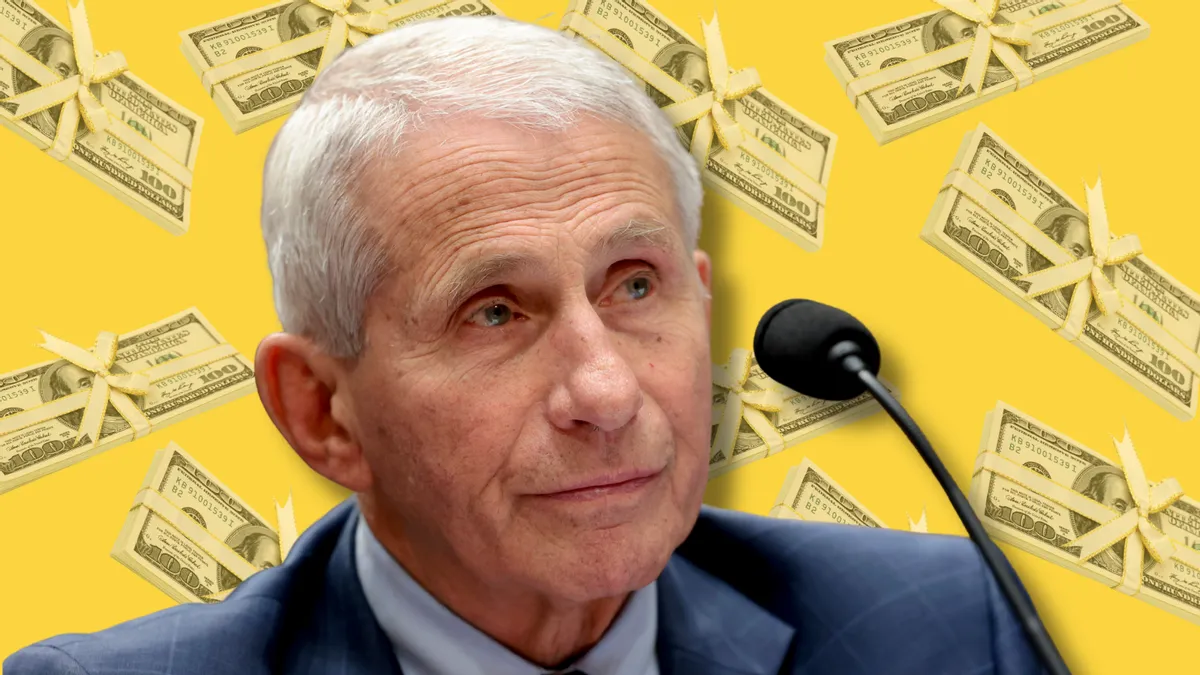
- The claim that Dr. Anthony Fauci used his staff to solicit cash prizes is unproven. Experts say there is no evidence Fauci broke any ethics laws.
- During a July Senate hearing, Sen. Josh Hawley, R-Mo., accused Fauci of using his staff at the National Institutes of Health to solicit cash prizes. Hawley appeared to rely on information shared by Sen. Rand Paul, R-Ky., who released hundreds of internal NIH emails that, if legitimate, show Fauci’s staff talking about putting together required components for award nomination packages after other scientists had already nominated Fauci for
the award s. Some of those awards came with cash prizes. Some people may interpret this as solicitation, but there is no evidence among the emails that Fauci asked staff to request nominations from other scientists. - The emails Paul released indicate that Fauci worked with the NIH’s ethics office to determine which awards and associated cash prizes he could accept. Unlike other public officials, NIH employees may accept cash prizes, or “gifts,” as long as they “confer an exceptionally high honor in the fields of medicine or scientific research.”
- Snopes has filed a public records request to obtain a full picture of the emails and to independently verify Paul’s documentation. We await a response and cannot rate this claim until we receive it. Fauci did not immediately return a request to respond to Paul’s accusations. Hawley’s team did not return a request for any additional documentation corroborating his claim.
During a July 2026 Senate hearing, U.S. Sen. Josh Hawley, R-Mo., repeatedly accused Dr. Anthony Fauci, who helped lead the United States’ COVID-19 response, of using his staff to solicit cash prizes during the pandemic.
Hawley claimed a trove of Fauci’s emails indicated that he broke the law. His accusations circulated on social media platforms such as X and Instagram (screenshot).
Here’s an excerpt from the hearing (at 1:29):
HAWLEY: You were using federal employees, with taxpayer money, to apply for and solicit cash prizes for you personally, cash prizes totaling over a million dollars. You did all of that during the pandemic, didn’t you? That’s a question.
FAUCI: On the advice of counsel, I respectfully decline to answer based upon my rights under the Fifth Amendment to the Constitution.
[…]
HAWLEY: We’ve got it in your emails. Your staff and employees, on federal time, using federal resources, being paid with federal dollars, are soliciting cash for you, and then they’re turning around and saying to the agency, “We don’t want just an answer. We want to get to yes because Fauci wants the money. He wants it. We want to get to yes, and yes takes time.” This is your chief of staff again using federal email to pressure the agency’s own ethics people so that you could get money, so that you could get rich, and it violated the law, didn’t it, Dr. Fauci?
[…]
Federal law, as you very well know, prohibits the solicitation of cash awards or other personal benefits for federal employees, and it certainly prohibits using your own employees to do this. … It says it right there in black and white. You cannot use federal resources, federal dollars, federal employees, federal offices, federal email, federal time to solicit cash awards.
During the hearing, Hawley cited internal National Institutes of Health emails released by Sen. Rand Paul, R-Ky., one of Fauci’s most dedicated critics. It is true that the emails show Fauci actively pursuing awards that carried cash prizes. However, the emails do not contain evidence that Fauci directed his staff to campaign or lobby other scientists to nominate him for awards. The emails show that Fauci’s staff helped him put together information for awards that other scientists had already nominated Fauci for. While some critics may still consider these actions to fall under “solicitation,” three experts told Snopes the emails do not indicate that Fauci broke any federal ethics laws.
The emails actually show the former chief medical adviser discussing the awards with the ethics office. Unlike other public officials, NIH employees may accept cash prizes, or “gifts,” as long as they “confer an exceptionally high honor in the fields of medicine or scientific research.”
Josh Fessel, a former chief medical officer at an NIH center, said via phone: “You don’t want a situation where the people who are supposed to be the leaders in federal scientific service cannot be recognized as global leaders in scientific service. That would be weird.”
The New York Times reported on July 30 that people who worked with Fauci said he was “scrupulous” in following federal ethics rules.
Snopes has filed a public records request to obtain a full picture of the emails and to independently verify Paul’s documentation. We await a response and cannot rate this claim until we receive it. Fauci did not immediately return a request to respond to Paul’s accusations. Hawley’s team did not return a request for any additional documentation corroborating his claim.
Some of the emails appear to suggest that Fauci may have personally asked other scientists to nominate him for awards. Without additional context, it is unclear whether Fauci was merely responding to colleagues who offered to nominate him for various awards — which actually happened in several of the emails Paul released. (It is common for scientists to nominate one another for awards, and credible nominators would likely know one another in niche scientific fields such as Fauci’s.)
During the physician’s opening statement at the Senate hearing, Fauci said he would invoke his Fifth Amendment right to remain silent given Paul’s “obvious obsession with calling for my prosecution.” The former chief medical officer was there because Paul subpoenaed him to appear before the Committee on Homeland Security and Governmental Affairs, which Paul chairs.
For context, the Cambridge Dictionary defines “solicitation” as “a request for money, information, or help;” Merriam-Webster defines “to solicit” as “to approach (someone) with a request or plea.” Assuming the emails are legitimate, whether they show that Fauci used staff to solicit cash prizes depends on how a reader might interpret the word “solicit.”
Inside Fauci’s emails
On July 24, 2026, Paul released more than 130 pages of internal NIH emails from 2018 to 2022 that discuss award nominations for Fauci. Paul’s office claimed (Page 1) the emails show Fauci’s “taxpayer-funded staff writing the nominations for him.” Paul and Hawley both pointed to Fauci’s acceptance of the Dan David Prize in 2021, in particular — a prestigious $1 million award from an Israeli foundation that Fauci won for “defending science.” (Fauci received about $900,000; the other 10% goes to scholarships.)
However, Fauci’s staff did not nominate him for that award — instead, Dr. Charles Dinarello, a professor of medicine and immunology at the University of Colorado, did, according to a November 2020 email from Dinarello (Page 10). After Dinarello nominated him, Fauci’s staff then began working on the nomination process (Page 9). Dinarello told Fauci’s team that he should emphasize his work on the mRNA vaccines, which his staff appeared to listen to (Page 8).
“I am working on thus nomination for the dan david award,” said Greg Folkers (Page 9), Fauci’s chief of staff. “Need to beef up the covid part.”
Thus, the emails do not show Fauci directing staff to get people to nominate Fauci for the Dan David Award, nor do the emails show Fauci asking staff to nominate him. Instead, his staff began working on the nomination process after someone else nominated him for the award. Again, readers may differ in opinion over whether this meets the definition of “solicitation.”
Fessel said asking staff to help write biographies or other components required for an award nomination package “doesn’t seem particularly unusual,” as long as staff are not actively lobbying outside scientists to nominate their boss for an award.
Fauci was also nominated for several other awards that his staff helped him work on. Snopes’ review of the emails Paul released uncovered no evidence that Fauci asked his staff to obtain any other award nominations from other scientists or that his staff reached out to other scientists and asked them to nominate Fauci.
In an email chain that commenced on Jan. 30, 2021, Dr. Lawrence Tabak — then deputy director and deputy ethics counselor at NIH — said the NIH reviewed the Dan David Prize in 2011 and it “was determined to meet the regulatory requirements.” Tabak told Fauci that if certain aspects of the award had not changed since 2011, “then most likely, you will be able to receive the cash prize.” That same day, Fauci responded that he was “very pleased” to hear the “‘good’ news” about the Dan David Prize and told the award organizers that he would accept the award (pages 18-22).
Paul’s office claimed Fauci “[asked] for forgiveness rather than permission” because he did not wait for the official green light from the ethics office (Page 1). However, Fauci said he would accept the award, but did not specifically say whether he would accept the cash associated with the award. Fauci also did not accept the money until he received approval from the ethics office about the payment (Page 77). Furthermore, the emails appear to suggest Fauci was following Tabak’s directions.
“I just received the official notification of my winning the Dan David Prize (see attached). As you can see, they will be announcing it on February 15. Larry asked me to forward this to you as soon as I received it so that you can proceed with the official clearance,” Fauci wrote on Jan. 31, 2021, to Holli Beckerman Jaffe, then-director of the NIH ethics office. Beckerman Jaffe replied that she would “proceed to process the award” and that she did not expect any difficulties with approving his award package (Page 24).
Several of the emails also indicate that the ethics office prevented Fauci from accepting cash prizes attached to two of the awards due to a conflict of interest (Page 19).
“I understand completely,” Fauci wrote in a January 2021 response (Page 18). “I was not expecting to be able to accept the cash on these. I will accept the honor and they can give the cash to charities of their choosing.”
Did Fauci ‘lobby’ for awards, violate ethics rules?
Meredith McGehee, an independent government ethics expert, said that if Hawley and Paul have an issue with Fauci’s actions, it’s a disagreement on policy, not on existing ethical obligations. (To that point, after the Fauci hearing, Hawley introduced legislation to ban cash prizes for federal employees.)
“If Fauci did indeed consult with the ethics office and followed their advice and counsel, he then did what he was supposed to do. Hawley and Paul don’t have a leg to stand on,” McGehee said via text message. “The system worked the way it is supposed to, even if they don’t like the outcome.”
Separately, some of the emails indicate that Fauci may have encouraged or requested that other academics nominate him for awards, including the Dan David Prize.
“There is another one that looks possible for me if you are willing to do it,” Fauci wrote to Dr. Barton Haynes, a vaccine expert at Duke University, in 2018 (Page 2). “As usual, I will supply all of the material. It is the Dan David Prize. I will send you their email separately in a minute.”
Haynes and Dinarello — Fauci’s eventual Dan David Prize nominator — have both been funded by the National Institute of Allergy and Infectious Diseases, which Fauci led from 1984 to 2022. Still, that’s not necessarily a federally regulated conflict of interest, as long as accepting the award did not influence Fauci in the course of his duties.
Fessel said that, in his opinion, it could be a conflict of interest for a public servant to reach out to seek a nomination from somebody else — but he could not tell if that is what happened, based on a review of the emails Paul released. While Fauci did suggest that people could nominate him for various awards, it is unclear if those people reached out and asked Fauci if there were any awards he wished to be nominated for before Fauci made any suggestions.
Lastly, Craig Holman, a government affairs lobbyist for Public Citizen, a consumer advocacy nonprofit organization, said via email that Fauci “broke no ethics laws.”
The bottom line
Fauci’s emails, per Paul’s release, do not seem to have a smoking gun indicating that Fauci told his staff to solicit cash awards. The emails, if legitimate, suggest that Fauci consulted with the ethics office while pursuing scientific achievement awards that came with cash prizes during the pandemic.
Some people may feel these actions still fall under “solicitation,” but multiple experts told us the emails do not show that Fauci broke any federal ethics laws. Whether Fauci should have actively pursued awards while leading the country’s COVID-19 response is a matter of opinion — but there’s no evidence he broke any law while doing so.
For more on Fauci, see our collection of claims we’ve examined about him.
