


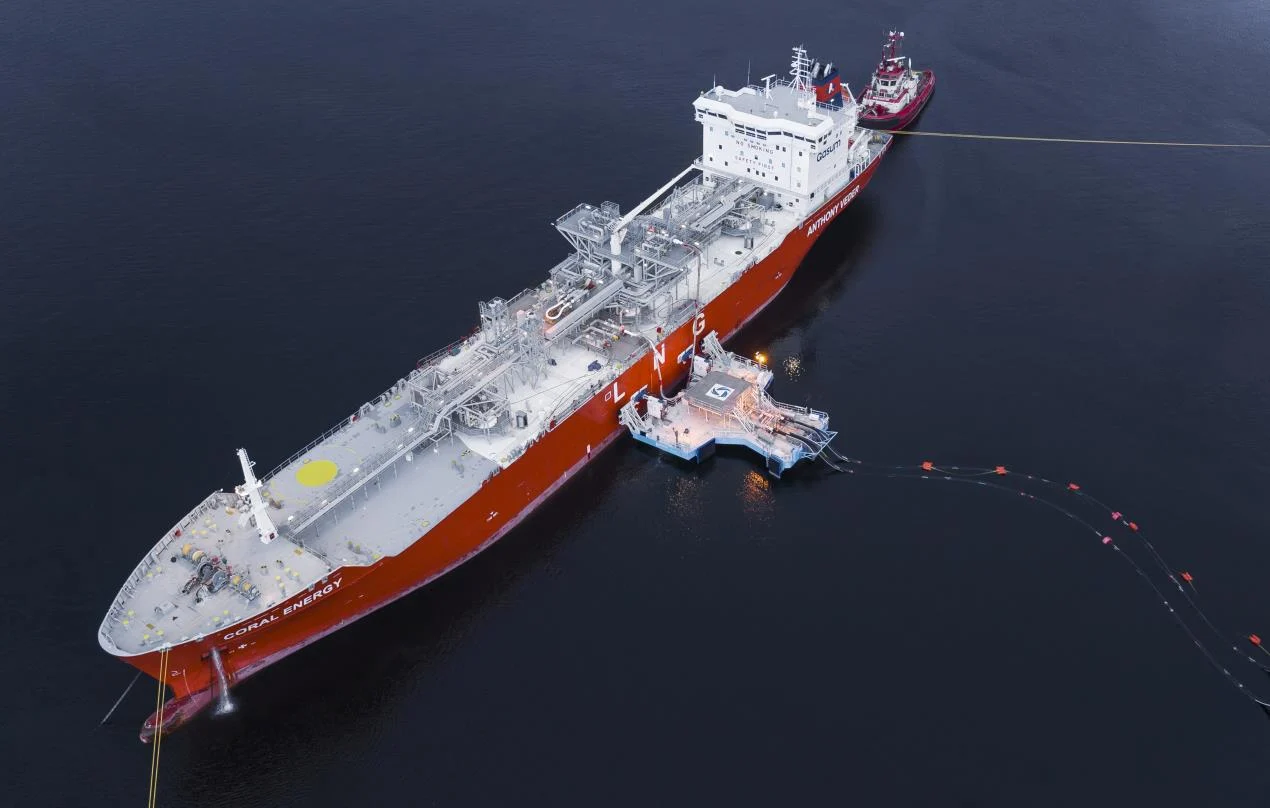
Norway’s technology company ECOnnect Energy has strengthened its position in the Caribbean with a deal for the use of its floating marine liquefied natural gas (LNG) infrastructure at an LNG terminal in The Bahamas.
ECOnnect Energy has signed a charter agreement to deploy its IQuay C-Class floating LNG infrastructure to The Bahamas with New Providence Gas (NPG), a joint venture between Shell Bahamas Power Company (Shell) and Sun Oil, a subsidiary of FOCOL Holdings.
This solution will enable LNG imports from an LNG carrier to the onshore terminal without the coastal construction associated with a conventional fixed jetty, supporting the island’s transition from fuel oil and diesel to a lower-emission fuel source. As a result, the marine terminal is expected to reduce environmental impact and accelerate LNG-to-power deployment on New Providence.
While a traditional terminal requires a fixed jetty, including marine piling work, seabed disturbance, extended construction windows, and significant permitting work, the IQuay C-Class solution simplifies this, as the floating platform connects to an LNG carrier and transfers LNG directly to onshore storage via flexible, floating insulated pipelines, causing minimal disturbance to the seabed and surrounding coastal environment.
Named “La Santa Maria”, the IQuay C-Class system is a floating offshore marine solution that connects LNG carriers or floating storage units (FSUs) directly to the onshore pipeline, eliminating the need for a fixed jetty. This system, which can be integrated with onshore storage tanks, is designed for rapid deployment compared to conventional infrastructure, as it ships as a complete unit and can be commissioned without extensive on-site construction.
Morten Christophersen, CEO of ECOnnect Energy, commented: “This is about enabling access to better energy solutions where they are needed most. With this project, we are providing the marine infrastructure to enable delivery of lower-carbon fuel. For island nations like The Bahamas, flexibility and reliability are critical. We are proud to be working alongside NPG on this fast-track energy project.”
The Norwegian firm explains that the country currently relies on imported fuel oil and diesel for the majority of its electricity generation, while energy costs have remained elevated for years, closely tied to global oil price movements.
This project is said to be aligned with The Bahamas government’s ambition to modernize the power sector, cut emissions, enhance affordability, strengthen reliability, and support a more competitive energy future for consumers and businesses.
Recently, Shell made an investment decision that entails the acquisition of a 40% interest in New Providence Gas, which will construct, own, and operate a new small-scale LNG regasification terminal at Clifton Pier, enabling the supply of natural gas for power generation on New Providence, the most populous island in The Bahamas.
According to ECOnnect, replacing heavy fuel oil with LNG will curb CO2 emissions and local air pollutants, while providing a more stable input cost and higher efficiency for power generation. The government chose to partner with NPG to develop the terminal, securing LNG supply and critical LNG infrastructure.
Dexter Adderley, President and CEO of FOCOL Holdings, underlined: “The project is intended to deliver a more reliable and efficient fuel supply for power generation in The Bahamas, while also helping to enhance the long-term competitiveness and resilience of the country’s energy system.”
While emphasizing that operational manning requirements are low and the modular design allows the solution to be relocated or reconfigured if operational needs change over time, ECOnnect highlights that the agreement with NPG marks its second project in the Caribbean and reinforces strong collaboration with leading regional energy partners.
“This agreement adds to a growing track record of delivering a new generation of marine energy infrastructure. By challenging conventional approaches, we enable terminals to be built faster, safer, and at lower cost, removing key barriers to scaling energy infrastructure and accelerating the global energy transition,” added Christophersen.
While the immediate application is LNG, the company’s C-Class technology is engineered to handle a range of energy carriers and the modular architecture can be adapted to transfer ammonia or CO2 as those supply chains mature, giving operators flexibility to repurpose infrastructure rather than replace it.
The firm outlined: “That adaptability is relevant for island markets in particular where the cost and complexity of building new infrastructure for each successive fuel transition is a constraint. A floating platform that can evolve with the energy mix represents a new, adaptable approach amid an evolving energy landscape.”

Power Your Brand With Offshore Energy ⤵️
Take the spotlight and anchor your brand in the heart of the offshore world!
Join us for a bigger impact and amplify your presence at the core hub of the offshore energy community!
