


- Vietnam’s coffee industry has a problem it can no longer sweep under the rug: its global success is built on a foundation of deforestation, biodiversity collapse, and human suffering, a new op-ed argues.
- Robusta coffee used in instant and supermarket blends has replaced an area of Vietnamese forest the size of Luxembourg, a new report finds, and wildlife like tigers, elephants, civets, sun bears, and saola have been squeezed into ever‑smaller fragments of habitat.
- But once consumers know the truth, they can demand better, the author writes: “They can choose brands that commit to traceability, agroforestry, and deforestation‑free supply chains. They can pressure problem companies that abuse people and planet.”
- This article is a commentary. The views expressed are those of the author, not necessarily of Mongabay.
Vietnam is now the world’s largest producer of robusta, the bitter, sturdy bean behind instant coffee, supermarket blends, and the overall global appetite for cheap caffeine. But behind its meteoric rise to No. 2 coffee producer in the world lies a story the industry has tried very hard to hide: forests are disappearing, wildlife is vanishing, and rural communities are being pushed to the brink.
As ecosystems start to collapse, coffee is getting harder and harder to grow, and the brands buying that coffee and filling supermarket shelves from Copenhagen to California are complicit every step of the way. Our new Coffee Watch investigation, “Vietnam: Robusta’s Reckoning,” reveals the scale of the crisis. Forests the size of Luxembourg have been wiped out for coffee.
In biodiversity hotspots like Vietnam’s Central Highlands, wildlife like tigers, elephants, civets, sun bears, adorable flying squirrels, and delicate saola (sometimes referred to as the “Asian unicorn”), have been squeezed into ever‑smaller fragments of habitat, or just plain wiped out. Communities are losing the very ecosystems that sustain them, and this destruction is largely happening so the world can enjoy cheap robusta in instant coffee, capsules, and mass‑market blends.
Vietnam’s rise as a coffee superpower is often framed as a rural development miracle, but the truth is far darker. Smallholder farmers, who grow the vast majority of Vietnam’s coffee, are trapped in a system that rewards expansion into forested land and punishes sustainable farming. They face volatile prices, limited agronomic support, deep poverty, and widespread child labor.
Let’s be clear: this is not a development story. It’s an extraction story about global supply chain built on local sacrifice.
Our investigation found that 207,428 hectares (512,566 acres) of tropical forest were cleared between 1990 and 2024 in areas now used for coffee production. In just one generation, coffee has driven the loss of one‑third of the forests in the Central Highlands, where 95% of Vietnam’s coffee grows. Undisturbed forest there fell from 2.49 million hectares (6.15 million acres) in 1990 to 1.61 million hectares (3.99 million acres) in 2024. Forest cover dropped from 42.8% of the region in 1990 to 19% by 2020, stabilizing only because, our satellite mapping shows, there is now so little forest left to kill.
Vietnam’s forests have been trashed so that multinational companies could keep prices low and profits high. What’s more, as a Mongabay commentator stated, nearly 70% of tropical forest loss linked to forest‑risk commodities, including in Vietnam between 2013 and 2019, was illegal.
The environmental cost is staggering: Vietnam’s forests aren’t just home to endangered species found nowhere else on Earth, they also regulate water cycles, stabilize soils, and buffer communities against climate shocks. When the forests fall, everything downstream begins to unravel. Rainfall goes haywire. Aquifers dry up. Rivers start to die. And crops, including coffee, start to fail.

Disturbingly, our investigation shows that the consequences of past deforestation linked to coffee are growing, not shrinking. Coffee thrived because of healthy forests, fertile soils, and stable water systems. Yet decades of deforestation and unsustainable farming eroded those natural foundations, putting the future of coffee itself at risk. Basically, by savaging Mother Nature, coffee has bitten the hand that fed it.
Now, climate change is accelerating threats: scientists warn that half of the global area suitable for growing coffee could disappear by 2050 (with similar trends in Vietnam) if its farming does not shift toward climate‑resilient, agroecological methods — pretty much the exact opposite of the current Vietnamese pesticide-soaked monoculture model, which turbocharges vulnerability to climate chaos.
If coffee fails across the Central Highlands, impoverished farmers will likely just move to other forests and clear them, too. But though scientists all agree on the forecasts, and have rung the alarm loud and clear, the industry still seems to think climate change is just a rumor started by people who don’t drink enough espresso.
Global buyers have perfected the art of looking the other way — a skill honed over decades of sustainability commitments that somehow never require them to make any meaningful change. We see biodiversity death-spiraling and forests that regulate water, stabilize soil, and buffer communities against climate shocks being bulldozed for short‑term profit.
Companies would say, “Don’t worry. It’s fine. Who are you going to trust, me or your lying eyes?” The industry assures us everything is OK because they planted a few shade trees somewhere and took a photo for their annual sustainability report. Coffee companies love to talk about sustainability so much they’ve turned it into a performance art of certifications, pilot projects, and glossy brochures.
These are very impressive until you realize the forests are still disappearing. Traceability? Patchy. Agroforestry? Rare. Living‑income prices? Practically mythical. Pesticide reduction? Mostly aspirational. Investment in climate‑resilient farming? Shockingly low.
The industry knows what needs to be done. It simply refuses to do it.
This is not just Vietnam’s problem. It’s the world’s problem, because global demand for coffee created the incentives that drive this destruction.
Consumers deserve honesty. They deserve transparency. And they deserve coffee that doesn’t come with a side of ecological collapse. Most people drinking their morning brew have no idea their daily habit may be contributing to forest loss thousands of miles away. They wouldn’t dream of ordering a latte with a dead tiger or elephant on the side.
But once they know the truth, they can demand better. They can choose brands that commit to traceability, agroforestry, and deforestation‑free supply chains. They can pressure problem companies that abuse people and planet.
Vietnam’s forests are irreplaceable. The world’s coffee industry must stop treating them as expendable.
If companies won’t act voluntarily, regulators must force them. And if regulators fail, consumers must hold them accountable.
Cheap coffee is never cheap: someone or something always pays the price. In Vietnam, that price is forests, wildlife, farmers, and the future of farming itself. The era of cheap coffee built on forest destruction must end. Now.
Etelle Higonnet is the founder of Coffee Watch and a member of VOCAL, a new coalition for sustainable coffee.
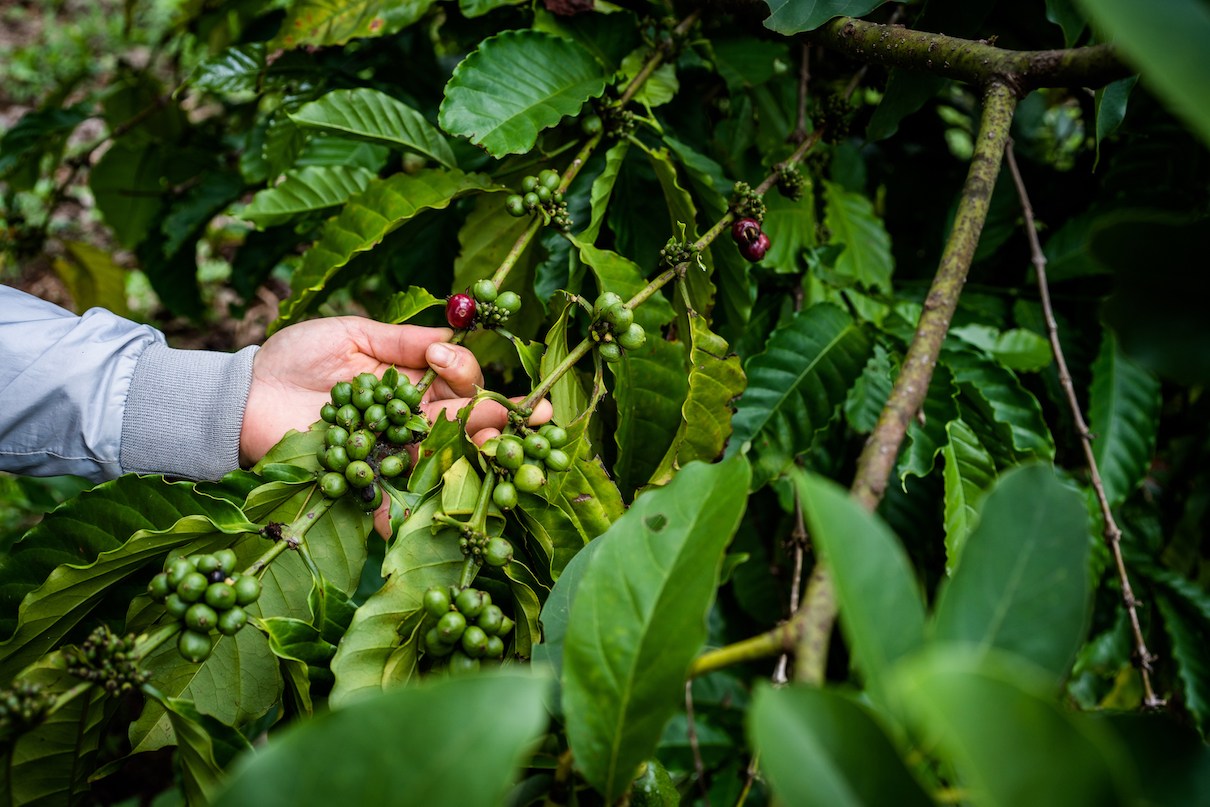
Banner image: Vietnam’s coffee market provides a livelihood for over 600,000 smallholder farmers. Image courtesy of Quinn Mattingly/Panos Pictures/Unfold Stories.
See related coverage:
Deforestation-free supply chains in Vietnam rely on working with small scale farmers (commentary)
Agroforestry grows in popularity among central Colombia’s coffee farmers (analysis)
Vietnam faces dilemma on forests as climate change threatens coffee crops
Citations:
Byrareddy, V., Kouadio, L., Mushtaq, S., Kath, J., & Stone, R. (2021). Coping with drought: Lessons learned from robusta coffee growers in Vietnam. Climate Services, 22, 100229. doi:10.1016/j.cliser.2021.100229
Hai, P. S., Hien, P. D., Nghia, N. H., Dao, N. M., Trung, P. Q., Lan, N. T., & Thang, L. X. (2025). Deforestation and land use changes impact soil organic carbon stocks in the central highlands of Vietnam. Journal of Soils and Sediments, 25(10), 2887-2895. doi:10.1007/s11368-025-04131-6
Bunn, C., Läderach, P., Ovalle Rivera, O., & Kirschke, D. (2014). A bitter cup: Climate change profile of global production of arabica and robusta coffee. Climatic Change, 129(1-2), 89-101. doi:10.1007/s10584-014-1306-x
Bhattacharya, S., & Nair, R. (2024). Adverse impact of climate change on coffee business in Vietnam. International Journal of Research in Engineering, Science and Management, 7(7), 164-167. Retrieved from https://journal.ijresm.com/index.php/ijresm/article/view/3140
Cite this article
Etelle Higonnet (2026). Cheap coffee is killing Vietnam’s priceless tropical forests (commentary). Mongabay Conservation news. DOI: https://doi.org/10.66709/news-325233

