


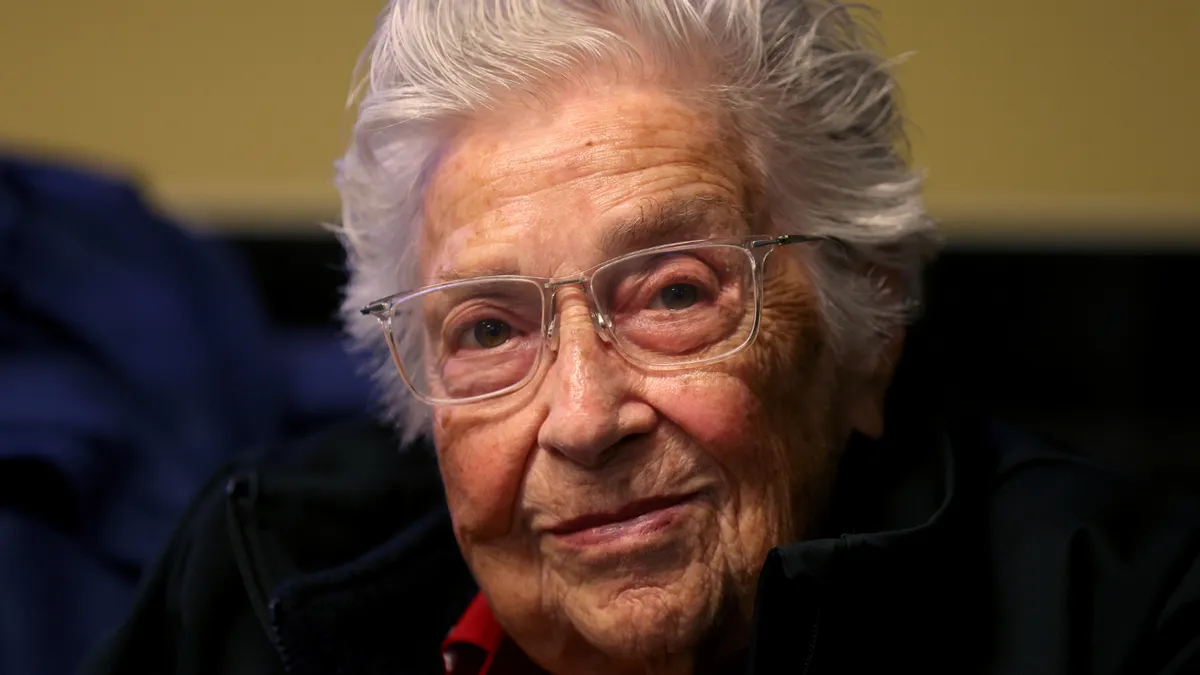
In July 2026, Jeanne Gibson, the inspiration for Rosie the Riveter, died at 100.
Gibson was a “Rosie” in the sense that she was one of millions of women who went to work during World War II to support the war effort. She was a passionate advocate for the so-called “Rosies” until her July 2026 death.
Gibson wasn’t the inspiration behind either Norman Rockwell’s 1943 painting “Rosie the Riveter” or a WWII-era motivational poster popularly associated with the character.
In July 2026, some social media
Other social media posts (archived) also referred to Gibson as the inspiration behind Rosie the Riveter. Some social (archived) media (archived) posts (archived) about Gibson’s passing referred to her as “a Rosie the Riveter” instead of the sole inspiration for the character. Snopes readers searched the site for “Rosie the Riveter,” wondering if the rumor was true.
While it is true that Jeanne Gibson, one so-called “Rosie” in a community of women the character Rosie the Riveter represented as an emblem, died at 100 in July 2026, Gibson wasn’t “the” Rosie the Riveter, and famous depictions of the character were not directly based on her appearance. Therefore, we’ve rated this claim as a mixture of true and false elements.
On July 29, 2026, Pacific Historic Parks – USS Arizona Memorial posted to Facebook (archived) to say that “‘Rosie the Riveter’ Jeanne Gibson, 100, passed away today.” It recognized her as one of more than 6 million women who served as “Rosies” during WWII by taking jobs supporting the war effort and that later on in life she regularly participated in events at Pacific Historic Parks commemorating the Rosies.
A day later, Rosie the Riveter WWII Home Front National Historical Park also announced Gibson’s death on Facebook (archived). It noted that just two weeks earlier, Gibson was honored at the park.
According to the two posts, Gibson left for Seattle at 18 in 1944 to weld destroyers for Todd Pacific Shipyards. Later in the war, she moved to Juneau, Alaska, to support the Army Transportation Corps by preparing documents that helped keep Allied forces equipped across the Pacific.
These organizations also make note of the two best-known pieces of art popularly linked to Rosie the Riveter and their inspirations, neither of which was Gibson.
The Rosie the Riveter Trust says that historians don’t know the original inspiration for a WWII-era poster of a woman flexing her arm below the slogan “We can do it!” that has become famously associated with the name in pop culture.
The American Rosie the Riveter Association says that Mary Doyle Keefe was the inspiration behind a 1943 Norman Rockwell painting titled “Rosie the Riveter.”
According to the National Park Service, the “We can do it!” poster was originally a motivational poster at a Westinghouse Electric factory that wasn’t popular — or popularly identified as depicting Rosie the Riveter — until the 1980s. The Department of the Interior says that Rockwell’s painting — which featured a muscular woman with overalls and goggles holding a riveting tool in her lap while eating a sandwich and stepping on a copy of Adolf Hitler’s book “Mein Kampf” — was the most famous depiction of the character during WWII.
Some posts about Gibson passing included an image that appears to show Gibson dressed up as and posed like the woman in the Westinghouse Electric poster. That image appeared to be generated using artificial intelligence tools. Some clues the image was not authentic included errors in the U.S. flag behind her, in which some stars are missing and others are awkwardly positioned. The image appeared to have been partially based on an authentic photo of Gibson.
For further reading, we’ve previously researched other claims concerning WWII heroes, including one that asserted the Trump administration was removing panels honoring Black U.S. soldiers who died in the Netherlands.
