


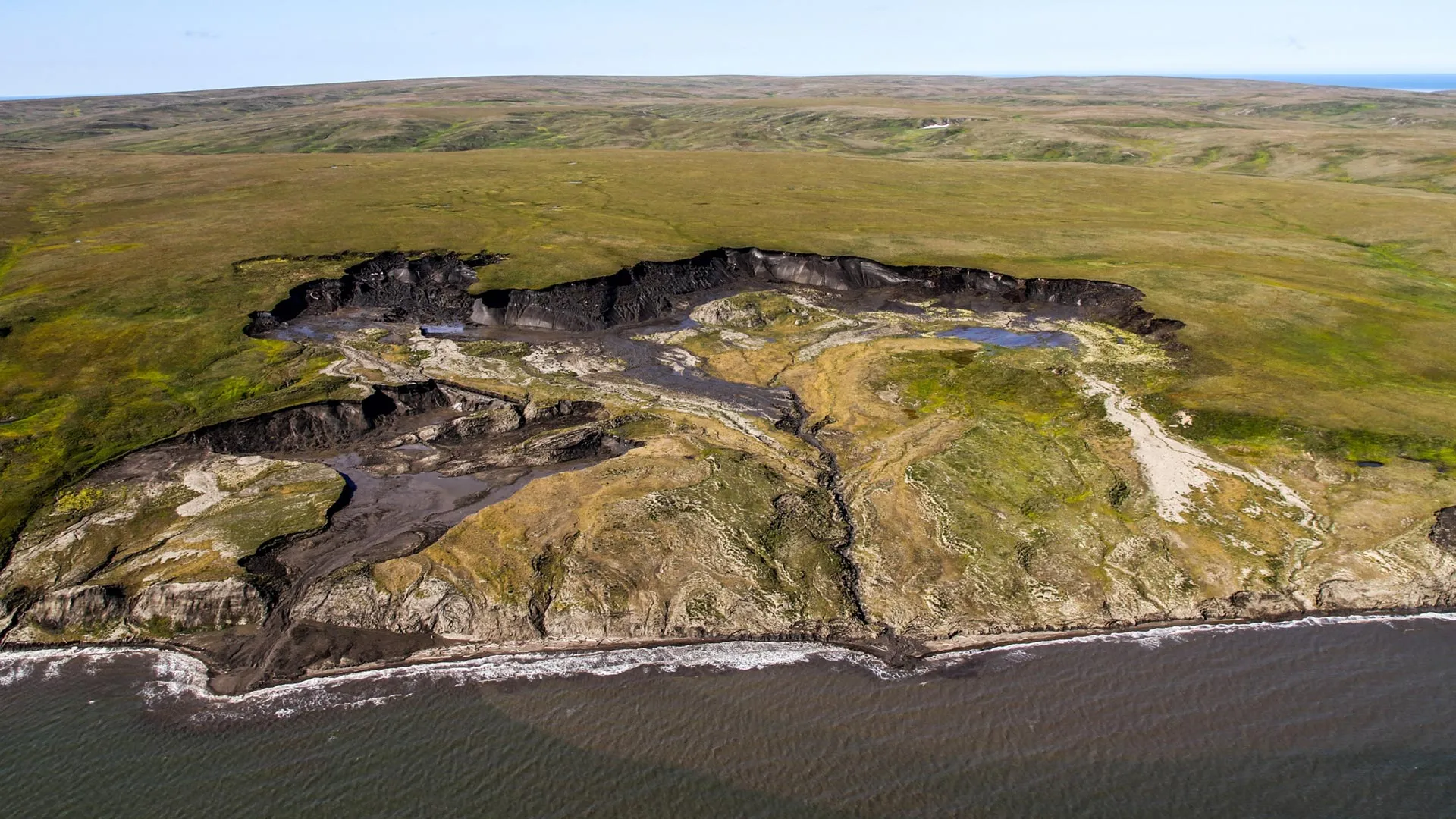
The Arctic’s frozen ground contains enormous stores of organic carbon. As permafrost thaws and coastlines erode, some of that carbon is carried into the ocean. There, microorganisms can break it down and release greenhouse gases that contribute to climate change.
Until now, scientists have had limited information about how much of this carbon returns to the atmosphere and how much remains trapped in the ocean. Researchers from the Alfred Wegener Institute and MARUM – Centre for Marine Environmental Sciences at the University of Bremen have now examined this process along the permafrost coast of Qikiqtaruk (Herschel Island) in Canada.
By studying sediment cores, the team found that large amounts of carbon from land are preserved in the seafloor. They also discovered that marine microorganisms behave like selective eaters, favoring fresh carbon from the ocean over older carbon released from permafrost. The findings were published in Nature Geoscience.
Vast Carbon Stores Are Beginning to Thaw
Permafrost ecosystems on Arctic land contain about 1,300 gigatonnes of organic carbon, much of it from plant remains. Another 400 gigatonnes are stored in ocean sediments and river deltas.
As the planet warms, the Arctic is heating faster than any other region. This rapid temperature rise is causing frozen ground to thaw and coastlines to break apart. Carbon that was previously locked in the soil can then reach the Arctic Ocean through rivers and coastal erosion.
“Consequently, up to 0.02 gigatonnes are entering the sea each year, and according to forecasts, this outflow could rise by 70 to 150 percent by the year 2100,” says Dr. Manuel Ruben, lead author of the study from the Alfred Wegener Institute, Helmholtz Centre for Polar and Marine Research (AWI). “However, how much of this is released back into the atmosphere as a greenhouse gas and how much is stored in the seabed has, until now, been largely unknown.”
Resolving that uncertainty is important because scientists need to know where the carbon ultimately ends up to estimate how thawing permafrost could affect the climate.
Sediment Cores Reveal Where the Carbon Goes
To investigate, the researchers collected sediment cores from several locations off the coast of Herschel Island. These cores contain layers of material deposited over roughly 50 years.
The results showed that only a relatively small share of the carbon swept into the ocean becomes part of the active carbon cycle.
“Although the sea here carries away huge quantities of organic carbon from the coast, surprisingly little of it ends up in the ocean’s active carbon cycle,” says Manuel Ruben. “Microorganisms convert around ten percent of the organic carbon from the sediments into gases, which rise into the water and can then enter our atmosphere.”
Most of the remaining carbon stays buried in the seabed.
Chemical Clues Track Microbial Activity
The scientists analyzed the composition of the sediment cores and measured how quickly material from the permafrost accumulated on the ocean floor.
They also studied dissolved inorganic carbon found in tiny spaces between sediment particles, known as pore water. These measurements reveal how much CO2 microorganisms have released after consuming organic material.
The isotopic makeup of the pore water helped the team determine where that material came from.
“Carbon isotopes represent our atomic indicators that can identify the food source of the microorganisms,” says Prof. Gesine Mollenhauer, a geochemist at the AWI and co-spokesperson for the ‘The Ocean Floor – Earth’s Unexplored Interface’ cluster of Excellence. “The 13C isotope, for example, tells us whether they have consumed carbon from land or from the sea. By way of the 14C isotope, we were able to determine whether the single-celled organisms preferred old organic carbon from permafrost or fresh organic carbon from algae remains.”
“Gourmet” Bacteria Prefer Fresh Carbon
The results suggest that the organisms living in the sediment are not equally interested in every type of carbon.
“The sediment is home to ‘gourmet’ bacteria that apparently prefer fresh carbon stemming from, for example, more recent algal remains over the ‘old’ carbon from permafrost deposits,” explains Gesine Mollenhauer.
Because the microbes favor fresh marine material, older carbon from thawing permafrost may contribute less to atmospheric greenhouse gas levels than scientists once feared.
However, the researchers caution that the full picture is not yet clear.
“However, we do need further research here. This is because some of the organic carbon from the permafrost may already have been broken down before it reaches the seabed.”
Coastal Carbon Could Reshape Arctic Ecosystems
The movement of carbon from land into the ocean may affect more than greenhouse gas emissions. It can also change the chemistry and biology of coastal waters that support food resources for local communities.
Sediment released by coastal erosion can reduce the amount of sunlight entering the water. Freshly eroded fragments make the coastal ocean cloudy, while dissolved organic carbon can darken the water.
That loss of light can affect single-celled organisms such as algae, which need sunlight to produce biomass and oxygen. This primary production supports a wider food web that includes fish, crustaceans and seals.
The researchers plan to explore these connections further during the international ‘Arctic Pulse’ campaign scheduled for 2027. Scientists will carry out coordinated observations from the Polarstern research icebreaker, aboard AWI research aircraft and at sites on land. Their goal is to understand how rapid environmental change is transforming Arctic ecosystems.
Improving Arctic Climate Models
“Our study shows, more precisely than ever before, how much carbon is safely stored in the seabed – and just how much of the decomposed material actually originates from the old permafrost,” says Manuel Ruben. “This provides an important foundation for climate models that can predict the consequences of permafrost thawing for the global climate.”
