


Why this matters:
The number of San Diego County residents using food stamps has plummeted. Experts say new rules and longstanding fears are behind the decline.
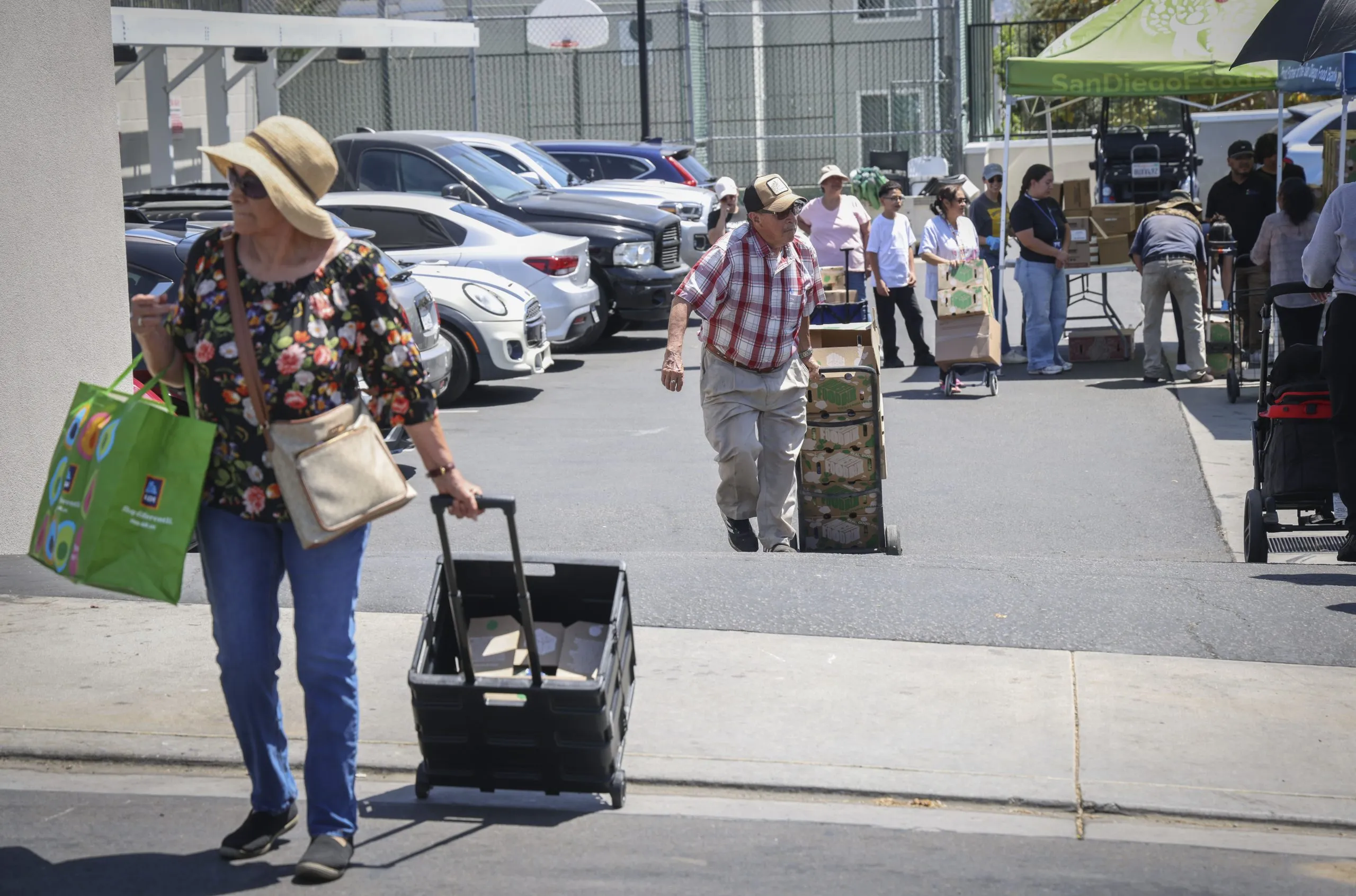
A line of umbrellas stretched around the corner and down the street as dozens of people sheltered themselves from the baking sun while they waited for cardboard boxes full of fresh produce and protein at a San Diego Food Bank distribution in San Ysidro Tuesday.
“The lines are getting longer,” Maria Lewis said. “People are worried now.”
Lewis, an outreach coordinator, walked up and down the line, trying to sign people up for the federal aid program known as food stamps, called CalFresh in California. Some were reluctant.
People in need have been pushed increasingly into food lines and away from federal aid by a combination of new policies limiting program eligibility, increasingly difficult and frequent applications to receive benefits and rising fears that the government will use identifying data to deport people getting food stamps or to take away their permanent resident status.
The changes to the program are part of President Donald Trump’s signature spending bill, which he signed into law a year ago, to help eliminate fraud, abuse and waste in the program.
The bill also cut off benefits to some immigrants such as asylum seekers, human trafficking victims and refugees starting in April in California. In June, people were given three months to meet new work requirements.
Before the new legislation, adults between the ages of 18 and 54 without dependents could receive SNAP benefits for three months in a three-year period without showing they are gainfully employed for at least 20 hours per week.
The new exemption for adults starts at age 65 and for parents with children younger than 14. It also removes exemptions put in place during the Biden administration for veterans, people experiencing homelessness and former foster youth under age 24.
The new eligibility requirements have been hitting states at different times. They took effect in California in April and June, but there has seen a steady drop in participation for the past year.
Amid that drop, Arika Daniels, director of communications for the San Diego Food Bank, said a recent survey of its 450 nonprofit organizations involved in regional hunger relief found a 20% increase in demand compared to this time a year ago.
She called it “a major jump in a very short period.”
“The biggest asks we’re hearing right now are basic staples — milk, eggs, produce — and even gas cards,” she said. “Families are trying to stretch every dollar.”
As a result of Trump’s massive tax and spending bill last year, San Diego County officials estimated that 93,500 in San Diego would be subject to food stamp eligibility changes and 13,000 people would lose benefits because of their immigration status.
Nearly 30,000 San Diego County residents have already dropped off CalFresh in the 10 months since Trump signed the bill — and a data analysis shows most of them — over 25,000 — left before the law’s changes to eligibility for noncitizens in April and before new work requirements took effect June 1.
The number of food stamp recipients in San Diego County fell every month from July 2025 through May 2026, the most recent month with complete data.
It fell from about 396,000 recipients to 367,000, an 8% decline, according to an inewsource analysis of California Department of Social Services caseload data.
The number of local food stamp recipients had grown through 2024 and dipped only slightly in early 2025. But when President Trump signed the spending package known as H.R. 1 into law in July, the number began a slide that has not stopped and shows no sign of slowing.
Experts say there isn’t data to explain specific reasons for the early drop, but local service providers told inewsource the decline is due in part to fears that receiving food stamps will jeopardize their immigration status.
Alondra Alvarado, president and CEO of the San Diego Hunger Coalition, a regional network that works to improve food access, said mixed-status families are dropping their U.S.-citizen children’s benefits and legal permanent residents are afraid their status will be jeopardized for receiving federal benefits.
“What we are hearing from around 500 partners that we work with in San Diego County is that people are scared of their immigration status,” she said.
Alvarado called it “a multilayer problem” made worse by persistent inflation.
“A lot of people are gonna lose their benefits,” she said. “They’re already losing their benefits.”
The Trump administration has said that starting in September immigration officers can weigh the use of food stamps against applicants when deciding if they qualify for permanent resident status. The first Trump administration had a similar policy, but it was rescinded during the Biden administration.
Heightened fears were evident as Lewis approached people waiting for food in San Ysidro.
One 58-year-old woman chose not to enroll in benefits after hearing the news that receiving food aid could jeopardize her permanent resident status.
“I’m scared that they will come and throw me out,” she said in Spanish.
Lewis said she’d heard the concern from others Thursday and moved on without enrolling them.
“Before this I would have had them,” she said. “But I prefer them not to be at risk.”
The drop in participation in San Diego is part of a national trend.
A year after the passage of HR.1, national enrollment declines in the food-stamp program, formally known as the Supplemental Nutrition Assistance Program or SNAP, are outpacing what the Congressional Budget Office estimated when the bill passed.
That’s according to an analysis by the Center on Budget and Policy Priorities.
“We haven’t seen anything like this since the last time the program was cut about three decades ago,” said Joseph Llobrera, the center’s research director and a co-author of the analysis.
SNAP enrollment normally rises and falls with the economy, he said, but “there hasn’t been significant improvement in overall economic conditions that would explain this drop.”
The Center on Budget and Policy Priorities said the biggest reason for the decline in SNAP enrollment is a provision that will make states pay part of the cost of benefits starting in 2028, with each state’s share set by how often it miscalculates payments.
States are racing to drive those error rates down.
Some states, like Arizona, which has had the nation’s highest drop in participation at more than 50%, made policy changes that make it harder to participate.
Gina Plata-Nino, the SNAP director at the Food Research and Action Center, said programmatic changes are leaving less income for grocers while making recipients’ lives harder.
“It really has come at the worst possible time for American families,” she said.
“This is putting states in a very difficult position. It’s not solving hunger. It’s actually increasing it.”
Type of Content
News: Based on facts, either observed and verified directly by the reporter, or reported and verified from knowledgeable sources.
